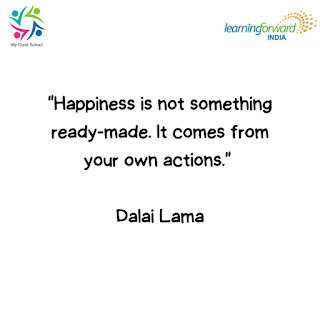
This quote highlights how happiness comes from within and is not dependent on external factors. It also emphasizes how unhappiness can make life difficult by causing us to focus on what we lack rather than what we have, and how it can lead to a negative self-image and an obsession with others' opinions. Ultimately, the key to happiness is finding contentment and fulfilment in oneself and one's life.
As an educator, I love doing my job with complete sincerity and commitment. I try my best to understand the needs of the students and deal with them most appropriately so that they succeed in their paths. Overall, being an educator can be a challenging yet rewarding experience, as it allows us to make a positive impact on the lives of the students and communities.
There are a lot of challenges while upgrading ourselves and working day and night for our students. One of the biggest challenges is failing to understand the needs of a student. I generally overcome every challenge efficiently because of my compassionate attitude.
In my teaching career, I came across a student who literally gave me a different outlook to understand problems. I would like to share that experience.
I met a three-year-old student who just started his first year in primary school. He had always been a shy and introverted child who struggled to make friends. He found it challenging to speak up in class, and as a result, he needed to catch up on his studies.
As the school year progressed, He began feeling increasingly unhappy. He felt isolated and excluded from class, so he dreaded going to school. He felt embarrassed and ashamed about his struggles and was afraid to ask for help.
Despite my efforts to engage him in class and provide extra support, his grades continued to suffer. He started to act out in classes and became disruptive, which only made him feel worse. I noticed that he seemed unhappy. I tried speaking to him to find out what was going on, but he didn't want to talk about it.
Eventually, I reached out to his parents to discuss his behaviour and academic performance. Together, we tried to develop a plan to support and address his needs. I gradually developed an understanding and convinced his parents to cope and start engaging him in activities that he liked. With the help of his parents and a counsellor, he began making progress. He learnt new coping strategies and social skills, and he started feeling more confident and happy in school.
In this scenario, his unhappiness is related to his struggles with socializing and academics. By working together, I, his parents, and a counsellor were able to provide the support he needed to overcome his challenges and thrive in school. He made me understand how important it is to understand the needs of a student and engage him in his interests throughout his educational journey to make him feel better and smarter.
There could be different meanings when describing an intolerable student. To be honest, I have never come across an intolerable student. Though if I have to describe an intolerable student, I would say, an intolerable student is a student whose behaviour is not acceptable and creates a negative impact on the learning environment.
This behaviour can range from disruptive, disrespectful, or aggressive behaviour towards peers, teachers, or school staff. Intolerable behaviour can cause harm to students, themselves, and the learning environment as a whole.
It's important to address intolerable behaviour early on to prevent it from escalating and to ensure a safe and positive learning environment for all students. Hypothetically, if I had to deal with an intolerable student, I would do the following:
1. Identify the root cause: Understanding the root cause of the student's behaviour is essential. It's important to talk to the student, listen to their concerns, and try to understand what's causing their behaviour.
2. Set clear expectations: Set clear expectations for behaviour and consequences for breaking the rules. Make sure that the student understands what is expected of them and the consequences of their actions.
3. Use positive reinforcement: Positive reinforcement is an effective strategy for encouraging positive behaviour. Praising the students when they display positive behaviour can help reinforce that behaviour.
4. Use consequences: Teachers can use consequences when the student exhibits intolerable behaviour. Consequences should be clear, consistent, and fair.
5. Provide support: Provide support to the student by offering resources and counselling. Working with the student to identify their strengths and areas of improvement can help them develop a positive attitude towards school and learning.
6. Involve parents: Involving parents in the process can be helpful. Parents can provide insight into the student's behaviour at home and be a valuable ally in developing a plan to address the behaviour.
7. Be consistent: Consistency is key when dealing with intolerable behaviour. Students need to know what to expect and what will happen if they continue to exhibit such behaviour.
My suggestion to all my fellow educators:
Building relationships with students is crucial for effective teaching and learning. Take the time to know your students, their interests, strengths and weaknesses and create a positive learning environment for their success.
Encourage positivity, respect, and inclusivity in the classroom. With gradual efforts and a "never give up" attitude, every educator can achieve their goals and the students can achieve success in their educational journey.
Vandana Sharma @KNPS Phagwara, India