Showing posts with label unhappy. Show all posts

Friday, October 27, 2023

Happiness & Tolerance - Sharda Pullabhatla


An Unhappy Student:

I am also one of the admission team members at our school. Every day I meet students from various schools of different classes with different mindsets, skills and hobbies. Last week I met a girl child who hadn’t cleared her grade IX final exams in her previous school.

She wanted to be admitted to grade IX in our school. Her parents were very tense and worried about her being very quiet and shy. They said that until grade 7 she was an active and enthusiastic girl. However, after the lockdown, she has changed a lot and does not want to talk to anyone. 

Gradually, she became lonely and this resulted in her inattentiveness to her studies. As a result, she could not score well in grade IX exams. While I spoke to her she expressed her sadness about not having friends. She said she was unhappy because she did not have friends to share her feelings and thoughts. 

During her interaction, I motivated her to stay happy and keep smiling. I also told her that we would make new friends for her in this school. Her buddies in class will help her settle down in this new school. She may share moments of joy and happiness with them. 

Even our school Principal motivated her very much and encouraged her to perform well in class. Be happy and do every work with zeal. She told her to forget the past and put her efforts into the present task. 

She was admitted to our school. I met her every day for one week. Gradually, I noticed changes in her. It's almost 15 days since she joined our school. She is paying attention in her class studies, sharing lunch with friends, making new friends and has started smiling as well. 

Educators who wish to inculcate the value of Happiness in their students may refer to these points:

i) We should always support students. 

ii) Lend an ear to their issues and concerns. 

iii) Make them understand the positives and negatives of the situation and then resolve the issues.

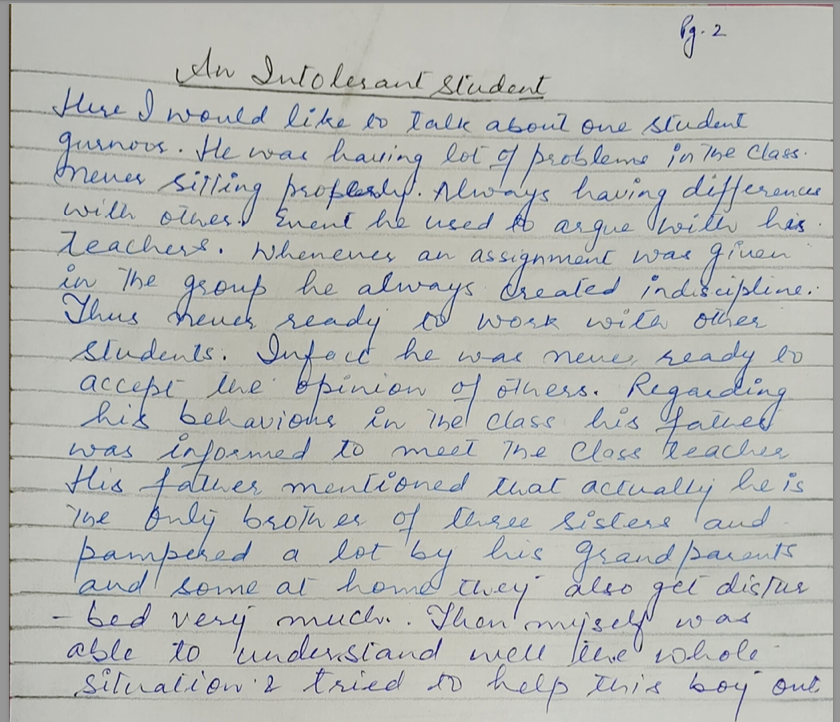
An Intolerant Student -

Early morning after the assembly while students were settling down for their periodic assignment, suddenly we heard a loud noise from a teacher. I ran towards the classroom from where the disturbance was coming. Two teachers were already scolding two students involved in the quarrel.

On investigating the matter, we found out, that one of them had posted some abusive/unwanted comments on the social media account of another classmate. As a result, the first student was irate and held his collar and asked him to apologize. Instead of apologizing he commented by saying - “I have done the correct thing”. 

We made both of them sit in different rooms, gave them a glass of water, heard the complete situation and counselled them about their behaviour and approach. We spoke to them about the method they have used to solve this situation. Also asked the students to write a realisation letter, promising this shall not repeat and they shall be more tolerant in future. I also made them say sorry to each other and shake hands. 

After a week, just went to meet them and gauge the situation. While I observed them, they were not talking to each other, but then the quarrel had come to an end. My advice to teachers who wish to inculcate the value of tolerance in their students shall be –

I) Consider every situation as separate. 

II) Take action based on a case-to-case basis. 

III)Share different stories and situations where people demonstrated 'the value of tolerance to achieve victory and succeeded with students during class.

IV)Be friendly with students.

V) Be tolerant of students.

Sharda Pullabhatla @KNPS Phagwara


Saturday, May 6, 2023

Happiness and Tolerance - Siddhi RPKM

Dealing with Challenging Students
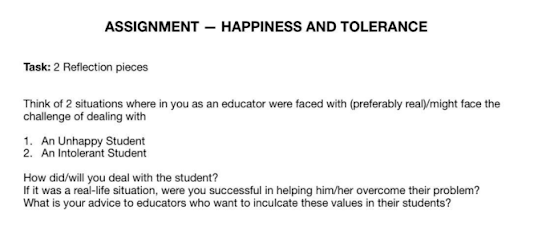
Think of two 2 situations where you as an educator were faced with (preferably natural)/ might face the challenge of dealing with:

How did/will you deal with the student?
A) If it was a real-life situation, were you successful in helping him/her overcome their problem?
B) What is your advice to educators who want to inculcate these values in their students?

Situation 1: Unhappy Student

"Happiness is contagious. Spread this among people surrounding you." -----Invajy

As a teacher, we must always teach students what is right and wrong. But sometimes children feel unhappy if they do not want to do something their teacher has asked them to do. This more prominently applies to little kids pampered mainly by their parents. That's why they need to be taken care of by the teacher according to their moods.

Recently, a similar situation was faced by one of our teachers in her class. One of her students wanted to skip the lunch. So, the child made an excuse that he was having a stomach ache and was missing his mother. Therefore, he insisted on going back to his home. The very first day, when he did that thing, the teacher asked him to finish lunch so that he won't feel the pain, and after that, he would be allowed to go back home. But then, again, on the second day, he did the same thing, and the teacher again asked him to finish his lunch without any excuses. But when on the third day, he did that thing again. The teacher realised that it had become his habitual activity, and he just made excuses not to finish his lunch daily.

On that day, the teacher told him to have some portion of his lunch to be healthy and strong if he wanted to finish only part. For that whole day, he was so happy in class; he talked to everyone nicely and didn't ask to go back home. With time, the child began adjusting to the class by interacting and observing his fellow students.

Advice to educators:

If you have an unhappy student, you must try and understand the situation he/she might be going through instead of imposing your perspective on them. According to an old saying:

"To get a better pickup, we must step back. Sometimes we must also listen to the child's perspective to make an unhappy child happy."

Situation 2: Intolerant Student


An intolerant student, the term itself should never be an impression in any teacher's mind about any student. However, we all face such an adverse issue wherein we may encounter such behaviour in a student. They may be exhibiting very inappropriate behaviour. There may be innumerable complaints against this student from a teacher and their classmates, and no amount of counselling / or any other strict action to rectify the student's behaviour seems to change their behaviour. Any behaviour or issue can never be diagnosed, judged or handled without knowing the reason behind those actions. The reason should be based on something other than any particular act. Different situations and scenarios that might have happened earlier at school and home should be considered. A child who is overpampered at home or has no listener will exhibit behaviour to gain attention. Usually, this kind of behaviour reflects a negative
outcome.

Let's discuss a situation of a student who was never interested in listening to any kind of explanation of the chapter but in spite was always ready to put up the questions whether related to the topic or not, so I, as an educator, was forced to think that if he is too curious to know every detail of every case, or he is just trying to seek the attention of everyone, so I just thought of an idea why not to engage him in something which can use his energy and hire him, so I asked him to maintain a notebook which we will discuss in class and utilise it in class activities or quizzes. So he was happy and felt confident that he got a huge responsibility. Slowly and gradually, he collected a piece of good information about many topics and used to note down the queries aside and discuss them later. This developed his confidence in the teacher; once the bond of trust sets in, rectifying the child's behaviour will be smooth and, most importantly, effective.


Advice to Educators:
My suggestion to all my fellow teachers is never to give up on any child but to give them your time, patiently listen, and understand the reason for their behaviour and not judge them just on their superficial behaviour. We, teachers, have this innate ability to make that impression in the minds and lives of our students, and we surely can be their guides who will help them become better human beings.

Siddhi @ RKP School Moradabad
Sanskriti Tondon, Lovely Singh, Priyanka Ruhela, Soni Bhatnagar, Manjeet Patil, Sadhana Negi and Swati Saluja

Happiness and Tolerance - Saumya RPKM

An Unhappy Student:

As an educator, we had an experience with an unhappy student struggling with personal issues and could not focus on academics. We approached the student with empathy, actively listening to his concerns and providing emotional support. We also referred him to the school's counsellor for professional help. In addition, we worked with the student to develop a plan to address his academic challenges and provided extra resources to help him catch up on missed work.

My advice to educators dealing with unhappy students is to create a safe and welcoming environment in the classroom where students feel comfortable expressing their emotions. Be patient, pay attention to their worries, and offer the proper resources and support. Encourage the student to seek professional help from school counsellors or mental health professionals and work with them to develop a plan to address their academic challenges.

An Intolerant Student:


As an educator, we have not had an experience with an intolerant student, but we may encounter such a situation. If a student shows intolerance towards their peers, we would first address the behaviour with a one-on-one conversation. We would clarify that intolerant behaviour is unacceptable in the classroom and emphasize the importance of treating others with respect and dignity. If the behaviour continues, we will involve the school administration to take appropriate disciplinary action. 

I advise educators dealing with intolerant students to create a classroom culture that promotes inclusivity and respect for all individuals. Encourage kids to be accepting of others and open-minded by teaching them about the consequences of bigotry. To make sure that all kids feel comfortable and respected in the classroom, deal with intolerant behaviour quickly, consistently, and, if necessary, with the help of the school administration.

How to deal with students?

➢ Dealing with students involves a combination of patience, communication, and understanding.

➢ Here are some simple tips on how to deal with students: Be patient: Students may take time to understand concepts, so it is essential to be patient with them.

➢ Use straightforward language.

➢ Stay away from jargon and explain ideas in ways students can grasp.

➢ Actively listen: Pay close attention to what students are saying and show them that with care. This fosters trust and fosters a conducive learning atmosphere. By doing this, a relationship of trust and respect is developed.

➢ Be approachable: Encourage the students to ask and be approachable. This helps build a relationship of trust and respect.

➢ Provide feedback: Give constructive feedback to the students to help them understand where they need to improve and how to do so.

➢ Celebrate success: Celebrate the students' achievements, no matter how small they may be. This helps boost their confidence and encourages them to continue learning.

These pointers will help to deal with the students and assist them in realizing their full potential.

Saumya (Soft) @ RPK School Moradabad
Asha Singh, Nidhi Narula, Beena Singh, Shefali Johri, Ekta Sharma, Rajni Gupta and Rashmi Wright

Images sourced from https://www.dreamstime.com/

Friday, May 5, 2023

Happiness and Tolerance - Samriddhi RPKM


Situation 1
: - "An unhappy student." 


For students of any age, the death of a parent is the most challenging time. They need time to go through the grieving process. They neither have the experience to cope with this pain.  Children who experience a parent's death, especially a mother, automatically feel separate and alone. They will feel different from their classmates. They are experiencing several emotions that they have never felt before. Their stability and security have been shaken by the loss of one of the most significant people in their life. 


This was the situation that I faced when the mother of one of my students died. It was very awkward for me to console such a small child. But I tried my best to divert his mind so that he could try to overcome this pain. 


Here are a few things that I did that may assist the child through the grieving process.  As the teachers are second mothers, I tried to develop a motherhood relationship with the child. 

  • Tried to communicate with him generously and made him comfortable in the class. 
  • Gave him the time to heal from the loss, as it cannot be done in a couple of days 
  • Tried to encourage and motivate him to participate more in class and help him in his academics by providing him extra time 
  • Made the other students realise his circumstances and made them understand how to support him. 

Conclusion- The loss of a parent is irreparable to a child. He/she is too young to face such a heart-wrenching situation. This is when a child needs all the support from his/her grieving family, relatives, and society. He/she should not be left alone momentarily as it is tough for a child to cope with this terrible loss. A teacher is also a guardian of the students, and in such a situation, empathy is expected from him/her. The child should be engaged in activities in the classroom to give him/her moments where the grief is somehow pushed away for some time. The other students must also be informed about the child's situation so they do not mistreat him/her during a time of great sorrow. With the support of teachers and fellow students, the child may start to find his/her life back on track. 


Situation 2: - "An intolerant student." 

Every child has a unique personality that causes them to act differently, so you must figure out how to enhance their interest in studying in different ways. As kids age, they must recognise that not every moment can be spent playing and studying is a crucial part of their everyday lives. I remember one of my students who was least interested in studies and never completed his homework on time. He was really an intolerable student. 


Here are a few things I did to make him understand the importance of education in everyone's life. 

  • Tried to create a loving, understanding, encouraging and supportive environment. 
  • Avoid comparisons between the students. 
  • Made learning more enjoyable through games 
  • By giving him rewards for participation and completing his work on time. 
  • By giving him a round of applause from the class. 
  • By making him the discipline in charge of the class. 
  • Tried to make an environment where he could easily interact and express his opinion. 

Conclusion- Each child is unique as he/she comes from different backgrounds. Many external factors contribute to the development of a child's personality. 


The child's early perception is formed by the lessons he/she learns from his/her family, friends, and society. The student who is least interested in studying should be dealt with delicately to develop his/her interest in studies. The teacher must work on identifying the hobbies and interest areas of such students and start creating a pedagogy which suits his/her learning needs. 


The child should be given rewards for his/her participation in class activities to encourage him/her to get involved in all future activities and events. The teacher must ensure not to compare a child with others. Such a child must also be encouraged to express his/her thoughts more often. With continuous support, such a child may become a hidden gem waiting to be discovered.


Samriddhi @ RPK School Moradabad 

Happiness and Tolerance - Prakriti RPKM


Great teachers know what conditions are required for the growth of their students and provide them efficiently.

SITUATION 1 – AN UNHAPPY STUDENT

Q1. HAVE WE DEALT WITH AN UNHAPPY STUDENT?

A1.YES

Q2. HOW WILL YOU DEAL WITH THE SITUATION?

A2. We as teachers face multiple challenges daily, but what we feel is the most difficult and unfortunate challenge is having unhappy students in our class. Firstly, we as teachers should be able to make out the unhappy students in the class and then try to find the reason behind the situation because we can reach the solution to the problem only by knowing the root cause of the problem. There might be multiple reasons behind this, just to mention a few:-
  1. The student might be new to the school.
  2. The student might be new to the class due to a change in the section.
  3. The student might be an introvert and needs help mixing up with the rest of the class.
  4. The student needs to be more active and able to cope with the syllabus.
  5. There might be some family problem which makes him distracted, tense and, in turn, unhappy.
  6. There might be some health-related issue which leads to a lack of concentration, and the child becomes dissatisfied and unhappy.
  7. The child is unhappy with the teacher’s behaviour and attitude, or let us take it the other way. The teacher is unhappy - they will then make unhappy students, and the class atmosphere will be whole negativity.
  8. Some other student of the school is troubling the child.
After knowing the exact reason for the unhappiness, the situation can be dealt with accordingly.

Q3. If it was a real-life situation, were you successful in helping him/her overcome his/her problem?

A3. We as teachers have encountered many such situations but let us proceed with one specific case to answer this question. There was a student of Class VII who remained absent frequently, and when asked about his reason for absence in the Parent Teacher Meeting, his mother informed the teacher that most of the time, he was unwilling to come to school, and she asked us to inquire about the same. On asking about his behaviour and overall routine at home, we concluded that the child was an introvert and most of the time preferred to stay alone, and due to this reason, he did not have any friends in the class. Since he remained absent most of the time, his work on all the subjects needed to be completed. When work was not submitted for correction on time, the teachers used to ask the reason and time, and again he used to get reminders to complete his work. 

His mother told us that he feels terrible when any teacher reminds him or gets angry with him, which would be a natural reaction of any teacher. After all, it is the duty and job of a teacher to keep a check on students’ work routines. We can clearly see his Introvert behaviour led to multiple reasons for his unhappiness. The first step was to make him comfortable in the class and bring him out of his introverted zone. We could do this successfully with the support of his classmates as well. We asked everyone in the class to give him company, keep him involved and not leave him alone. He was involved in class discussions to make him feel more confident and happy.

We, as teachers, gave him that assurance that you are capable and can do it by asking him the simplest of questions, which he could answer. No doubt the questions were simple but the amount of confidence they instilled in him was tremendous. He started liking the class and, in turn, his studies and eventually became regular at school. It was not a one or two-day process. It took time but gave us positive results.

Q4. What is your advice to educators who want to inculcate these values in their students?

A4. The famous proverb is, “You can’t make an omelette without breaking a few eggs”. That means it is impossible to do something good or accomplish an important task without encountering problems or making sacrifices. Being a teacher is not an easy task, and each day brings new challenges to be dealt with one at a time, patiently and calmly. Not every teacher needs to encounter similar problems. They might vary accordingly because no two individuals in this world are alike. Having said that, I don’t mean you will encounter zillions of problems. Issues are more or less common, and it is your way to deal with them by following some common set of rules.

We are teachers and clearly do not have a magic wand which can lead to a significant transformation in a jiffy! Keep working on the problem consistently, and you will surely get positive results. Lastly, to make the class happy, you must be satisfied because if you are unhappy, that will make the course painful.


SITUATION 2 – AN INTOLERANT CHILD

Q1. HAVE WE DEALT WITH AN UNHAPPY STUDENT?
A1. Yes, many times.

Q2. HOW WILL YOU DEAL WITH THE SITUATION?

A2. When dealing with an intolerant child, PATIENCE IS THE KEY. We have to patiently try to figure out the following two conditions:-

Condition 1 - Whether a particular student is showing such behaviour only under certain specific situations or people.

OR

Condition 2 - Whether his attitude is intolerant every time and with everybody.

How will we deal with Condition 1?
We will avoid such situations, people who make him restless and intolerant for the time being. We can only do that for a while. Once the student calms down and understands his/her behaviour, he/she will adapt to that situation/person. First, you have to calm him/her down. Then only he/she can understand and implement your instructions. This condition can be dealt with comparatively efficiently and in less time than Condition 2.

How will we deal with Condition 2?
If a child’s behaviour is intolerant every time and with everyone, then this is problematic, but of course, NOTHING IS IMPOSSIBLE. It requires a lot of input from the teacher in the form of time, energy and brain work. We need to understand the complete personality traits of that particular student to deal with him. We can explain better by taking an example – A patient visits the Doctor, and the Doctor asks about the problems and prescribes the required medicines. What if the patient is not ready to consider himself/herself a patient? The Doctor then has to deal with the situation entirely differently without making the patient feel like a patient. Similarly, if a student is intolerant, we must first make him feel normal without continuously highlighting the problem, which will worsen his attitude.

Q3. If it was a real-life situation, were you successful in helping him/her overcome his/her problem?

A3. Yes, we have encountered this problem in real life, and we were successful in minimising the problem. We will be dishonest if we say we completely eradicated the problem. Such problems need time, and they improve as the individual becomes more mature and capable of distinguishing between right/wrong and benefit/loss.

Q4. What is your advice to educators who want to inculcate these values in their students?

A4. Our advice to educators in situations like this will be to maintain patience and keep working on the problem. It is not easy to handle an intolerant student because you are not only taking care of the intolerant student, but you have to take care of the students/people towards whom that student is intolerant, as, at the end of the day, a teacher is responsible for the entire class. 

Let us put it like this for dealing with an intolerant student, you have to be tolerant towards many things. 

According to Helen Keller, ”The highest result of education is tolerance”.

With due credit to the author of the above lines, we as educators should add and read this quote like this:-
“The highest result of education is tolerance and the highest result of tolerance is quality education”.

Prakriti (Nature) @ RPK School Moradabad
Dhiraj Gupta, Naina Soni, Rekha Kapoor, Suman Singh, Sandeep Negi, Naushaba Sami and Isha Sharma.

Wednesday, May 3, 2023

Happiness and Tolerance - Avighna RPKM


SITUATION 1
Last year, one of the teachers found a student who could neither study nor socialise with her peers. She was not interested in any of the schoolwork or homework. When the exams came up, she got failed. When the teacher asked her why, she didn't say a word and remained silent. So the teacher tried to call her parents, but no response was received from them.

On the day of the PTM, the teacher talked with her cousin (who came to attend the PTM). She then learned that the child's parents abandoned her, and she no longer lives with them. She feels more lonely after seeing other students having a good time with their parents. Days and nights, she is spent crying, missing her parents. She is no more willing to do anything that anyone is asking her to do.

How did the teacher deal with the student in this situation?
The teacher asked her peer group -
• to make her feel included every time and be a little polite towards her so that she will feel less lonely (VALUE- Love and Affection).
• Invite her to various group & solo activities (VALUE - WORKING TOGETHER).
• Have lunch with her (VALUE-SHARING).
• Try to be as much friendly as they can (VALUE - FRIENDSHIP/ BEING FRIENDLY).
• Make every moment special for her (VALUE- IMPORTANCE).

If it was a real-life situation, were you successful in helping him/her overcome their problem? 

Yes, it was a real-life situation, and the teacher could help that student, and she even showed significant improvement in her studies and other curriculum activities. Even she started feeling important in her class and improved her loneliness.

Advice to the educators:
Before scolding or giving any sort of punishment -
• talk to the child
• understand his/her situation
• make him/her feel at home at school.
• act like his/her mother or father when required.
• stop comparing the students with each other.
• motivate them

         
SITUATION 2
A student used to continuously disturb the class between lectures, roaming here and there unnecessarily, not completing his work, and not bringing his books and notebooks. Sometimes he misbehaved that he used to get scolded by everyone, but his behaviour remained unchanged, and instead of showing improvement, he got worse and was getting intolerable. Even his parents were very disturbed by his behaviour.

How does the teacher deal with the student in this situation?
One day the teacher decided to confront and counsel him after the class.
• Firstly, she pampered him.
• Then, politely, she asked him about the reason for his behaviour and if something was troubling him. And when she heard his reply, she was astonished. He confessed some heart-touching feelings. It was that whether it was at home or school, the child was facing negligence. Due to the lack of attention, he started behaving savagely; all the frustration he got from people who made him feel unwanted and unnoticed was bursting. Even when he wanted to confess his feelings, there was no one to hand an ear to him and the irony was everyone now became harsh and rude towards him. So he got habitual to this new behaviour cycle.

- By listening to these words, the teacher decided -
• to talk with his parents (VALUE - DISCUSSION) regarding what he shared.
• Instead of scolding him, she gave him more positive attention (VALUE - IMPORTANCE).
• Started analysing his behaviour and giving him personal advice (VALUE - GUIDING).
• In front of the class, instead of scolding and giving him punishment, the teacher started
appreciating him for his little efforts(VALUE - APPRECIATING). 

If it was a real-life situation, were you successful in helping him/her overcome their problem?

Yes, this is a real-life situation, and the teacher was able to help that student. It took a lot of time & effort to improve that child, but in the last, he improved his academics and became one of the best and most lovable children in the class.

Advice to the educators -
Everyone has a story, and so do the students. So instead of reacting,
• First, as a human, understand the reason behind every child's act.
• Secondly, discuss as many things as possible with the parents regarding the child's behaviour
and counsel them and their parents.
• Instead of scolding, find a way to help the teacher, parents, and child overcome
such a situation with a positive attitude.


Avighna @ RPK School Moradabad
Ritika, Neeru, Shwetank, Evon, Swadha, Saymeen and Deeksha

Happiness and Tolerance - Ananta RKPM

Scenario 1 Unhappy child

A) Such type of situation we have yet to face.

B) What can we do if the child is unhappy at school?

● Communication is a key to solving significant obstacles.

● Be positive and think positive.

● Encourage the children to discover what they are passionate about.

● Maintain a positive and cheerful environment for children.

● Stir up children about their goals and ambitions.

● When the children accomplish their goals, let them know you are proud.

● Provide incentives only when needed.

Scenario 2 An Intolerant Student

A) We have not faced this type of situation.

B) How to deal with intolerant Students in Classroom?

● Communicate with parents regarding students' behaviour.

● Keep calm and patient.

● Personally discuss the matter.

● Praise their efforts and achievements.

● Ask them for help.

● Give them duties and responsibilities.

● Imitate their body language, which helps us discover their difficulties.

● Become a role model for students.

● Give them realistic examples to set their own reasonable goals.

● Teachers should provide an autocratic environment.

Ananta (Infinite) @ RKP School Moradabad

Bhawana Arora, Parul, Asha Mamgin, Poonam Mehra, Ashita, Rebecca, Rajni Mehra and Neha

Happiness and Tolerance - Aadhya RPKM


Dealing with Challenging Students

How did / will you deal with the student?

A) If it was a real-life situation, were you successful in helping him/her overcome their problem?

B) What is your advice to educators who want to inculcate these values in their students?

Scenario 1: An Unhappy Student

A) Our comments: We did not encounter such a situation.

B) Our Comments: If you have an “Unhappy Student” to tackle, there is no cut-and-dried formula to address such a situation. However, our group believes that under-noted suggestions may be of much help in coping with such students.

Our advice to Educators:

a) Try to ascertain the reasons for the unhappiness

b) If necessary, the parents may be contacted or counselled.

c) Motivational and appreciative words soothe the feelings

d) Make the student involved in some physical form of activities

e) Development of hobbies and creation of interest in reading books etc. are of much help also.

Scenario 2: An Intolerant Student

A) Our comments: We did not encounter such a situation.

B) Our Comments: Intolerant students are like a bull in a china shop and must be handled carefully and cautiously.

Our advice to Educators:

a) An intro with the class teacher, classmates and parents may give the insight to tackle with.

b) Motivational and appreciative words soothe the feelings

c) Make the student involved in outdoor sports activities which vent his complicated feelings for others.

d) Importance of sharing with friends and involvement in group activities to be encouraged and closely monitored with timely intervention wherever necessary would be helpful.

 Aadhya (Victorious) at RPK School Moradabad.

Deepa Khanna, Rachna Bisht, Asma, Farida, Sushma Paul, Kulmeet, Jaswant and Sunanda

Sunday, April 30, 2023

Happiness and Tolerance - Aarya RPKM

Scenario 1- Unhappy Child
A student in my class shifted to our city from another city due to his father's job transfer. In the course, he was always silent and sad. He always seemed a bit nervous and didn't even have friends. I noticed this, and one day I asked him to meet me after the class.
When he came to meet me, I asked him, "I see that you are often very quiet. Neither do you talk to anyone nor show interest in anything, and its effect can also be seen in your studies? What is the reason?
The student replied, "Ma'am, I miss my friends, cousins and grandparents. I have no friends here, and because of this, I cannot concentrate on my studies."
I carefully listened to him and decided to help him to overcome his sadness. I asked a few of my class students to be friends with him so he could quickly settle down in this new environment. I always cared that he might not sit alone and nobody would hurt him. I asked the other teachers also to take care of him. After a few days, I saw him laughing with his classmates and playing with them. His smile was God's blessing for me.
Advice to teachers 
  • Always treat your students with love and care.
  • Never criticize a student In front of other students.
  • Nothing is more important than the mental health of a child.
  • They are like sunflowers; you are like a sun to them, 'A ray of hope.'
  • A happy teacher is a good teacher, so try to be satisfied with them.
Scenario 2- Intolerant Students    
Two years back in my class, two students, Naman and Reyan, started fighting and arguing with each other. Seeing them fighting, I stopped them and asked them, `What happened? Why are you arguing and fighting with each other?"

Naman said, "Madam, he is telling me I am wrong in my point."
Reyan said, "Ma'am, what he is saying is wrong."
Both were right on their points and didn't want to listen to each other. I decided to solve this. I asked Naman to stand on one side of the desk and Reyan on the opposite.
I took the chalk and drew the number 9 like this so that From Naman's side, it would look like 6, and from Reyan's side, it would look like 9.
Then I asked Reyan what he could see? Reyan said this is Number 9.
Then I asked Naman what he could see? Naman said this is Number 6.

Both answers were different, and they again started arguing. Seeing this, I calmed them down and asked them to change their places.
When both changed their places, I again asked them, "Now, look at the number. What is it?'
Reyan replied, "Ma'am, this is 6."
Naman replied, ``it is 9.’’
Seeing this, both students were surprised and realized they were right. I explained, "Life is like that too. One whose opinion differs from yours doesn't need to be wrong. It's just a difference in point of view. In such situations, instead of getting into arguments, we should try to understand other's point of view. This is how they both understood and decided not to argue anymore and try to understand each other's point of view.
Advice for educators
1. We should always maintain our patience with students, no matter how bad our mood is.
2. Sometimes, you experience many students with different strengths and weaknesses. Some students may have behavioural problems, making them difficult to handle in class. If a student is behaving poorly, address the behaviour at the moment. Take the route to get the student back on track with his or her studies. In the long term, take measures in your classroom to discourage problem behaviour. Work on preventing problem behaviours by establishing and reinforcing clear rules.
Aarya @ RPK School Moradabad
Nishi, Manisha Bansal, Natasha Singh, Kalpana Saxena, Meeta Gulati, Shivani Mathur and Jyoti Singh.

Monday, April 24, 2023

Happy Teachers: The Joy of Learning

Happiness and Tolerance
Assignment 1

Dealing with Challenging Students

Think of two (2) situations where you as an educator were faced with (preferably natural)/ might face the challenge of dealing with:

How did/will you deal with the student?
A) If it was a real-life situation, were you successful in helping him/her overcome their problem?
B) What is your advice to educators who want to inculcate these values in their students?

Scenario 1: Unhappy Student
Recently, one of my students lost a family member, and they were feeling unfortunate and upset. This the student needed help focusing on their schoolwork and not participating in class. As their teacher, I wanted to help them feel better and ensure they got the support they needed. I talked to them privately and listened to their feelings, letting them know that it was okay to be sad and that they were not alone. I offered them extra time and resources to help them catch up on their schoolwork, and I also suggested they speak with a counsellor if they needed more support. Over time, the student began feeling better and participating more in class.

Advice to Educators:
If you have an unhappy student, it’s essential to approach them with empathy and understanding. Listen to their feelings, validate their emotions, and offer them support and resources to help them cope with their challenges. Ensure the student knows they are not alone and asking for help is okay.

Scenario 2: Intolerant Student

In my class, a student was intolerant towards others because of their political beliefs. This student was making fun of others and calling them names, making the classroom environment uncomfortable and hostile. As their teacher, I knew I needed to address this behaviour and promote empathy and respect for others. I talked to the student privately and explained why their behaviour was unacceptable, emphasizing the importance of treating others with kindness and respect, regardless of their beliefs. I also encouraged the student to be more open-minded and inclusive in their interactions with others. Over time, the student began to change their behaviour and started treating
others with more respect and kindness.

Advice to Educators:
If you have a student who is intolerant towards others, it’s essential to address the behaviour
immediately and firmly. Explain why their behaviour is not acceptable and how it can hurt others.
Promote empathy and understanding by encouraging students to be more open-minded and inclusive in their interactions with others. Finally, foster a safe and respectful classroom environment where all students feel valued and included, regardless of their background or identity.

Sanju Sharma
Kamla Nehru Public School
Phagwara, Punjab, India
23rd April 2023

Wednesday, May 18, 2022

Happiness and Tolerance - Maithreyi Venkataraman


Joy Of Learning program will inspire you by using examples of where the
values are already being used by children and adults in schools

An Unhappy Student

Happiness is the most fundamental emotion for a person. If one needs to be happy, they need to learn to realise their distinctive qualities have a sense of self-respect, accept the limitations of their capabilities, and feel joyful.

To learn anything, the learner must be receptive to learning. They are interested and feel inquisitive to know more. There are various ways wherein we, as mentors, make a difference in the lives of the varied students we are a part of. Feeling truly happy makes the student feel receptive and open to learning.

I would like to share a student I have met in my 12 years of experience. This student helped me gain a perspective and confidence that with empathy and understanding, we teachers can truly make a lasting impact on the life of students.

My first interaction with this 15-year-old - The first day I entered his class, among all the mixed curious faces trying to craft their own impression of me – was with a new teacher in their school who had come to teach them English. This one boy was staring out of the window; he caught my attention as it seemed like a challenge to make him willingly turn to my class.

Days passed, and yet this student seemed to remain unhappy, never interested in the class. Despite all attempts at different kinds of activities, nothing seemed to work. Even getting more minor marks made no difference for him.

Determined that I wanted to make this boy happy, I set up a meeting with his parents to understand the reasons for his state of mind. This interaction gave me an insight into the child and his mentality that also helped me understand his actions.

He was a brilliant student but would never respond or participate in class. He would not pay attention as he had grown to believe that other than the two subjects that interest him the most Science and Math, all other subjects were just a waste of time.

Hence, he would remain unhappy in all other subjects. I started talking to the boy and explaining how all subjects are integrated with one another. It was indeed not a one-night wonder. It took months, but there was indeed a gradual improvement.

I included activities where he spoke of the subjects he loved, and happiness started setting in with his interest. Soon by the end of the year, he stood as the highest scorer in my subject and most importantly, he was a very happy boy who had learnt to associate life with his studies.

My learning from this experience, which I wish to share with my fellow colleagues, is that we may form impressions of our students as mentors, but we should never judge them. We must know the reason behind their behaviour. We will certainly be able to help the student and make them happy.

An Intolerable Student

“An intolerable student”, the term itself, I feel, should never be an impression in any teacher’s mind about any student. However, the fact also remains that we all face such an adverse issue wherein we may have to encounter such behaviour in a student.

I cannot share a personal experience as I have never ever categorised any of my students as intolerable or unmanageable. Hence, I shall share my general viewpoint on the subject.

There may be many ways a teacher may label a student as ‘Intolerable’. They may be exhibiting very inappropriate behaviour in class towards their teachers /peers.

They may be disturbing the class to the extent that it is impossible to continue teaching in the class.

There may be innumerable complaints against this student from a teacher and their classmates, and no amount of counselling / or any other strict action aiming to rectify the student’s behaviour seems to change their behaviour.

Any behaviour or issue can never be diagnosed, judged or handled without knowing the reason behind those actions. The reason should not be seen based on any one particular act. Still, other situations and scenarios that might have happened earlier, both at school and at home, should be considered.

A child who is over-pampered at home or a child who has no listener at home will exhibit behaviour to gain attention. Usually, this kind of behaviour reflects a negative outcome.

E.g., The over pampered child has grown to believe that whatever they do is acceptable and may bully a fellow classmate. The child yearning for attention has been raised to think that if they just usually speak, they may never be taken seriously; hence, gaining attention will adhere to inappropriate behaviour like bullying a child. Therefore, the action of both the children though may be the same, but they both cannot be handled in the same manner.

Some of how we can handle the children are first being good unbiased listeners. All children need someone to listen to them without judging them. This will develop their confidence in the teacher; once the bond of trust sets in, the journey of rectifying the child’s behaviour will be very smooth and, most importantly, effective.

My suggestion to all my fellow teachers is never to give up on any child but to give them your time, patient listening, understand the reason for their behaviour and not judge them just on their superficial behaviour. We, teachers, have this innate ability to make that impression in the minds and lives of our students, and we surely can be their guides who will help them become better human beings. 


MAITHREYI VENKATARAMAN
Gyanhsree School, Noida
maithreyi@gyanshree.in
Happy Teachers JOL Cohort 2022
Learning Forward India Academy

Tuesday, May 10, 2022

Happiness and Tolerance - Nitin Sharma

 Happiness and Tolerance, what the two values mean to me and how I handled the situations fo an unhappy student and an intolerant one.


Nitin Sharma
Kamla Nehru Public School, Phagwara
JOL Cohort 2022

Happiness and Tolerance - Roopa Bhattacharyya

We, as educators, have to make a happy class. Extract from the child what we want. I have not had any such experience of an unhappy child or an intolerant student in my teaching career. However, if I did, I would do the following:

UNHAPPY STUDENT
1. If I find an unhappy child in my class. I will first examine the child’s behaviour under the Johari Window, as shown below. 
JOHARI WINDOW
2. Adults may have a primarily hidden self as they can play act through life – pretending to be happy when they are not. But a child cannot do so. Therefore the child is unhappy because of one of the following reasons or a combination of the following reasons:
A) Circumstances at home
B) Circumstances in the classroom
I. Behaviour of classmates
II. Behaviour of some other teachers
III. Behaviour of self (class teacher)

3. So, the first thing I have to do is examine my own behaviour to see whether I am making the child unhappy. If this is not the case, I have to closely interact and interview the child (in the most friendly manner possible) to pinpoint the root cause of the child’s unhappiness, whether it is because of the classmates/ some other teacher or domestic issues or a combination of two/three of the above reasons.

4. Having pinpointed the root cause/causes, I have to take the following actions:
A) Change my own behaviour (if that was a contributing cause
B) Council the parents if the circumstances at home were a contributing cause
C) Council the subject teacher if they were a contributing cause
D) Interact with classmates if they were a contributing cause and device
activities/games where the classmates will be enthused /invigorated to co-opt the subject child in the games/activities.

Educators can also act accordingly for an unhappy child.

INTOLERANT STUDENT
Let us try and understand what and who is an intolerant child. An impatient child believes that they are right and all others are wrong. This kind of a belief can emanate from one of the following reasons:
1. A psychological/ philosophical belief that propagates supremacist behaviour.
2. Delusional belief that I am always right.
3. Nurture by the parents to believe that their child is always right.
4. A self-defence mechanism to overcome adverse situations where the child starts off by believing that they are always right, and then it becomes a part of their nature.

As a teacher, I have to first pinpoint the root cause of this behaviour to overcome this. However, what happens in real life is the following:
A) Withdrawal – the teacher avoids the student's behaviour and takes no action.
B) Smoothing – the teacher emphasises areas of mutual acceptance and tries to create a healthy and conducive environment within the classroom.
C) Compromising – the teacher tries to compromise between the intolerant child and their victims. This makes the situation within the classroom more conducive.
D) Forcing – the teacher forces a solution to the conflict situation because they have to get on with the teaching.
NONE OF THE ABOVE ACTUALLY SOLVES THE PROBLEM/ISSUE. THESE ARE, AT BEST TEMPORARY SOLUTIONS.
E) Confrontation – the teacher interacts and interviews the child to discover the root cause of their behaviour. Then the teacher addresses this issue and removes the root cause.

The choice in front of teacher #1. Confrontation #2. Compromising #3. Smoothing #4. Forcing /Withdrawal

Educators can also act accordingly for an intolerant child.

Roopa Bhattacharyya
Ahlcon Public School
JOL Cohort 2022

Blog Archive