Showing posts with label patient. Show all posts

Saturday, May 16, 2026

Right vs Wrong, how do we handle teenage challenges - Part 1


Learning Forward Saturday

To read and discuss a chapter from “Wanted Back-bencher, Last-ranker Teacher,” chapter 6, Right vs Wrong.

Key Takeaways

  • Proactive Intervention: Roma’s calm, immediate rescue of four intoxicated students from a dangerous club prevented harm, demonstrating decisive teacher responsibility.

  • Empathetic Guidance: Roma guided the students’ safe exit with clear, empowering instructions (“Hold your head high”) rather than scolding, building trust and respect.

  • Collaborative Resolution: The school’s mature response—a private meeting with only Roma and the counsellor—protected the students from intimidation and focused on support.

  • AI for Professional Growth: Sandeep introduced an AI assistant to generate summaries and allow teachers to ask questions about their own contributions, promoting self-reflection.

Topics

Teacher Reflections & Context

  • The session began with a reflection from Sunita Tripathi on the “Like vs. Unlike” chapter.

  • Sunita’s Experience:

    • Problem: Peer pressure led to mocking, causing emotional distress among students.

    • Solution: Sunita used calm dialogue to explain the difference between joking and insulting. A class discussion and group activity on positive words transformed the atmosphere.

    • Lesson: Patience and positive guidance are crucial for helping adolescents learn from mistakes.

  • Related Book Session: Sandeep promoted the Thursday 5:30 PM session for “Every Last Girl” by Safina Husain, which covers the “Educate Girls” initiative.

Chapter 6: Right vs. Wrong

  • The Incident:

    • Roma received a panicked call from student Rupa.

    • Four girls (Rupa, Simmi, Supriya, Patricia) were at “Club Paradise.”

    • Simmi was heavily intoxicated (“tipsy”) from beer and a neat vodka shot.

  • Roma’s Response:

    • Roma immediately drove to the club with her father, Sunil.

    • She entered the smoky, crowded club alone to find the girls.

    • She gave clear, empowering instructions for their exit: “Keep your back straight... Hold your head high.”

    • When a man grabbed Simmi, Roma, a black belt, punched him to create an escape route.

  • Aftermath & Resolution:

    • The girls were driven home; Simmi stayed at Roma’s house.

    • Simmi’s home situation (separated parents, caregiver only) was revealed as a potential factor.

    • Roma informed the girls that their parents would be contacted, framing it as support rather than punishment.

    • School’s Mature Handling: The principal arranged a private meeting with only Roma and the counsellor (Uttera) to avoid intimidating the parents.

AI Assistant for Professional Development

  • Sandeep introduced an AI assistant to enhance learning and professional growth.

  • Functionality:

    • Provides session summaries, key takeaways, and screenshots.

    • Allows teachers to ask questions about their own contributions, promoting self-reflection.

  • Purpose: To use AI for genuine learning and skill development, not for academic shortcuts.

Next Steps

  • All Participants: Write a reflection on Chapter 6, focusing on how the story influenced your thinking and how you might apply its lessons in your classroom.

  • All Participants: Send reflections to Manisha.

  • All Participants: Join the Thursday 5:30 PM session for “Every Last Girl” if interested.

  • All Participants: Use the AI assistant link (in Zoom chat) for summaries and self-reflection.

  • All Participants: Join the “Saturday 3 PM” WhatsApp group via the link in the Zoom chat.

  • All Participants: Attend next week’s session to continue reading Chapter 6.

FATHOM AI-generated notes.

Saturday, April 18, 2026

Education is friendship, not work

Sandeep Dutt’s Masterclass

To explore Adlerian psychology’s application to education and self-reliance.

Key Takeaways

  • Problem behaviour is a cry for help: Students act out to find a sense of belonging, not just to misbehave.

  • Education is friendship, not work: The teacher’s role is a counsellor-educator who builds relationships based on trust and equality.

  • All problems and joy are interpersonal: Suffering and happiness both arise from relationships, making them the central focus of life and education.

  • True worth is self-reliance: External validation (e.g., rewards, grades) creates dependence, turning individuals into “clockwork dolls” who cannot move without being wound up.

Topics

Recap: Adlerian Principles

  • Problem behaviour is a direct plea for help, stemming from a student’s need to belong.

  • External validation creates dependence, undermining self-reliance.

  • Reward/punishment systems are “immature and violent” forms of control.

  • Teacher happiness is a prerequisite for helping students; a “messiah complex” is a sign of a teacher’s own unresolved unhappiness.

Case Study: Adler’s Patient

  • A patient with severe mental illness, committed for 8 years, recovered completely after 30 days of counselling with Adler.

  • Adler’s Approach:

    • Spoke to her patiently as an equal, even when she was unresponsive.

    • When attacked, he offered no resistance and looked friendly, treating her as a friend in distress.

  • Diagnosis: Her behaviour (barking, spitting) was a subconscious rebellion, keeping open a wound to her dignity from being treated “like a dog.”

  • Insight: The patient was “keeping the wound open with her own hands,” highlighting the self-perpetuating nature of psychological pain.

Core Principle: Education as Friendship

  • The case study’s lesson: the teacher’s role is a counsellor-educator who interacts with students as a friend.

  • Friendship vs. Friendliness:

    • Friendship is a genuine relationship built on trust.

    • Friendliness is a superficial act.

  • My Good School Retreat Example:

    • Living with students in a hostel fostered a deep connection.

    • A student’s question (“Why do you have such a glow?”) demonstrated the trust and purity of this friendship.

Adler’s Life Tasks & Interpersonal Psychology

  • Adler’s three life tasks (Work, Friendship, Love) are all interpersonal.

  • Premise: All problems are interpersonal relationship problems.

    • Rationale: Suffering (conflict, envy, loneliness) arises only in relation to others.

    • Corollary: All joy is interpersonal relationship joy.

  • Friendship’s Role:

    • Definition: “In friendship, we see with the eyes of another, listen with the ears of another, and feel with the heart of another.”

    • Friendship is the primary setting for developing “community feeling”—a sense of belonging and contribution.

    • School is the first place children learn about friendship and community.

Q&A: Practical Application

  • Q: Should grades and awards be removed?

    • A: The focus should shift from “work” as a task to “work” as a relationship. True education is reading with reflection, which builds relationships.

  • Q: What is “insanity”?

    • A: In the text, it refers to the youth’s perception that the philosopher’s ideas about love and relationships are “madness.”

Next Steps

  • Sandeep Dutt:

    • Share Adler’s friendship quote in the group chat.

  • All Participants:

    • Reflect on Adler’s definition of friendship.

    • Invite a friend to the next masterclass.


  • FATHOM AI-generated notes

Wednesday, February 19, 2025

Heart Vs Mind - Sunbeam School Sarnath

The video HEART VS MIND highlights the contrast between emotion and reason. The heart drives decisions through feelings and passion, while the mind relies on logic and analysis. A balance between both is crucial—too much emotion can lead to turmoil, while excessive logic may make life rigid. Adolescents often follow their hearts due to their developing brains, causing communication gaps and anger issues. Instead of being rigid, adults should practice soft power—being assertive yet patient—to guide them effectively.

Roza khan
Ankit khare
Gautam Verma
Sunbeam School Sarnath


Friday, May 5, 2023

Happiness and Tolerance - Prakriti RPKM


Great teachers know what conditions are required for the growth of their students and provide them efficiently.

SITUATION 1 – AN UNHAPPY STUDENT

Q1. HAVE WE DEALT WITH AN UNHAPPY STUDENT?

A1.YES

Q2. HOW WILL YOU DEAL WITH THE SITUATION?

A2. We as teachers face multiple challenges daily, but what we feel is the most difficult and unfortunate challenge is having unhappy students in our class. Firstly, we as teachers should be able to make out the unhappy students in the class and then try to find the reason behind the situation because we can reach the solution to the problem only by knowing the root cause of the problem. There might be multiple reasons behind this, just to mention a few:-
  1. The student might be new to the school.
  2. The student might be new to the class due to a change in the section.
  3. The student might be an introvert and needs help mixing up with the rest of the class.
  4. The student needs to be more active and able to cope with the syllabus.
  5. There might be some family problem which makes him distracted, tense and, in turn, unhappy.
  6. There might be some health-related issue which leads to a lack of concentration, and the child becomes dissatisfied and unhappy.
  7. The child is unhappy with the teacher’s behaviour and attitude, or let us take it the other way. The teacher is unhappy - they will then make unhappy students, and the class atmosphere will be whole negativity.
  8. Some other student of the school is troubling the child.
After knowing the exact reason for the unhappiness, the situation can be dealt with accordingly.

Q3. If it was a real-life situation, were you successful in helping him/her overcome his/her problem?

A3. We as teachers have encountered many such situations but let us proceed with one specific case to answer this question. There was a student of Class VII who remained absent frequently, and when asked about his reason for absence in the Parent Teacher Meeting, his mother informed the teacher that most of the time, he was unwilling to come to school, and she asked us to inquire about the same. On asking about his behaviour and overall routine at home, we concluded that the child was an introvert and most of the time preferred to stay alone, and due to this reason, he did not have any friends in the class. Since he remained absent most of the time, his work on all the subjects needed to be completed. When work was not submitted for correction on time, the teachers used to ask the reason and time, and again he used to get reminders to complete his work. 

His mother told us that he feels terrible when any teacher reminds him or gets angry with him, which would be a natural reaction of any teacher. After all, it is the duty and job of a teacher to keep a check on students’ work routines. We can clearly see his Introvert behaviour led to multiple reasons for his unhappiness. The first step was to make him comfortable in the class and bring him out of his introverted zone. We could do this successfully with the support of his classmates as well. We asked everyone in the class to give him company, keep him involved and not leave him alone. He was involved in class discussions to make him feel more confident and happy.

We, as teachers, gave him that assurance that you are capable and can do it by asking him the simplest of questions, which he could answer. No doubt the questions were simple but the amount of confidence they instilled in him was tremendous. He started liking the class and, in turn, his studies and eventually became regular at school. It was not a one or two-day process. It took time but gave us positive results.

Q4. What is your advice to educators who want to inculcate these values in their students?

A4. The famous proverb is, “You can’t make an omelette without breaking a few eggs”. That means it is impossible to do something good or accomplish an important task without encountering problems or making sacrifices. Being a teacher is not an easy task, and each day brings new challenges to be dealt with one at a time, patiently and calmly. Not every teacher needs to encounter similar problems. They might vary accordingly because no two individuals in this world are alike. Having said that, I don’t mean you will encounter zillions of problems. Issues are more or less common, and it is your way to deal with them by following some common set of rules.

We are teachers and clearly do not have a magic wand which can lead to a significant transformation in a jiffy! Keep working on the problem consistently, and you will surely get positive results. Lastly, to make the class happy, you must be satisfied because if you are unhappy, that will make the course painful.


SITUATION 2 – AN INTOLERANT CHILD

Q1. HAVE WE DEALT WITH AN UNHAPPY STUDENT?
A1. Yes, many times.

Q2. HOW WILL YOU DEAL WITH THE SITUATION?

A2. When dealing with an intolerant child, PATIENCE IS THE KEY. We have to patiently try to figure out the following two conditions:-

Condition 1 - Whether a particular student is showing such behaviour only under certain specific situations or people.

OR

Condition 2 - Whether his attitude is intolerant every time and with everybody.

How will we deal with Condition 1?
We will avoid such situations, people who make him restless and intolerant for the time being. We can only do that for a while. Once the student calms down and understands his/her behaviour, he/she will adapt to that situation/person. First, you have to calm him/her down. Then only he/she can understand and implement your instructions. This condition can be dealt with comparatively efficiently and in less time than Condition 2.

How will we deal with Condition 2?
If a child’s behaviour is intolerant every time and with everyone, then this is problematic, but of course, NOTHING IS IMPOSSIBLE. It requires a lot of input from the teacher in the form of time, energy and brain work. We need to understand the complete personality traits of that particular student to deal with him. We can explain better by taking an example – A patient visits the Doctor, and the Doctor asks about the problems and prescribes the required medicines. What if the patient is not ready to consider himself/herself a patient? The Doctor then has to deal with the situation entirely differently without making the patient feel like a patient. Similarly, if a student is intolerant, we must first make him feel normal without continuously highlighting the problem, which will worsen his attitude.

Q3. If it was a real-life situation, were you successful in helping him/her overcome his/her problem?

A3. Yes, we have encountered this problem in real life, and we were successful in minimising the problem. We will be dishonest if we say we completely eradicated the problem. Such problems need time, and they improve as the individual becomes more mature and capable of distinguishing between right/wrong and benefit/loss.

Q4. What is your advice to educators who want to inculcate these values in their students?

A4. Our advice to educators in situations like this will be to maintain patience and keep working on the problem. It is not easy to handle an intolerant student because you are not only taking care of the intolerant student, but you have to take care of the students/people towards whom that student is intolerant, as, at the end of the day, a teacher is responsible for the entire class. 

Let us put it like this for dealing with an intolerant student, you have to be tolerant towards many things. 

According to Helen Keller, ”The highest result of education is tolerance”.

With due credit to the author of the above lines, we as educators should add and read this quote like this:-
“The highest result of education is tolerance and the highest result of tolerance is quality education”.

Prakriti (Nature) @ RPK School Moradabad
Dhiraj Gupta, Naina Soni, Rekha Kapoor, Suman Singh, Sandeep Negi, Naushaba Sami and Isha Sharma.

Tuesday, June 28, 2022

My Classroom - Anvesha Rana

Teachers help students to find things that they have lost…
sometimes it's their book, bottle or bag but most of the time
it is the child's confidence, patience, courage and smile.

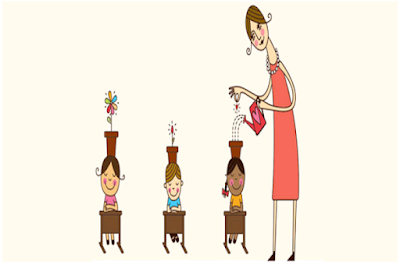
If I were an educator and had the opportunity to deal with students from diverse backgrounds, I would first understand that a classroom is like a garden blooming with flowers. Flowers that are of all different shapes and sizes, colours and fragrances. In my class, each student would be treated like a flower, nurtured with care, watered with love and planted with firmness. I only vision this garden right now, but I hope to visit it one day; oozing with so much learning, education, laughter and love. 

Nothing is perfect, but our imperfections are what make us. Imagine how monotonous a classroom would be without the troublemakers, the backbenchers and the ones at the root cause of the chaos. They are the imperfections that make you imperfect. Similarly, perfection will not be the key in my class, but accepting your flaws and trying your best will be one of the core principles. So no flower will be perfect; all of them will enter the gates of the raw garden only to learn how to appreciate themselves, just the way they are.


I don't want perfect flowers, but I like happy flowers, so if a fearful student or an impatient learner enters my class. I will try my best to make them grow. 


A fearful student will be afraid of others, but more than that, they will lack trust in themselves. Fear is nothing more than an obstacle in the way of progress. In overcoming our fears, we can move forward more robust and wiser within ourselves. First, I will try to understand my student's fear of making friends, coming to school or interacting with teachers. Then I will try to counsel them. Also, I will open up with the student to increase their confidence. As a teacher, I will be frank towards them, like regularly cracking jokes or talking about simple everyday things. This way, I will develop a comfort and fun level with the student, and then I would ask them to do the same with the other kids and maybe with every new person they meet. 


I hope that I will be able to pull the fearful student out of his pot and help him grow into a beautiful, lush green tree. 


If an impatient student ever enters my class, I would make them learn patience and appreciation. Most impatient people are attention seekers and think that they are the best. So humility will also be an integral value for the impatient student. I would try to interact with the impatient student separately and give them exercises to increase patience. As a teacher, I would demonstrate how patience helps in life and why it is important to inspire them to walk onto the path of patience. 


I hope that through all this, I will be able to ameliorate patience in this young learner. 


I would love to be a teacher because a teacher is not only an educator but a learner, a counsellor, a parent, an entertainer and a confidant. 


Anvesha Rana,
Grade 10-B,
Gyanshree School

Tuesday, May 10, 2022

Happiness and Tolerance - Shalini Solanki

   Dealing with ‘An Unhappy student.’

I still remember a student studying in my class 3 years ago. I was the grade mentor of one of the sections of K.G. She was a new student in the school, and I knew nothing about her. I met her for the first time and made a perception that this child has some special needs and she is not able to understand instructions. She started coming to school regularly, and I noticed a similar pattern each day, like not eating her meal; after circle time, she used to stand near my chair without speaking anything, used to get shocked at any sound and would not make friends. 

Every day during circle time, everybody used to have free discussions about their likes/ dislikes, favourite person, place, problems etc. One day, every child spoke, she was quiet, and even after motivating her, she chose not to speak. I thought of giving her some more time. That day she came to me and asked me to write a letter to her mother. When I asked her what to write, she told me the entire story that her mother was living in London and expecting another child. The mother couldn’t come to India because of her work commitment and medical issues, and this child was not able to go with her father because of some visa issues. For 6-8 months, she stayed without her mother.

Every day this child would come to me after the circle time and share her feelings. She would come with a piece of paper every day with colour pencils and used to dictate her letter. She wanted me to draw her mother with her baby sister and some gifts. Surprisingly, she would keep all the letters with me and not take them home. I got to know about the root problem. After speaking to her father and mother, we started working together in a similar direction, where we gave her enough time to speak her heart out. Her mother was advised to speak to her every day and explain that soon she would be with her mother. On the PTM, I handed over all the letters from Aadvika to her father for her mother.

She was an entirely changed child and used to participate in all the activities, laugh, make many friends, and improve her academics. Finally, she went to London, but the habit of discussion in circle time activity continued. She would call me from there frequently to discuss her new school and life.

My advice to educators:

To be patient
Never jump to a conclusion
Make a habit of changing perceptions
Give time to your students
Trust students- sometimes they know more than us
Respect their feelings and be alert to their silence
Teachers have a magic wand that can make desirable changes

Dealing with ‘An Intolerant student.’

I had a student in my class who was very bold, talented, outspoken and intelligent. She had a problem agreeing with others. She would go to any extent to show her disapproval. If she was asked to share anything, she would run from the class, not eat anything or sit on the floor. Even in the class assemblies, she wanted a solo role without anything scripted. She would listen to no one in the school. Parents also had a similar opinion about her. Once, another teacher in my class said her ‘no’ to check her work first and asked her to wait for her turn. This student punched the teacher in her stomach. 

Now we know that she will not be handled by anyone this way. So we started avoiding her behaviour for some time after speaking to this student’s parents. When she used to sit on the floor to grab attention, we would praise her and say that we must respect her choice; she is more comfortable sitting here. When she used to disagree to share things with her peers, we stopped insisting she share, and after a few weeks, she realised that everybody was sitting in different groups and working, and she was sitting alone. When she insisted on participating independently, we would tell her that we do not have such roles with us, and she would have to wait for other assemblies to experience them. We used to share stories related to her problems during circle time, where indirectly, she got messages of loving, caring and sharing.

Gradually, she was a changed girl totally. Now she realised that she would have to give consideration to get the respect. She started loving her teachers, and she made almost everyone her friends. She participated happily with the entire group on an annual day. She is a changed and happy child now. Her parents are pleased with the changed personality of their child; they always wanted to see her.

My advice to educators:
  • To be patient
  • Sometimes a different approach can work
  • Share stories indirectly catering for the problem
  • Give time to your students
  • Trust yourself and your capabilities
  • The child is a clay container. Mould the way you want.

Shalini Solanki
Gyanshree School, Noida
JOL Cohort 2022

Monday, October 19, 2020

Happiness and Tolerance - Rudrani Ray

Happiness is something which we can’t describe in words it can only be felt from someone’s expression or a smile. Happiness is a signal or identification of good and prosperous life.  Happiness is a feeling and difficult to describe. However, happiness comes from within, and no one can steal any one’s happiness.  True happiness comes from within yourself.  Happiness is basically a state of mind.

Happiness is defined by different people in different ways. When we feel positive emotions, we tend to feel happy. Happiness is also regarded as the mental state of a person optimistically.  Every person defines happiness in his/ her own manner. Happiness should be distinguished from joy. When joy as a constant state of mind, happiness depends on events in our lives. Happiness is that feeling that comes over you when you know life is good, and you can’t help but smile.   

Happiness is one of the most important and most desirable aspects. Happiness may also be defined as being nice and spreading it all around. When joy and happiness are a constant state of mind, Happiness depends on events in our lives.  

To achieve the state of complete happiness, one has to practice on improving the state of life by: 

1. Staying contended in life what you have been cribbing and grumbling never lead to happiness.

2. Staying focused on the current life instead of daydreaming of the good days or old days.

3. Stop blaming for something that went terribly wrong in life. Life is all about moving on. stop worrying and set new goals in life.

4. Being thankful to God for all the good things that you have in your life.

5. Having good people around you who can boost -up positivity in your life. 

Happiness is a sense of well-being, joy or contentment. When people are successful, safe or lucky, they feel happiness. 

Tolerance is being patient understanding and willing to accept the ideas of others. Tolerance is accepting others and appreciating difference and live together peacefully. Tolerance means that you accept other people’s opinions and preferences even when they live in a way that you disagree with. To be tolerant means that you accept other people’s opinions and preferences, even when they live in a way that you disagree with.  Tolerance can be defined as the possession of a fair and objective perspective and attitude towards those people who are different races, religions, nations or have a set of opinions, beliefs and ideas. 

Schools must teach children the right values. Tolerance is a significant one. In every society, we need tolerance and acceptance of religion, eating habits, culture. To be tolerant means that you accept other people’s opinion’s and preferences even when they live in a way that you disagree with. Tolerance is accepting differences. Tolerance plays an important part in promoting equality in school.

- Rudrani Ray is pursuing the Professional Learning Program at the Learning Forward Academy, this is the post after attending Session I of Joy Of Learning. 

Blog Archive