Showing posts with label care. Show all posts

Sunday, July 5, 2026

Heart Vs Mind - Sunbeam School Mau


Reading the chapter “Heart Versus Mind” made me reflect deeply on the responsibilities of a teacher. The chapter beautifully shows that every child carries emotions, fears, dreams, and struggles that are not always visible. As a teacher, I believe that before correcting a student’s behaviour, I must first understand the reason behind it, as Brinda Ma’am said. Young children need emotional security more than strict discipline. If a child cries, becomes silent, or behaves differently, I would patiently listen, comfort them, and make them feel safe rather than scold them. A classroom should be a place where children feel accepted, respected, and confident to express themselves. 

A student’s emotional well-being is the foundation of meaningful learning. At the same time, senior students need guidance, trust, and motivation as they face academic pressure, peer influence, and personal challenges. Instead of judging them for their mistakes, as a Pastoral Guide, I would encourage open conversations, appreciate their efforts, help them set realistic goals, and remind them that failures are opportunities to learn. 

The title “Heart vs. Mind” reminds me that a good teacher should never choose one over the other. The heart teaches us to be kind, compassionate, and understanding, while the mind helps us remain fair, responsible, and thoughtful in our decisions. A balance of both qualities enables a teacher to create a positive learning environment where students not only achieve academic success but also grow into confident, responsible, and emotionally strong individuals. 

This chapter has strengthened my belief that the greatest achievement of a teacher is not producing high scorers but touching students’ lives with empathy, patience, and genuine care.

Rekha Sharma

As I read this part of Heart vs Mind, I was reminded that adolescence is one of the most sensitive phases of a student's life. As an Academic Head and an English teacher, I often observe that students need not only academic guidance but also emotional support, understanding and someone who listens to them without judgement.

What impressed me most was Roma Mathur's approach of understanding her students before correcting them. She looked beyond their behaviour and recognised their emotions, fears and hidden potential. This reflects the true essence of education—that every child deserves empathy, trust and an opportunity to grow.

In my experience, students perform their best when they feel valued and emotionally secure. Meaningful conversations, encouragement and a positive teacher-student relationship often create a greater impact than mere classroom instruction. This chapter also reminds us that when teachers and parents work together with patience and understanding, children develop the confidence to make responsible decisions.

For me, education is not only about academic excellence but also about nurturing emotionally strong, responsible and compassionate individuals. Heart vs Mind beautifully reinforces the belief that before shaping a student's mind, we must first connect with their heart.

Sangeeta Singh

Wednesday, September 3, 2025

A Home Away From Home

My stay at Fig Tree Cottage was nothing less than being at home with copious amounts of hospitality. The staff here made the stay beautiful, comfortable and inviting. Every morning, Mithlesh ji arrived with a fresh cup of coffee. These big windows offer a lush green and a small pond with lotuses about to bloom. Just a few steps away from the pond are Guava-laden trees. 


This is a privilege one receives when at Fig Tree Cottage - hospitality. The staff works harmoniously. Each morning, they prepared a homely and healthy breakfast, which is something one rarely finds when away from home. 


There are small details to the Cottage that are not to be missed - copper bottles and glasses, cleanliness in every corner, a beautiful bookshelf, and greenery in the space. It didn't feel like a work trip at all; more like a holiday with some work thrown in, all made easy by the presence of these people who ensured your stay was smooth and full of warmth. 

The staff meet you every morning with a smile! The Cottage is surrounded by some sweet little cafes, where one can always get more coffee for a change. 

Enjoy your stay at the Fig Tree Cottage in Dehradun; they are only on Instagram: www.instagram.com/fig.tree_cottage

Wamly,

Neelashi Mangal
Guest at the Fig Tree Cottage
September 2025

Tuesday, November 26, 2024

Why do we require a Tree house ๐Ÿก in education?

Why do we require a Tree house ๐Ÿก in education?

A treehouse in a school- isn’t it magical?
It’s a space that can nurture growth in Service, Skill, Sport and Study - a place where children can enhance their skills, a space where they can grow stronger, a place where they can learn the value of caring for others and a space where they can discover the joy of learning, Give that magical space to the children and watch them thrive.
Gurdeep Kaur

We require a tree house for  education as it will help the child learn in lap of nature.A child can learn about various birds' sound and animals living.Also he can feel the peace and happiness of nature.It will develop a special bond between the students and nature which other way will create a environment aware human for world.
Suman Jhakar

Saturday, September 28, 2024

Reflections - 28th September 2024

To review recent reflections and content from The Teacher's Academy participants and discuss upcoming retreat plans.

Key Takeaways

  - Teachers shared thoughtful reflections on topics like Affection vs. Rejection and Love Learning vs. Hate for learning, demonstrating the application of book concepts to real classroom scenarios

  - Sunbeam Suncity school teachers produced engaging video content on classroom dilemmas, showcasing creative ways to apply learning

  - The upcoming Retreat in November was announced, with limited spots available on a first-come basis

  - Reading, reflection, and peer-to-peer content creation are emphasized as crucial learning approaches in the Teachers Academy


Topics

Recent Teacher Reflections

  - Carol Henrick shared two reflections on "Love Learning vs. Hate Learning" and "Affection vs. Rejection", exploring how teachers can foster positive attitudes and support students' emotional needs

  - Mohini Rai reflected on understanding and supporting children from troubled family backgrounds, emphasizing the need for pastoral care

  - Sneha and Leena produced video content on classroom dilemmas like cheating and overcoming fear, demonstrating creative application of book concepts

Video Content Creation Process

  - Teachers first discuss ideas, write a script as a dialogue, practice once, then shoot

  - They adapt book concepts to real classroom experiences they've had

  - Aim to keep videos concise (2-3 minutes) for good attention span

  - Videos are shared on the "My Good School" YouTube channel

Upcoming Teachers Retreat

  - Scheduled for November 13-16 at Khan Farm near Rajaji Sanctuary

  - Limited to 50 participants, cost is 15,000 rupees for 4 days/3 nights

  - Will include service projects, skill development, sports, and study

  The guest speaker is Amit Sachdeva, the "CSR man of India."

Teachers Academy Structure

  - Meets Saturdays at 5:30 PM for 45 minutes

  - First two Saturdays: Reading assigned book chapter

  - Third Saturday: Discussion of readings

  - Fourth Saturday: Review teacher-generated content/reflections

  - All content shared openly on www.happyteacher.in blog and Telegram group

Next Steps

  - Interested teachers should register soon for the November retreat (limited spots)

  - Continue reading assigned book chapters and sharing reflections

  - Explore the My Good School YouTube channel for more teacher-created content

  - Join the telegram group for ongoing communication and access to resources

  - Next Saturday: Read chapter 10 of the current book

VIEW RECORDINGhttps://fathom.video/share/eNvcMXyv2YmB8jvyUBWUm--1yBBkmkKq

Wednesday, August 9, 2023

A fearful and Impatient Student: Saumya RPKM

What is fear? 

Fear is a powerful and primitive human emotion which alerts us to the presence of danger. It is the good side of fear but on the other side, too much fear can harm self-confidence, it can prevent from achieving heights of success by destroying reality or being grounded in false beliefs. 


A fearful and impatient student 


There was a child in my class who used to stammer. He found it impossible to participate in any competition like poem recitation or elocution etc. When he stammered, he got anxious and when he got anxious he stammered even more. He used to sit still in the corner, knowing all the answers and just watching other kids— never participating in the activities. He also never participated in any conversations for fear that he might stammer. 


He was known as a good listener, but the fact was he just avoided talking because he knew what would happen if he spoke. I observed him for a few days to know the reason behind his behaviour: why he was so shy or different from others?


One fine day, I got to know about his stammering issue. I started talking to him, being friendly with him but he didn't involve himself much. It didn't stop me from encouraging him. I used to encourage him and provide him with chances to speak so he could regain his confidence.


It took time but his stammering lessened which boosted his confidence. Through encouragement, he got the courage and strength to face his fear and regain his lost confidence. In the teaching profession, we see these kinds of children who are struggling with speech issues. But with patience and consistency, teachers can help them. 


Advice to educators: As an educator, I and my group would like to suggest- 


  1. Teachers should deal with these kinds of children (lack of confidence, shyness etc.) with calmness. 
  2. Teachers should encourage children by giving them as many chances as possible. 
  3. Teachers should teach them the attitude of never giving up in difficult or frightening situations (like exams, competitions etc). 
  4. Teachers should boost children's morale so they can stand up on their feet firmly (without hesitation). 


"Courage is the Power of the mind to overcome fear" - Martin Luther King JR. 


Patience is the art of concealing your impatience.


In the past, I encountered an impatient student who was eager to move ahead with the lesson. To address their restlessness, I took a moment to talk with the student privately after class. I listened attentively to their concerns and empathised with their desire for more challenging material. 


I acknowledged their enthusiasm for learning and explained that while I understood their feelings, it was crucial to ensure that all students grasp the foundational concepts before progressing. 

To keep the student engaged, I promised to explore more advanced topics in the near future and encouraged them to take an active role in class discussions. 


This way, they could contribute their knowledge and potentially spark deeper conversations. By validating the student's eagerness and providing a plan for future learning, I aimed to channel their impatience into positive motivation for academic growth. 


Patience is the skill to accept or tolerate delay without becoming annoyed or anxious and without responding in disrespect or anger. 


Experience has taught me, that we undo ourselves through impatience. 


"To lose patience is to lose the battle" - By Mahatma Gandhi 


Saumya @ RPK School Moradabad

Rashmi Wright, Ekta Sharma, Rajni Gupta, Shafali Johri, Asha Singh, Beena Singh, Nidhi Narula

Friday, June 9, 2023

They Need Structure (and So Do You)

THE DAILY DAD

June 9


The message is for teachers and parents and a life lesson for all.


If a person puts even one measure of effort into following ritual and the standards of righteousness, he will get back twice as much. - XUNZI


If you talk to a sleep expert about sleep training your infant, they'll tell vou: kids need structure and routine. If you talk to an educational expert about helping your kid do better in school, they'll tell you: structure and routine. If you talk to a behavioral expert about helping your kid behave, they'll tell you: structure and routine. Hell, if you talk to a dog trainer, they'll tell you the same thing about your pet: structure and routine (and exercise).


Pretty much whatever the problem or whatever the issue, structure and routine are the solution. Which makes sense. The world is scary. So much ofit is new and overwhelming. But if you give them structure and routine, they can relax because they have less to figure out, and less to worry about. Instead, they can explore. They can get comfortable and accept things. They can feel safe.


But what about you? What about Mom and Dad? Do you maintain structure and routine for yourself? You put them to bed at the same time each night, but do you wing it after that? You plan their dinners in advance ... but what about your lunch at work? You give them quiet playtime in the afternoon and downtime on the weekends. But do you create that kind of regular time for yourself? Structure and routine are essential ho matter who or how old you are. They're important for kids and they're important for parents.


And guess what-when you keep a routine for yourself... it's easier to keep them on one.


Page 181 from Ryan Holiday’s book The Daily Dad, published by Profile Books. 

Sunday, April 30, 2023

Happiness and Tolerance - Aarya RPKM

Scenario 1- Unhappy Child
A student in my class shifted to our city from another city due to his father's job transfer. In the course, he was always silent and sad. He always seemed a bit nervous and didn't even have friends. I noticed this, and one day I asked him to meet me after the class.
When he came to meet me, I asked him, "I see that you are often very quiet. Neither do you talk to anyone nor show interest in anything, and its effect can also be seen in your studies? What is the reason?
The student replied, "Ma'am, I miss my friends, cousins and grandparents. I have no friends here, and because of this, I cannot concentrate on my studies."
I carefully listened to him and decided to help him to overcome his sadness. I asked a few of my class students to be friends with him so he could quickly settle down in this new environment. I always cared that he might not sit alone and nobody would hurt him. I asked the other teachers also to take care of him. After a few days, I saw him laughing with his classmates and playing with them. His smile was God's blessing for me.
Advice to teachers 
  • Always treat your students with love and care.
  • Never criticize a student In front of other students.
  • Nothing is more important than the mental health of a child.
  • They are like sunflowers; you are like a sun to them, 'A ray of hope.'
  • A happy teacher is a good teacher, so try to be satisfied with them.
Scenario 2- Intolerant Students    
Two years back in my class, two students, Naman and Reyan, started fighting and arguing with each other. Seeing them fighting, I stopped them and asked them, `What happened? Why are you arguing and fighting with each other?"

Naman said, "Madam, he is telling me I am wrong in my point."
Reyan said, "Ma'am, what he is saying is wrong."
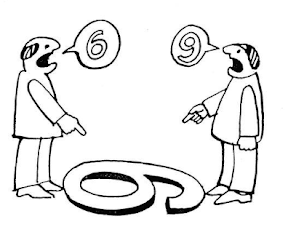
Both were right on their points and didn't want to listen to each other. I decided to solve this. I asked Naman to stand on one side of the desk and Reyan on the opposite.
I took the chalk and drew the number 9 like this so that From Naman's side, it would look like 6, and from Reyan's side, it would look like 9.
Then I asked Reyan what he could see? Reyan said this is Number 9.
Then I asked Naman what he could see? Naman said this is Number 6.

Both answers were different, and they again started arguing. Seeing this, I calmed them down and asked them to change their places.
When both changed their places, I again asked them, "Now, look at the number. What is it?'
Reyan replied, "Ma'am, this is 6."
Naman replied, ``it is 9.’’
Seeing this, both students were surprised and realized they were right. I explained, "Life is like that too. One whose opinion differs from yours doesn't need to be wrong. It's just a difference in point of view. In such situations, instead of getting into arguments, we should try to understand other's point of view. This is how they both understood and decided not to argue anymore and try to understand each other's point of view.
Advice for educators
1. We should always maintain our patience with students, no matter how bad our mood is.
2. Sometimes, you experience many students with different strengths and weaknesses. Some students may have behavioural problems, making them difficult to handle in class. If a student is behaving poorly, address the behaviour at the moment. Take the route to get the student back on track with his or her studies. In the long term, take measures in your classroom to discourage problem behaviour. Work on preventing problem behaviours by establishing and reinforcing clear rules.
Aarya @ RPK School Moradabad
Nishi, Manisha Bansal, Natasha Singh, Kalpana Saxena, Meeta Gulati, Shivani Mathur and Jyoti Singh.

Saturday, April 1, 2023

Humility and Appreciation - Welham Boys's School


Humility begins with accepting who we are and what makes us human. As a result, you gain control over your attitude and outlook.

Appreciation is giving something or someone their proper value, and everybody has value.

We practice Humility and Appreciate in our day-to-day lives unknowingly. Consciously, there have been instances where I have tried to incorporate these virtues in the classroom.

One evening, I heard my students crying in the hostel. I was curious to know what had happened that led them to be so upset. So, I asked a few questions and discovered that it was one of the student’s birthdays, and these kids were sent back from the ceremony due to the shortage of cake pieces. So, I decided to discuss it in the classroom the following day. It was essential to address this issue.

As I walked into the class, I wished that student “happy birthday” and asked why I wasn’t invited to the cake-cutting ceremony. That’s when a few other students got up from their seats and said since there was a small cake, even they were uninvited after being invited. As soon as I learned that, I spoke to the birthday boy and explained the importance of a guest and that they should be treated respectfully. 

One should never be uninvited once invited. The student nodded and learnt a new life lesson as he said he felt terrible about doing it. Suddenly, another student got up from his chair, recalling when one of his classmates had given his share of the cake to him when there was a shortage of another piece. I made the whole class stand up and clap for the kid, making a point to appreciate him for the hidden virtue of humility. 

These two incidents strongly impacted the kids and taught them humility and appreciation. This completely changed the perspective of that student whose complaints had no limits. He was one of the naughtiest, most mischievous and troublesome kids. I took away a lesson of never judging a book by its cover. This accurately shows humility, appreciation, and how unnoticeable these virtues are.

- Neelima Parmar, Monika Gupta and Vandana Sahay
Welham Boys’ School

Saturday, March 4, 2023

Quality and Love - Laxmi Kant Bhatt

A student who does a shoddy job in classwork and homework 

A classroom is a mixture of children having different learning competencies and interests. Each student is special and unique, so some may perform well in some subjects while others may not. Each student will be different from another and may showcase different talents and creativity. In this group of students, some may need to catch up regarding their academic performance. Some students take more time to comprehend learning topics, and some need to write faster.

A new student was admitted to the class. He was a very active and intelligent child. He used to participate in every lively discussion in the class. But when it came to writing or completing the class work or homework, he was at the last of the class. He was too slow in meeting any of his notebook assignments. He was very used to typing away on laptops and Ipads that his writing skills needed to be higher. I explained to him the importance of writing. He should have a habit of writing fast, as in board exams, the children must complete the paper writing in the given time. After that, they are not given any extra time for writing. I advised him to write letters to his parents, friends etc. His family members will also appreciate him for the letters, and it is a great way to work on his writing skills for anyone. Keeping a journal and writing daily can help increase the speed. He followed my advice, and slowly his writing skills improved.

Two underage students in a romantic relationship

Being involved in a romantic relationship at an early age hurts motivation and concentration, and thus also learning. Early romantic relationships are often very emotionally intense, leading teenagers to invest much time and energy in them that would otherwise be devoted to hobbies, friends, family schoolwork.

L.K Bhatt
The Doon Girls' School

Saturday, February 11, 2023

My Experience in the Happy Teachers Program - Rishona Chopra


 Joy Of Learning (JOL) is based on The Little Book of Values: Educating Children to Become Thinking, Responsible and Caring Citizens. Learning happens through these values.

Appreciation, Caring, Cooperation, Courage, Freedom, Friendship, Happiness, Honesty, Hope, Humility, Love, Patience, Peace, Quality, Respect, Responsibility, Simplicity, Thoughtfulness, Tolerance, Trust, Understanding & Unity.

These values make up our life. We don't have to do anything significant to master these. Just opening a door for someone, bringing a smile to someone's face, making friends with someone, trusting someone, understanding someone, and other little acts can do it all.

All these values have an essential meaning in my life. But the one I connected to the most was - Humility and Appreciation. I am very competitive, and this value gave me the essence of appreciation and the happiness it provides. 

The greatest thing is; I get to see all these values from the teachers' perspective. I get to see what they think while dealing with children like us. 

I hope to do another session like this again!

Rishona Chopra 
Grade VI
Gyanshree School

Wednesday, December 28, 2022

Unity and Caring - Nitin Sharma

When you have unity, it’s fantastic. When you don’t, it’s awful. Unity lightens the heart and brightens the day, an abundant source of joy and optimism, allowing even the most difficult tasks to be enjoyable. Unity represents togetherness. Therefore, it is standing together for every thick and thin matter. When we work together, we are motivated and encouraged to work harder. Also, we push each other to accomplish our goals, which is a significant motivational factor.

In this context, we have done a challenging activity in our classes IX and X. The move was that some groups were made from classes IX and X, and students were supposed to decide the best place for an excursion. All groups were given one week, and each group leader was supposed to prepare various pros and cons for an excursion to that place along with all the details. To my surprise, students had prepared excellent information for that place, such as location, travelling expenses, and refreshments. They beautifully linked that excursion to the related topics mentioned in their curriculum. So an excursion to Maple Camp was decided, full of adventurous activities. This excursion was full of joy and excitement, as this was possible only because of the unity of the students.

I am very thankful to the JOL Cohort for allowing me to share the experience of this beautiful activity.

Caring:
No other experience better than this excursion can be there to share the best example of caring for each other. Each group leader was very concerned about his/ her team members and their teachers. It was a tremendous hand-holding for all of us. Each student came ahead to help another student, and how they motivated each other.

In the end, I would like to end with a quote -

Thanks!

Nitin Sharma Kamla Nehru Public School, Phagwara

Tuesday, November 1, 2022

Hope and Friendship - Preeti Mahajan

“Hope is the power that gives a person the confidence to step out and try.
Once you choose hope, anything is possible.”

Life is a roller coaster ride. We all face ups and downs in the course of life. The only weapon that helps
us to sail through the darkest of times is hope.

My Observation
A girl in class 8, Vibhuti (name changed), lost her parents in a car accident. She was an average student, but post the tragedy, she became utterly hopeless and pessimistic in her approach to life.

The effort from my side.
Vibhuti was given individual attention in class. Many times, counselling and guidance were provided to her. Personalised notes and test papers were given to her. She was made comfortable to ask and discuss her personal problems and challenges. In due course of time, she regained her lost hope and interest. Instead, her academic performance also improved.

Friendship
“True friends are like diamonds bright, beautiful, valuable and always in style.”

My observation
A child named Zoya (name changed) in class 8 was a reserved and quiet girl. No friend circle at all. She occupied the last seat always and often found herself lost in her thoughts only. At times, she was quarrelsome and short-tempered also. This indifferent behaviour made her isolated from her entire class.

Action taken
Zoya was counselled for her indifferent behaviour. She was convinced to sit and mix up with the
students of a class. She was given group tasks like board decoration, copy collection, group projects,
enacting plays and many more to make her converse, interact and talk with her classmates. She was
appreciated for her excellent performance and transformation.

Advice to the educators

Children are like soft clay, ready to be moulded and shaped by us, the sculptors.
Observe the child deeply.
Take the right action at the earliest.
Hold their hands firmly.
Show them the light so that they can traverse even the darkest tunnel in their life smoothly.

Ms Preeti Mahajan
Ahlcon Public School
JOL Cohort 2022

Friday, October 14, 2022

Hope and Friendship - Anvesha Rana


Hope is the little ray of sunshine that peaks into our lives every morning. It is the reason we jump out of bed in the hope for a good day, it is the event we look forward to in the hope for a good time and it is the reason we love and care for people in the hope for a good family. We grow, we fall, we change, we love, we struggle all in the hope of a Good Life. Happily Operating for Pleasant Expectations is Hope. 

No one can ever be Hopeless, like there's something about the flower that grows through the rocks, the pavement; through logs and stone or brick walls, there’s also something about each student who grows in tough situations and it’s all because of hope. Hope should be stubborn like a Hit-me toy, no matter how hard we are hit, how badly we fall yet we come up again with more strength and vigor because we are Hopeful. 


Another important value in a classroom is Friendship. It is silent, transparent and simple, it is what it is. We may be close together or miles apart, but we will always remember them and they are our friends. Friendship is a two-way street and not a one-way road, it should include love, care and sacrifice from both sides. We don’t lose track if we are friends, we start from where we stopped. 


A classroom is simply four walls with teachers and students but what makes these four walls a place that oozes with learning is the friendships that flourish in it and the hopes that everyone holds inside it. Hope and Friendship are the building blocks of a classroom.


Anvesha Rana, 

Grade 10-B, 

Gyanshree School

Thursday, March 17, 2022

On Education and Social Media

The meeting of education and social media has an immense value for teachers, especially as a resource for lesson ideas and connecting with like minds to share experiences. This has been especially true during the COVID-19 pandemic, as teachers have been able to share best practices about remote learning. However, like every part of the internet, it has its unproductive side.

When I dig too deep into Education Twitter, I mostly experience it the way I experience looking at a feed of people's perfect lives, children, pets, homes, and vacations. I'm left with the feeling there's no way I'd be able to live up to the standard I'm seeing. Or I just know in my gut there's more than meets the eye to what's being peddled in 140 characters or a carefully crafted image. These posts on teaching can also feel disorienting when I'm not clear if the motivation is to help teachers and students or to cultivate one's personal brand.

The emergence of "Edu-Twitter' can be as agitating as any other part of social media, and it never hurts to look from a distance or find balance in the way I am using it.

It is important for me to be clear-headed and constructive in my engagement with what's shared about teaching online. If I engage during times of stress, I am likely to see other teachers' posts through the lens of unhealthy comparison, envy, or criticism - three very unproductive emotions to carry back to my students.

Reflection: It's no secret that social media can be toxic, but its best attributes can be life- and world-changing in their ability to inspire the greater good. Today I will look for ways to participate in and draw from ongoing conversations about teaching in a way that I believe will benefit my students and me most.

For All You Do
Self-Care and Encouragement for Teachers
Peter Mishler

Thursday, July 29, 2021

Thoughtfulness and Understanding- Anubhuti Sharma

“A door is much smaller compared to the house, a lock is much smaller compared to the door, and a key is the smallest of all, but a key can open the entire house. Thus a small, thoughtful solution can solve major problems.” A.P.J. Abdul Kalam

Education can enhance the personality of any human being. And this is possible only when all the values are included in us since childhood. Schools are great places where children spend more time and understand most things from there, whether through the syllabus, educators, or companions. Teachers and students have a huge influence on the formation of values. Thoughtfulness means making someone feel important, being kind and empathetic towards others, the quality of thinking and caring about others unconditionally.

As HM, we interact with our children in the dorm daily, we not only interact with the children in our house, but we are always there for every child. We don’t just focus on the problems because we believe that every child is exceptional and needs attention. We sit and interact with everyone individually to listen to them and make them feel importantWe inculcate values like thoughtfulness and understanding by showing care and respect towards children. With this, they learn to respect their elders and their juniors and all the helpers who take care of them. We also incorporate thoughtfulness and understanding by allowing children to perform various activities like taking care of the environment, preserving our culture, taking care of public property etc. And when they do a group activity, they learn almost all the values. They understand each other, care about each other, enjoy freedom in a group, and always feel important and contented. Thus, happy children can make every corner of the school happy.

The most important area where I would like to develop thoughtfulness in students.

First of all, I will try to reduce the feeling of competition among students. I will share my thoughts or stories from my childhood to make them believe that competing with others may make you happy for a moment, but it takes you away from certain values. I will not stop my students from competing. Rather, I will tell them to be their own competitors only then you can enjoy the true meaning of all the values. When we start competing with others, we forget to pay attention to; our goals, team spirit, and patient. Due to which there is a lack of understanding among themselves. I would always encourage my children to celebrate and enjoy success but never get discouraged if they don’t win. Whatever you do, give your best.

Thoughtfulness in action inside the classroom.

We can have circle time, where children can express their views, and they will learn to listen, communicate, respect and understand each other. This ability to understand someone else’s thoughts and emotions will make them empathetic. We can do this once a week. We can celebrate this week in many ways. This will help children build relationships and learn to pay attention to the other person.

Extra-curricular activities such as debate, story-writing or telling, art & craft and dramas are proper ways to explain values. It enhances the skills of critical thinking among the students.

Game 1 Game 2  (Tap on the link to play the game)

Word Wall Game quizzes were conducted in the classroom to teach the meaning of values to the children.

This week I was teaching the lesson on Being a Good Citizen, and I am glad that I had the opportunity to teach values like thoughtfulness and understanding to my students in the classroom. I did an activity with the children to understand the meaning of these two values.

I gave Sentence Stems to all the children and they were not allowed to change the given words, but they needed to add something to it.


- Anubhuti Sharma, The Doon Girls' School, Dehradun

Blog Archive