Showing posts with label Simplicity and Trust. Show all posts

Tuesday, November 21, 2023

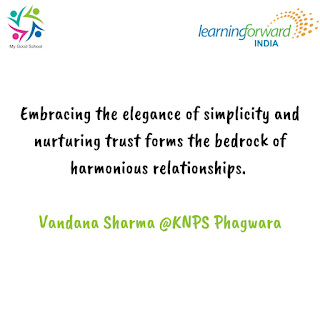
Simplicity & Trust - Vandana Sharma


Exercise on Simplicity:

Initial Responses: During the introduction of the concept of simplicity, students exhibited a mix of curiosity and uncertainty. Some students expressed interest in understanding how simplicity could improve their lives, while others were sceptical about its effectiveness.

My Role/Contribution: I began by defining simplicity and offering relatable examples, such as streamlining daily routines or reducing digital clutter. This allowed students to grasp the concept more easily and relate it to their own experiences. I encouraged them to share their thoughts on areas of their lives that they felt could benefit from simplification. 

Impact on Students: As the exercise progressed, students started engaging in thoughtful discussions about how simplifying their surroundings, tasks, and even their thought processes could lead to increased clarity and reduced stress. Some students shared personal anecdotes about times when they simplified things and noticed positive changes. 

Takeaways/Learning: It was intriguing to observe that while many students embraced the idea of simplicity, some struggled with the practical implementation. Some noted that the fast-paced nature of their lives made it challenging to find opportunities for simplification. This highlighted the need for ongoing support and guidance in practising simplicity. 

Initial Responses: When introducing the topic of trust, students exhibited a range of emotions. Some students were enthusiastic about discussing trust-building experiences, while others hesitated, possibly due to past experiences of broken trust. 

My Role/Contribution: I initiated the session by discussing the significance of trust in various aspects of life, such as friendships, family, and professional relationships. I shared relatable stories to highlight the impact of trust and how it can be rebuilt after being damaged. I also facilitated group activities that encouraged students to share their views on trust and collaborate on identifying the elements that contribute to building trust. 

Impact on Students: As the exercise unfolded, students became more open to discussing both positive and negative experiences related to trust. They shared stories of instances when trust had been pivotal in their relationships and discussed the challenges of rebuilding trust after it had been compromised. 

Takeaways/Learning: It was enlightening to observe the emotional depth of the discussions, as students revealed vulnerabilities and insights about trust. Some students remarked that this exercise allowed them to better appreciate the importance of open communication and honesty in building and maintaining trust. 

In both exercises, the classroom environment fostered active participation, thoughtful reflection, and deeper understanding among the students. The insights gained highlighted the complexity of these concepts and the diverse ways in which they impact individuals. As an educator, I learned the significance of tailoring discussions to the unique experiences and perspectives of each student,  ensuring a more inclusive and enriching learning experience.


Friday, October 14, 2022

Hope and Friendship - Anvesha Rana


Hope is the little ray of sunshine that peaks into our lives every morning. It is the reason we jump out of bed in the hope for a good day, it is the event we look forward to in the hope for a good time and it is the reason we love and care for people in the hope for a good family. We grow, we fall, we change, we love, we struggle all in the hope of a Good Life. Happily Operating for Pleasant Expectations is Hope. 

No one can ever be Hopeless, like there's something about the flower that grows through the rocks, the pavement; through logs and stone or brick walls, there’s also something about each student who grows in tough situations and it’s all because of hope. Hope should be stubborn like a Hit-me toy, no matter how hard we are hit, how badly we fall yet we come up again with more strength and vigor because we are Hopeful. 


Another important value in a classroom is Friendship. It is silent, transparent and simple, it is what it is. We may be close together or miles apart, but we will always remember them and they are our friends. Friendship is a two-way street and not a one-way road, it should include love, care and sacrifice from both sides. We don’t lose track if we are friends, we start from where we stopped. 


A classroom is simply four walls with teachers and students but what makes these four walls a place that oozes with learning is the friendships that flourish in it and the hopes that everyone holds inside it. Hope and Friendship are the building blocks of a classroom.


Anvesha Rana, 

Grade 10-B, 

Gyanshree School

Sunday, August 14, 2022

Responsibility and Cooperation - Anvesha Rana

Responsibility and Cooperation go hand in hand and are the two fundamental pillars of any classroom. A classroom always bursting with creativity, energy, and innovativeness is an uncontrollable power in need of the right master, a teacher. A class is a team; after all, it is a group of young learners who connect with each other to create something new and then critically analyze what could be done better; they take responsibility for their actions in case something is done wrong and then empathize with others to only cooperate more.  

Responsibility is accountability for owning up to your things and words, whether they were correct or incorrect. We are held responsible for others and for ourselves. Responsibility is the ability to respond and not react; it is to calmly anchor the ship without blaming others and by simply sharing the credit. Trust is perhaps the most crucial aspect of being responsible. Unless and until you are not accountable, you will never be trustworthy. 

We can teach students responsibility by assigning group tasks where each child needs to contribute. In my class, we often need to do group presentations on different topics, so we split the subtopics among ourselves. This way, all the bases are covered, and we can go in-depth about each subtopic; plus, all the members in the group are equally working. So, responsibility can be ignited in a team set up by simply doing what you are supposed to do. 

When someone is not responsible, rather than punishing them, we should make them realize and reflect upon the consequences of their actions so that they can empathize with others and never repeat the same mistake. If they were in a team and didn't prepare their part, the entire team would suffer because the team trusted them enough to hand over a task, but they broke the group's trust by not doing what was supposed to be done. How will he feel if that group member is asked to imagine himself in a similar situation where he is ready with his part, but a fellow team member has not prepared anything? 

When many young learners brainstorm upon a topic, it yields better results than when they work alone; this is Cooperation. It teaches us to trust, friendship and responsibility. When we cooperate with someone, we will only build trust, and once we build trust, we will be friends who will be trustworthy enough to be responsible. 

Our strength lies in our unity, and unity lies in our diversity. Imagine if we were all the same. How monotonous it would be, but our differences are what bring us closer. Close enough to respect others, learn from others and cooperate with others to achieve a common goal. 

Responsibility and Cooperation both arise from love and passion. If we love our education and are passionate about our profession, then only passion will meet education. Our Responsibility and Cooperation lie in loving what we do. 

Anvesha Rana, 
Grade 10-B, 
Gyanshree School. 

Thursday, July 28, 2022

Simplicity And Trust - Preeti Mahajan

Simplicity is the ultimate form of sophistication. It is a state of mind, not a lifestyle.

Trust is the bedrock of all strong relationships. Without it, chaos and coercion dominate.

Activity conducted: Role Play.

Number of participants: 20
(4 teams, 5 in each group)

The children enacted a one-act play on Simplicity and Trust. They highlighted these virtues with the help of a story. They also made slogans and posters on it.

Initial response:

In the beginning, the children were quite apprehensive about the activity. They were hesitant to perform. They also did not know how to write the script.

My role/ Contribution

I guided the children to take up any daily incident where they have observed the importance of Simplicity.

For example, wearing a school uniform, the Simplicity of village life, and the life of famous people like Sh. Abdul Kalam, Sh. Narendra Modi etc. They were told how Trust is the base of all relationships, for example, family bonding, friendship, student-teacher relationship etc.

Impact on students :

They came up with beautiful ideas and narrated many such incidents from their daily life. They wrote the script and dialogues and presented the one-act play enthusiastically.

Take away /learning for me: The students learn better by experience learning; they showcased the value of Simplicity and Trust in front of the class.

Preeti Mahajan
Happy Teachers JOL Cohort 2022

My School

Simplicity and Trust - Laxmi Kant Bhatt

 Simplicity and Trust 

What is trust? Is trust essential for the way we live our everyday life? Trust is a quality or condition of being trustworthy, loyal, and reliable. I think trust is an essential way of life because you cannot make a relationship, friendship, business, or organization if there is no foundation. Part of that foundation is trust and loyalty because you should be able to depend on and trust others that they will do precisely what is right for them and you. 

I'm a fan of simplicity. When I tackle a topic, I don't think I'm done until I've found the simplest way to look at it. I think of simplicity as a process. You can't always start there, but you can find it or create more of it as you go. I also think of simplicity as a by-product.

The most important thing I've learned about simplicity is that simplicity wins in the long run. Simple is stickier than complexity, and it survives. I think nature teaches us that, and we learn it repeatedly in work and life. I am here sharing one of my experiences on simplicity and trust.

It has been a long time since I taught lower classes like 5th or 6th grade. I was deployed to teach grade 5. I was a little unprepared to teach the kids. I went with a mentality of teaching them the same way I used to teach the higher classes. At that point, I did not realize they were growing kids who could not handle a fast-running course. I taught for 1 week, completely forgetting about them being kids. Being a senior teacher, the students were a little petrified to ask or say something in my class. After a week, the class teacher of grade 5 came to me and told me about her children's problems in my subject. She told me the children could not follow up with my speed. They were lacking and could not understand my subject's whole concept. At that moment, I realized my mistake of not thinking correctly before reaching the lower grade. The next day I interacted with the students to develop a friendly relationship between us and started teaching them slowly and giving them enough time to cope with my subject. Slowly and steadily, the children began warming up to me. They told me about their feelings at first, how they were frightened to ask me questions or tell me to stop and go slowly, but now they feel comfortable. In this way, with simplicity, I gained their trust. Laxmi Bhatt Happy Teachers JOL Cohort 2022

My School

Tuesday, July 26, 2022

Simplicity and Trust - Roopa Bhattacharyya & Mridula Renjit

SIMPLICITY
Simplicity is the state of being simple, uncomplicated or uncompounded. It is the directness of
expression and clarity. The truth is that simplicity is always best because when focusing on
simplicity, your creative work becomes easier to understand, recognize, and use; in other words,
it makes things easy.

In life, simplicity is appreciating the small things. Simplicity is freedom from material
desires and emotional desires. Simplicity avoids waste, teaches economy, and avoids value
clashes complicated by greed, peer pressure and a false sense of identity.

Exercise on Simplicity
In class 3 SST, while teaching the lesson Food, a straightforward activity was carried out in class.
Children were asked to bring plain rice, dal (lentils) and potato sabji (vegetarian side dish).

Impact on students
The whole class brought rice, dal and potato sabji, enjoyed having it with their friends and
also learned about cereals, pulses and vegetables. They discovered the pleasures of a simple meal.

TRUST
Trust is a two-way street. There are two basic approaches to trust.

1. Start with trust and see what happens; trust the other till the other person disproves
your trust.

2. A person has to prove he/she is trustworthy. Only after the other person has demonstrated,
their trustworthiness will that person be trusted.

In the classroom, the first approach will be successful. We have to give trust and earn the
the trust of the children.

Exercise on Trust
I made each child stand on the desk and fall backwards. The other children were positioned to catch the falling child. What great fun it was! The children caught the falling child; of course, I was there to catch the child in case the children missed the falling child. Trust was earned and learned.

- Roopa Bhattacharyya & Mridula Renjit
Ahlcon Public School
JOL Cohort 2022

Saturday, July 9, 2022

Simplicity and Trust - Anvesha Rana


Simplicity and Trust go hand-in-hand. Students can only trust you, if you are simple enough and you can be simple, only by letting others trust you.  

Simplicity makes everything easier be it life, be it love or be it learning. Simplicity is the cure for our topsy-turvy world where we are constantly running after things, we don't even know. It is directly proportional to humility. When we are ordinary, we are modest but when we are extraordinary, we might fill ourselves with pride and arrogance. If we live simply, we can connect better. As teachers, we need to bend ourselves to the level of students and then talk to them, for one day they might grow taller than us. 

Simplicity and Curiosity are the sides of the same coin. Being simple allows us to explore new dimensions of learning, enter different worlds of growth and discover new paths to limitless places. It arises curiosity and there is no better way of learning than learning with inquisitiveness and love. Simple is perhaps the best way to do anything. 

The reason why I love all my teachers is that they are the purest form of simplicity. With just a mix of chalk and challenges, teachers can change lives. I love my school because I get to see my teachers, beaming at us no matter how notorious we are, no matter how much pain they suffer yet they put a brave face on and smile. The simplicity of a teacher can make her a friend or a mother, for students need that one teacher whom they deeply love. Blackboards, books and chalk, a teacher is much more than this all... 

We don't need to be so complex that we tangle in our threads and tumble down the stairs. What we all need is simplicity. Simple enough to accept the truth, simple enough to work on your mistakes and simple enough to learn from others. If we do what our conscience allows, if our mind and body are in harmony and if we see the beauty within then, we live simply.  A Simple Life is always a Happy Life. 

Another value we need for a Happy Life is Trust. T for Teachers and T for Trust so, Trust is the most important value that a school should evolve and Trust is also something that we learn from an early age. It is the faith, belief and responsibility that we thrust upon a reliable person. In school, trust starts when Parents send their children to school, trusting that the teachers will make their kids experience the joy of learning. 

The second transfer of trust in a school is when teachers entrust students with responsibilities which could be as small as collecting the notebooks, or minding the class, or even helping a new student. If we want to gain trust, then first we need to learn how to trust others. A Teachers trusts a student, for then only can the student learn to respect, to listen to and to trust the teacher. 

The third type of trust that circulates in a school is among students. Children trust their friends with secrets or with projects. In a group activity, it is very important that everyone connects, collaborates and creates with blind trust over the others. Trust is the foundation of Teamwork. The last type of trust which is beyond school boundaries, is when a teacher trusts a student to keep in touch and to keep connect even when they are no longer in school. It is this bond of trust that ties us in a school forever, even when we are no longer students but we will always be lifelong learners, all thanks to the trust we share. 

Simplicity and Trust may be easy to speak about but they are earned only when our actions meet our words. 

Anvesha Rana, 
Grade 10-B, 
Gyanshree School

Blog Archive