Showing posts with label activity. Show all posts

Thursday, April 17, 2025

๐ŸŽจ Impressions That Inspire: A Thursday of Thought and Fire ๐ŸŽถ

๐ŸŽฏ Purpose with a Pulse: Why We Gathered, What We Gained

As part of our ongoing Thoughtful Thursday series, this session explored Impressionism across literature, visual art, and music. The aim was to inspire educators to weave these forms together, deepening students' emotional and sensory engagement and allowing creativity to flow freely.

Golden Glows and Gentle Flows: What Impressionism Bestows

  • Impressionism is all about evoking feelings, not dictating meaning—letting images, sounds, and words speak softly and suggestively.
  • Art captures fleeting light and motion; literature paints with moods and metaphors; music stirs emotion through tone and silence.
  • Integration of art forms makes learning holistic and heartfelt.
  • Avoid giving detailed instructions—give students space to feel, interpret, and express themselves.
  • The arts become a doorway to personal understanding and more profound empathy.
๐Ÿ“– Stories in Shadows: When Words Paint and Meanings Drift

  • Impressionist literature avoids clear-cut narratives, instead using imagery and mood to allow readers their own interpretations.
  • Authors like Virginia WoolfJoseph Conrad, and R.S. Thomas paint with words, letting moments linger like mist.
  • Example: In Conrad's Heart of Darkness, nature is used not only as a backdrop but also as a metaphor for internal turmoil.
  • Why it matters: This approach cultivates empathy and imagination, encouraging students to explore inner landscapes.

๐Ÿ–Œ️ Brushes and Breezes: Art that Catches the Light

  • Born from a desire to break away from rigidity, Impressionist painting captures the essence of a moment rather than its details.
  • Hallmarks include:
    • Loose brushwork
    • Outdoor painting (en plein air)
    • Bright, expressive colour palettes
  • Artists like Monet and Van Gogh invite us to feel the moment, not just see it.
  • Why it matters: It teaches students to observe the world more intimately, appreciating subtle shifts in mood and light.

๐ŸŽผ Echoes in the Air: Music that Moves the Mood

  • Impressionist music, like the works of Eric Satiespeaks through mood rather than melody.
  • Satie's Gymnopรฉdie was shared as an example: simple yet emotionally profound.
  • Introduced the idea of "colour" in music, relating to tone and timbre.
  • Why it matters: Encourages students to listen beyond notes—to the feel of sound, building more profound auditory sensitivity.

๐ŸŽญ When Arts Align: Weaving Wonder Through Every Line

  • Blending literature, visual art, and music creates a multidimensional learning experience.
  • Effective integration tips:
    • Avoid rigid instructions
    • Sensitise students to the "why"
    • Let expression lead the way
  • Why it matters: Students develop creativity, interpretation skills, and emotional intelligence through cross-modal exploration.

 ๐ŸŒฑ Steps to Bloom: What Comes Next, and How We'll Grow

  • Delve deeper into the "colour" of music in upcoming sessions
  • Teachers to experiment with Impressionist-inspired integrated activities in classrooms
  • Continue the momentum with weekly Thoughtful Thursdays to build a strong foundation in arts integration

We hope you enjoyed our creative journey through Impressionism in art, literature, and music. Let the colours, sounds, and stories inspire you—and don't forget to share your reflections and thoughts in the comments below. We'd love to hear from you!

Tuesday, December 31, 2024

Tom and Jerry- Sunbeam School Indiranagar

In a school, teachers and students are like Tom and Jerry. Where the teacher, like Tom, keeps chasing the students to complete their tasks so that the students complete the given tasks on time. But some students are like Jerry, who are restless, they cannot stay on any task for long and get bored very quickly,  they also start misbehaving and do not even complete their work. In such a situation, a teacher tries that the students should be attentive by making them do different types of activities so that they can develop an interest in their subject and complete their task.

When a teacher behaves normally with the students and keeps aside his seniority, considers himself a facilitator of the students. There is trust in the teacher develops in the students, due to which they share their problems with the teacher which hinders their personality or learning. A teacher is not there only to impart bookish knowledge, he has to play different roles, sometimes he has to be a guardian, sometimes a friend, because to make a student a good citizen, a teacher has to take many forms.

Sunbeam School Indiranagar Varanasi
Chandrani Singh
Shalini Tiwari
Shilpi Chakraborty
Vijeta Wilson
Mizan Ali

Monday, November 18, 2024

My Good School Retreat 2024 - JDS School

The first Retreat we attended was a wonderful experience. It illuminated all aspects of learning, exploration, and giving. It was exhilarating to witness a blend of three distinct cultures from Varanasi, Punjab, and Meerut coming together to showcase their unique ideals. The reality of diversity was undoubtedly at its peak during the retreat. The high standards set by our chairman, Mr. Sandeep, along with Mr. Amit, Mr. Jugjiv, Mr. Assad, Mrs. Manisha, Mr. Devgan, Ms. Feroza, and many others who motivated both students and teachers, left a lasting impact. The efforts of these remarkable individuals know no bounds. I am deeply grateful to all these nation builders who, in their own way, are supporting A FA. Thank you for the warm hospitality.

Suman Jhakar
Jhamku Devi School

Tuesday, October 10, 2023

Humility and Appreciation - Aadhya RPKM

Topic- Humility 

Activity- Students were asked to prepare worksheets for any teacher whom he/she has hurt, admitting his /her mistake and apologizing for the same.

Student's response- Students put their feelings in writing and acknowledge their mistakes:

  • I'm sorry for _____________________
  • In the future I will_________________
  • Will you please forgive me? __________________
  • Teacher's Response - ____________________________

Teacher's  role:

1. Ask students to accept their faults and express their sincere regrets.

2. Ask students to forgive the apologizer and move on.

3. Teach students to learn from their mistakes.

Impact on students:-

1. It teaches students to put others before themselves and encourages them to be better learners and problem solvers.

2. It helps them to build strong relationships.

3. Facilitate the ability to learn from mistakes.

4. Encourage personal growth.

Teacher's learning:- If we want our children to learn, we must in return enter the classroom as learners.

Topic - Appreciation

Exercise - Ask students to think of something they are grateful for and express their thanks to someone who has made a positive impact on their life and thank you notes for their classmates and teachers.

Student's response-

  • Some students were thankful to their friends for adding colour and fun to their lives. Some students were thankful to their teachers who inspired them and added value to their lives.
  • Some students were thankful to their parents or family for taking care of them and giving good upbringing.

Teacher's role:- As a teacher, I share stories of my personal life about to whom I am thankful and about positive effects on our behaviour and attitude.

Impact on Students:-

1. Trained their needs to focus on the positive aspects of their life and build a habit of appreciation.

2. Create a powerful and positive effect on them.

Teacher's learning:-

1. A positive attitude creates positivity and changes the environment and life.


Aadhya @RPK Moradabad

Deepa Khanna, Rachna Bisht, Asma, Farida, Sushma, Kulmeet, Krishangi.

Sunday, January 15, 2023

Unity and Caring - Sukhpreet Kaur

The significance which is in Unity is an eternal wonder. – Rabindranath Tagore


Unity or teamwork occurs when diverse abilities and insights join together to achieve a common goal. It is sustained by concentrating energy, accepting and appreciating the value of the array of participants and the unique contribution each can make and remaining loyal to one another and the task. It inspires more substantial personal commitment and more extraordinary collective achievement. The nature of society is different. Each individual who grows up is separate, unmixed and non-repeatable.

Unity:-

In Grade V, I conducted one activity on The United Nations (UN) based on Unity. Students were divided into 5 teams. Students researched various works of the United Nations in India. Topics for the teams were:- 

TEAM-1 Poverty and Urbanisation

TEAM-2 Health, Water, and Sanitation

TEAM-3- Education and Employability

TEAM-4 Gender Equality and Youth Development

TEAM 5 Climate Change, Clean Energy and Disaster

Each Team was divided into roles. Buzz (Team), Affinity (Questionnaire), Teach and talk (presenting conclusion) and Critics.


The task was given to them during winter vacations. The presentation was in the second week of January. I was happy to see the work presented by them. Even I asked them what they learnt from this activity? I would like to share the learning shared by a few participants of Team -2:


It was a great acTeamty. I learned about how the United Nations manages Health, Sanitation and water for needy people worldwide. I discovered my team member's hidden qualities and learned to manage them together. I learned how to work in Unity, also. This was my best activity in 5th grade. Thank you, Ma'am, for giving us such a great activity!


Thank you, Ma'am, for this activity. I liked the group work and how Parvi properly managed all of us. I would like to be in Parvi's Team in future, also. I learned when people me shouting how to manage them politely from Parvi. And thank you, Ma'am, for this united activity.


I was excited to hear about our topic when we presented the activity. I found this activity to be unique because of its Unity. I learned that Unity makes our work easy too. Thank you, Ma'am, for this great activity.


As a facilitator, I guided my students about the topics and explained the value of a team. Students worked well in the Team. I was amazed to see the handholding of each Team during the presentation. Students who were critics used their power and role for the betterment of everyone. With maturity and self-reflection, more research work will happen in future. I would like to share one quote from Rabindranath Tagore "Don't limit a child to your own learning, for he was born in another time."


Caring:- 

Indeed this quote speaks the truth of life. The picture was my assignment for the students. I displayed this picture, and I felt silence in my class. Suddenly one student wrote the word kindness on the whiteboard. This was the trigger for our discussion. While discussing values in my class, I observed different views and opinions. Then I shared another picture which was related to success.

I asked what is most important to them– achieving at a high level or achieving at a high level and caring for others. I received mixed responses. I did this survey with the age group of 10-17 years old children. I was distraught to see the result when I observed 75 per cent chose to achieve at a high level, and 25 per cent decided to perform at a high level and to care for others.


The 25 per cent age group was 10-12 years old children. So it is essential to inculcate values from the initial phase of life. I would like to end with the English proverb - As you Sow, So Shall you Reap. Sukhpreet Kaur
Gyanshree School, Noida Happy Teachers JOL Cohort 2022

Wednesday, December 28, 2022

Unity and Caring - Nitin Sharma

When you have unity, it’s fantastic. When you don’t, it’s awful. Unity lightens the heart and brightens the day, an abundant source of joy and optimism, allowing even the most difficult tasks to be enjoyable. Unity represents togetherness. Therefore, it is standing together for every thick and thin matter. When we work together, we are motivated and encouraged to work harder. Also, we push each other to accomplish our goals, which is a significant motivational factor.

In this context, we have done a challenging activity in our classes IX and X. The move was that some groups were made from classes IX and X, and students were supposed to decide the best place for an excursion. All groups were given one week, and each group leader was supposed to prepare various pros and cons for an excursion to that place along with all the details. To my surprise, students had prepared excellent information for that place, such as location, travelling expenses, and refreshments. They beautifully linked that excursion to the related topics mentioned in their curriculum. So an excursion to Maple Camp was decided, full of adventurous activities. This excursion was full of joy and excitement, as this was possible only because of the unity of the students.

I am very thankful to the JOL Cohort for allowing me to share the experience of this beautiful activity.

Caring:
No other experience better than this excursion can be there to share the best example of caring for each other. Each group leader was very concerned about his/ her team members and their teachers. It was a tremendous hand-holding for all of us. Each student came ahead to help another student, and how they motivated each other.

In the end, I would like to end with a quote -

Thanks!

Nitin Sharma Kamla Nehru Public School, Phagwara

Saturday, December 10, 2022

Freedom and Peace - Sukhpreet Kaur


 "Human Beings, indeed all sentient beings, have the right to pursue happiness and live in peace and freedom." - Dalai Lama.

Freedom is a mirror of internal peace. They are sides of a coin which are incomplete without each other. The moment we are peaceful from the inside, we feel and provide freedom to all. Looking back to the school days of my life, I am lucky enough to get teachers who provided me with a better environment for learning. I am thankful to all of them for shaping my life. I always remember one line of my past that my parents and my Hindi teacher shared with me-


เคœो เคนुเค†, เคตเคน เค…เคš्เค›ा เคนुเค†, 

เคœो เคนो เคฐเคนा เคนै, เคตเคน เคญी เค…เคš्เค›ा เคนी เคนो เคฐเคนा เคนै,

เค”เคฐ เคœो เคนोเค—ा, เคตเคน เคญी เค…เคš्เค›ा เคนी เคนोเค—ा। 


If I think about instances, each phase of life indicates some vital message to us. It is us who we need to focus on. The giver and the taker need to understand the importance of life and do things peacefully and with the right intention.


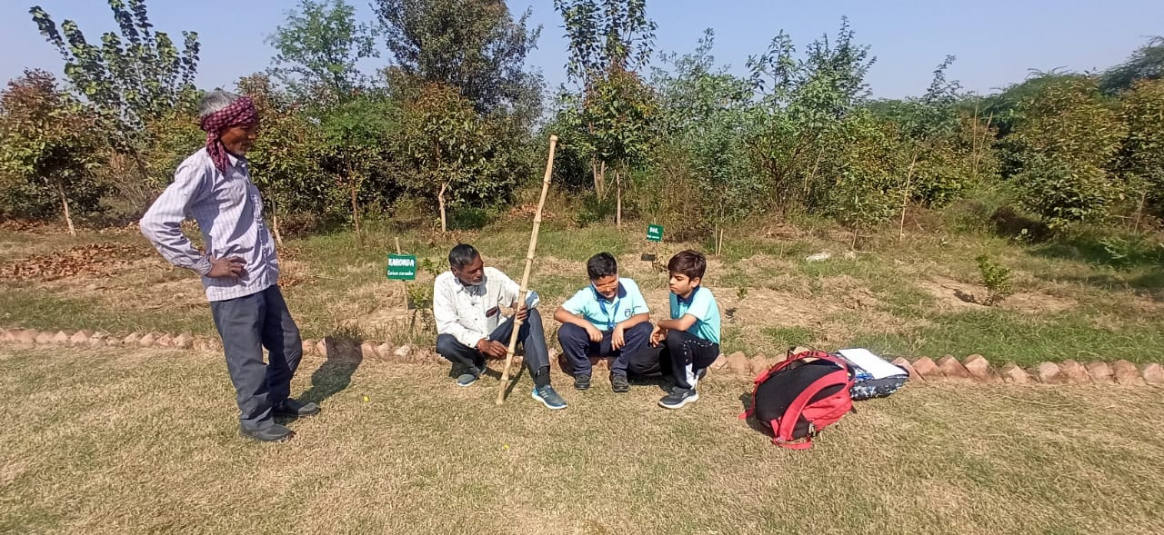
I would like to share one activity where we took our Shreeyans (students) to a micro forest setup in Jewar. Students observed different varieties of plants and herbs and learnt the techniques by which they can grow plants. After the activity, they all sat and had their meal in the arms of Mother Nature. Students were amicably talking to each other. After some time, I observed two of my students talking to the caretaker. I was curious and went silently closer to them and sat near them. They took an interview with the caretaker and asked about his life. I could see the calmness and peace on their faces and the feeling of happiness.                                                                             

It inspired me to write a few lines in Hindi, which I am sharing with all of you.  


เคฐเคนเคคा เคœिंเคฆเค—ी เคฎें เคธुเค•ूเคจ เค‰เคธเค•ी เคฎเคฐ्เคœी เคธे 

เคนเคฎ เคธुเค•ूเคจ เค•ो เคขूंเคขเคคे เคนुเค เคฌेเฅœिเคฏों เคฎें เคœเค•เคก़ เค—เค 


We can quickly promote peace in the classroom. By promoting peace, students will develop a sense of responsibility, positive regard, and empathy, feel safe and learn naturally and encourage others to learn. Education for peace seeks to nurture ethical development, values, attitudes and skills required for living in harmony with oneself and others as responsible citizens. 


Regards

Sukhpreet Kaur

Gyanshree School

Monday, September 26, 2022

Humility and Appreciation - Jaspreet Kaur

Humility

Humility is the quality of being humble and means putting another person's needs before your own and thinking of others before yourself. It also means not drawing attention to yourself and acknowledging that you are not always right.

Activity

In Grade V 'A', as a Class In charge, I motivated my students to wish Class four employees daily when they come to school. I observed that initially, a few students started wishing them good morning and good afternoon. After One week, I watched that all students had started doing it regularly. Every day, they want to wish the Class four employees, whether he/she is gardeners, gatekeepers or Ayyas. One day one student went to the accounting office for a pain killer. When he came back, I asked him about his health. He said, "I am wonderful, Ma'am, but one Ayya (school maids) was not feeling well, so he brought a pain killer for her at her request". This, for me, was a great observation. I hugged that child and appreciated his action in Infront of the whole Grade V 'A'.

Impact on students

Students learnt humility from one of their friend's actions.

Stay humble and be kind.

Appreciation

I requested the student to appreciate the small actions of parents, garbage collectors, peers and class four employees. I counsel them to thank their parents when they give them food and water or help them with homework. I told them to say thanks when Ayyas cleaned their desks after lunch. It was observed that most of them have done the same. 

Impact on students

Appreciation is a beautiful thing. It makes what is excellent in others belong to us as well.

Jaspreet Kaur 

Kamla Nehru Public School, Phagwara.

JOL Cohort 2022

Sunday, September 25, 2022

Humility and Appreciation - Shalini Solanki

In a world of 7.8 billion people, no matter how social we are, the human race is looking for that one thing, a talent, and a purpose, anything which is their own, which gives them meaning and helps them make sense of the world. They want something to be known by and something they are known for. The speciality is what people need to be content and happy for that individual. However, this search for individuality often leads to the path of isolation, arrogance and selfishness. If not taken with humility, this search for personal gain removes the focus from our ultimate purpose of serving others.

Taking it up from the very beginning is essential, especially in schools. Accepting failure and success with humility for themselves and others is the skill required to raise a generation of individuals ready to face the world with courage and kindness. Accepting and giving appreciation with genuineness is directly linked with humility. To explore this connection and to help learners experience this feeling.

Activity:
I created an activity about festivals. While discussing various festivals, we tried to explore the
music, clothes, food and activities related to each festival using audio and visual aids.

Learner’s role:
Learners saw the grandness of the harvest festivals, the magnificence of the national festivals and
the richness of the religious festivals all over India. They identified the beautiful differences and
unexpected similarities between various festivals.

I observed learners expressing themselves as a part of the community while describing their
favourite festivals. They were open, appreciative and eager to know about each other’s
experiences. This led me to extend this feeling of community based on humility and
appreciation into another activity.

We decided to feel the spirit of festivals more closely and have our own class festival. Learners brainstormed and decided they would have a festival to celebrate the beauty of nature.

We dedicated one day to celebrating this class festival. Learners decided what they wanted to do to
celebrate their festival. They also learned subtly and humbly the things they cannot yet do. For
example, suggestions like going on a trip, buying and using plastic decorative items were put down
very gently and humbly by other students based on the understanding of what they are capable of
doing and what is harmful to nature.

On the day of the festival, learners cleaned their classes; they decorated the board and the class
with origami crafts and drawings. I assisted them in making groups and assigning tasks. We started
our day with a choir performance dedicated to nature by all the learners. We went on a nature walk
and enjoyed the beauty around us.

As a part of our festival ritual, we sat together on the grass in a circle; everyone shared one thing
they appreciated about nature. It was beautiful to see everyone enjoying and appreciating the
beauty of nature. We wrote one promise on a slip of paper to save the beauty of nature around us. I
instructed them to write a simple commitment that they could do themselves. Later, we collected all the
slips and distributed them again. This time, everyone had a promise written by someone else. They read
it aloud and agreed to keep it and implement it to the best of their ability.

We ended the day by having a community feast. Everyone was asked to bring some healthy snacks.
In the class, we enjoyed the food together with light music while sharing our experience of
celebrating our own festival. I was so happy to see the ownership reflected by the students for this
activity. They were concerned about the cleanliness and implementation of all the activities 
they decided to include in their festival.

My role: Facilitator

Impact on students:
The spirit of humility and appreciation was not just observed in the experience but was also seen
growing by the end of it. Recognition of self concerning the community and appreciation of
different viewpoints was evident throughout the day.

Shalini Solanki
Gyanshree School, Noida
JOL Cohort 2022

Thursday, September 22, 2022

Humility and Appreciation - Maithreyi Venkataraman and Sukhpreet Kaur

"The roots of all goodness lie in the soil of appreciation for goodness." Dalai Lama

A humble person will undoubtedly be a person who will appreciate. To appreciate someone, one must look beyond oneself and recognise the other's effort and actions. One's level of appreciation indeed can vary by the quality of the job, but it should not qualify as the criteria for appreciation. 

Example. : With great excitement, a child who has attempted to draw scenery approaches his teacher and exhibits his work. That teacher must begin her feedback with a positive appreciation of the child's effort and then state how the child can improve the outcome.

Activity:  

The students planned and organised a class party for Teacher's Day. The party was a great hit, and the students' teamwork, hard work, and planning days were evident. As their grade mentor, I was overwhelmed with pride. The after-effect of the celebrations was not just loads of happy memories but also a dirty classroom. 

The children were now given this as an activity to clean up their classroom. They all participated without any apprehensions. I observed that they did have a few concerns, which they overcame with appreciation and motivation.

They enjoyed seeing a neat classroom after their effort. Now, this activity also made them realise the hard work put in by the cleaning staff, and they voluntarily went to thank the cleaning staff for keeping their classrooms always clean; they also apologised to them for increasing their work, dropping paper bits and promised to observe their part in keeping their classroom clean.

So, here are a few reasons why we should reward or appreciate students for their efforts. 

Sense of accomplishment - A sense of relief that the assigned task was completed and their hard work didn't go in vain gets inbuilt in the students. And with this thought, the mindset brings better, and they also receive what we all constantly seek: acceptance!

Overwhelming respect - Rewarded students get genuine appreciation and respect for just doing their best. 

Self-confidence - Rewarding someone for their work directly increases their level of self-confidence. 

Inclination towards learning - Success, when appreciated, turns into motivation, which brings zeal and enthusiasm to learn new things because how much you know and work determines how far you will go. 

Our learning: As grown-ups and mentors, we should trust more and criticise less. Students will always be more responsive when they are allowed to shoulder responsibilities.

-- Maithreyi Venkataraman and Sukhpreet Kaur, Gyanshree School

Sunday, July 31, 2022

Simplicity and Trust - Shalini Solanki

Simplicity Through Complexity – Contingencies Magazine

Simplicity is beautiful as it is away from all complications, complexities, distractions and confusion. Simplicity and Trust go hand in hand. It is difficult to achieve simplicity ultimately. But regular practice makes one closer to it.

Activity: We recently conducted an exercise on simplicity and Trust. The name of the activity was 'Scavenger Hunt', where students were asked to draw clues on A4 sheets like walls of mirrors, beds, many books, computers, flowers and bushes, water, a smart board etc. They were asked to leave some space to write after each image. The children were very excited and curious about the next step. They were informed that they would be going for a school round, where they were asked to observe their surroundings and find out the room or place matching the images drawn by them and tick the same. They were discussing with their peers, excited to find something resembling their drawing, listening to the teacher and each other, using each other's back to tick, disciplined, happy and trusting each other for their ideas.

We returned to the classroom, and the children wrote the room names or places where they saw the things drawn by them. We discussed the entire activity, and without opening any book or smart board, we were done with the topic of 'Different Places in School'. I was pleased and satisfied with my students' clarity of concept and responses. It is fantastic that we can simply make little ones understand anything with clear and simple ideas. C:\Users\GS111\Downloads\WhatsApp Image 2022-07-31 at 2.32.19 PM.jpeg


Initial responses from students: They were curious, excited, happy and eager.

My role: Facilitator 

Impact on students: They were more observant and calculative (e.g. they found 5 rooms of mirrors, where I was expecting one) 

My Learning: By being simple or making things simple, we can build Trust and make anyone understand, even the most challenging problems/ situations.

Shalini Solanki
Gyanshree School
JOL Cohort 2022

Thursday, December 24, 2020

Importance of Discipline - Shivani Rao

Courtesy Source: uiic@aktu.ac.in
Discipline is one of the most important personality traits in everyone's life. It refers to a set of rules and regulations which are to be followed while undergoing any task or activity. It is a way of being honest, hard-working, motivated, and encouraged while doing any task. 

It is a character trait that helps the individuals to complete the tasks in a given fixed deadline. The role of discipline in our life is to set orderliness, efficiency, punctuality, organization, and focus on our tasks. “Life without discipline is just like a ship without radar.” Therefore the importance of discipline in life just cannot be ignored.

Courtesy Source: https://www.cuemath.com/learn/importance-of-discipline/

Shivani Rao
The Fabindia School
sro@fabindiaschools.in

Saturday, July 18, 2020

Making Mathematics Joyful - Prerna Rathod

I attended CBSE Workshop on 15th July.  The topic was “Joyful Mathematics – Creating a Culture of
Mathematics.” The host center of excellence was Dehradun and the resource person was Mr. Shiv Narayan Hari Sharma.

He started with what was the general thinking of people and students about Mathematics.  It is thought of as a boring and difficult subject. But actually Mathematics is the basic of all subjects.  To make Mathematics interesting and joyful we need to keep the following things in our mind:

1. Connect all topics we teach to our daily lives. 
2. Make our lesson plan keeping in mind the learning outcomes for the students. 
3. Use different types of aids while teaching. 
4. Keep every child in our mind and while teaching keep eye contact with all the students. This will make all students to be attentive in the classroom. 
5. Activity based projects can be given as exercises to make students understand topics. 
6. By making our own tricks to learn formulas. 

Different types of examples were given as how Mathematics is connected to our daily life like in our home we need knowledge of area and volume for decoration,  white washing, making furniture, etc. Measurements and ratios are used while preparing food items. Varieties of geometrical shapes are seen in utensils. In sports, knowledge of probability, data handling, mensuration are required. When we go shopping or do investment then percentage and interest knowledge is required. In today’s world all are using mobile phones where knowledge of numbers is essential. 

Many students have difficulty in learning formulas of Mathematics.  A teacher has to find tricks, which students can remember easily. Like in integers same sign numbers we add and different sign numbers we subtract.  This can be written as S.S.A (same sign add) and D.S.S. (different sign subtract). In this way we can create our own trick to learn formulas. 

If we follow all these things then definitely Mathematics will be joyful for all students.  No one will be afraid of Mathematics. 

Prerna Rathod
The Fabindia School
prd@fabindiaschools.in

Friday, June 12, 2020

Unity & Caring - Harmony BHIS

Unwavering Unity
Human values are necessities in today's society. They are the features that guide people to take into account the human element when one interacts with the other person.

 Unity creates the experience of cooperation, increases enthusiasm for the task and makes the atmosphere empowering. When children unite together to achieve a single goal a sense of socialism arises, and thus the beginning of the journey towards 'Caring'. 

"How was your day at school Riya?" asked Riya's mom, when they both were heading home back from school, on a Monday afternoon.
"It was great Mom" responded six-year-old Riya. "Mother I want to tell you what happened in school today," said Riya in a muffled voice while entering her home. She kept her bag aside and started narrating "Mom today we played a game in school, wherein our teacher divided our class into two teams. She had spread various coloured balls on the floor and asked us to pick up the ball one at a time and put it into the corresponding coloured boxes. We all started with great enthusiasm. Both the teams were doing well. The teacher kept cheering for both the teams. We were all enjoying the activity to the fullest when suddenly....." Riya gave a pause to her words.
Her worried mother asked "Yes, darling …..Then what? "
Riya sighed and continued “And I suddenly fell down mom. The teacher came running towards me and picked me up in her arms. She made me sit on a chair. The ancillary brought the First Aid Kit and teacher applied it on my knee, but luckily I didn't hurt myself much. But Mom you know what the moment I fell down, all my teammates stopped the game and came running to me."
"That's nice of them Riya," said her mom to make her feel good.
 "Yes Mom, definitely!!!" replied Riya. "But the best I felt was when I saw the other team that was just one step away from victory left the game and came running to check on me."
 "That's amazing darling. This is how caring your friends are for you. This shows you all unitedly care for each other. You should always be thankful for such wonderful friends around you." exclaimed Riya's mom. "To care for others is to show empathy, to show concern. Your friends were concerned about you and that is why they didn't even bother about their victory and ran to check on you. Kind-hearted people always care for others and this gesture makes the other person feel good. So always remember to be kind to others. A kind heart is all about giving happiness to others. Treat others the way you want to be treated and try to spread the joy of care and love all around" added Riya's mom.

Riya felt a gush of delight in her heart and was thankful for such wonderful friends in her life. 

The moment we adopt a sense of caring for others it brings us inner strength and greater self-confidence. Caring for others helps us sustain our peace of mind.

"We shall walk together on this path of life, for all things are part of the universe and are connected with each other to form one whole unity." - Maria Montessori

Harmony @ Billabong High International School, Thane 
- Abira Chakraborty, Pooja Khona, Bhumika Ailsinghani, Rajshri Rane, Soniya Kuril, Poonam Choudhary, Kavita Shetty

Thursday, May 14, 2020

Responsibility & Co-operation - Harmony BHIS

We can lead the world
                     “Never help a child with a task at which he feels he can succeed”
                                                                                                                     - Maria Montessori
Children learn to do basic things at an early age and these learning experiences provide them with an enormous boost to their self-esteem. They learn the art of becoming independent, day by day.  It is important to raise responsible, capable adults much sooner than we think. Giving responsibility to the children for their actions, their belongings and the environment that they stay in helps them to fight the plentiful crawls of entitlement so evident in much of today's society. 
A group activity is the finest way to inculcate values such as responsibility and cooperation among children at a very young age.

Like every day the class was engaged in their usual routine when the teacher came up with an announcement, "Children, today is a day to do an activity on our national animal." 
"Tiger" was the shout echoed among the tiny toddlers. 
"Perfect!!!" exclaimed the teacher, "We shall make charts for the project 'Save Tiger' wherein you have to colour the picture of a Tiger and stick it on the chart paper. Each of you will be responsible for making the chart by working in a group. ”
The teacher asked, after a pause, “Children, what will you do to save your endangered national animal?"

The little children came up with creative ideas to express their love and care for ‘Tigers’. The teacher engaged her students in a brainstorming session and encouraged them to bring out their ideas on charts to save Tigers. Every child shared ideas about the same.                                                                The teacher then announced, “The class will now be divided into two groups and each group express their creativity on the chart paper.”
At once, the children were absorbed in bringing out their ideas on the chart paper in collaboration with each other.
The teacher observed their enthusiasm delighted. They performed their tasks while co-operating with each other in order to complete the task. She felt that she had attained her goal by involving all the kids and making them work together. She noticed that two groups were drawing forests to show the need for afforestation. Some of them drew food items for tigers, logos that displayed love and care for their national animal and so on. The charts of the groups revealed the ingenious ideas to exhibit a sense of responsibility towards the project 'Save the Tigers'. 

Eventually, the teacher called out a student from each group to explain the work done. The little child could comfortably illustrate the effort that manifested cooperation between the children of each group. The keenness and satisfaction that the children derived while working on the project together - was a noticeable bonus.
 Cooperative learning results in remarkable growth in the social well being of preschool children. It refers to learning to work in collaboration with their peers to achieve a common goal, rather than doing activities that emphasize competition. It results in remarkable growth in the social well being of teeny weenies. When children begin to learn in cooperation, it provides opportunities for sharing ideas, they learn how others think and react to problems. While working with others in small groups a child also enhances linguistic skills.
     
Cooperative learning in early childhood can promote a positive attitude towards school, teachers and peers.

'What works in the real the world is the responsibility towards cooperation'. Consequently, we can give-

Two Gifts to Our Children: The Roots of Responsibility & the Fruits of Co-operation.

Harmony @ Billabong High International School, Thane 
- Abira Chakraborty, Pooja Khona, Bhumika Ailsinghani, Rajshri Rane, Soniya Kuril, Poonam Choudhary, Kavita Shetty

Blog Archive