

It’s all about helping teachers, educators, and students access the tools they need to embrace the joy of learning, including reading and critical thinking.
Showing posts with label impact. Show all posts
Showing posts with label impact. Show all posts
Sunday, June 7, 2026
The Doon School Old Boys’ Society Impact Report 2025-26
The Rose Bowl DOSCO Impact Report by Learning Forward India Foundation
 The Doon School Old Boys’ Society (DSOBS) has partnered with the Good Schools Alliance and supports the initiative of the Learning Forward India Foundation to work in the space of affordable quality education, particularly in rural and budget-friendly schools. The Society has also signed an MoU with the Learning Forward India Foundation, enabling special education projects driven by service, participation of Old Boys and their spouses in on-ground initiatives and the connection of regional chapters with credible service projects across India.

 Founder of Good Schools Alliance, author, educator, and adventurer empowering children to discover the magic of literature.
Friday, June 5, 2026
The "Antimbala" Quest Continues
Read and Lead
Discuss the final chapters of Every Last Girl and its core message.
Key Takeaways
The “Antimbala” Quest Continues: Despite enrolling over 2 million girls, Educate Girls’ mission is incomplete. The Right to Education (RTE) Act covers only elementary School (Grades 1-8), leaving girls vulnerable to high dropout rates (40% by Grade 10) and limited life opportunities.
The Secondary School Gap: The primary barrier to secondary education is infrastructure, not mindset. India has only 20 secondary schools for every 100 primary schools, making access to secondary education impossible for many rural girls.
Authentic Storytelling Drives Change: Educate Girls’ success stems from the use of local “Team Balika” volunteers to share personal stories of transformation. This approach builds emotional connection and trust, which is more effective than data or external messaging.
Call to Action: The group’s key insight is that the mission is personal. The most direct way to “find Antimbala” is for each individual to support the education of one person.
Topics
The Unfinished Mission: The Secondary School Gap
The RTE Act mandates elementary education (Grades 1-8), but this is insufficient for life-changing opportunities.
Dropout Rates:
Primary School (<1%)
Middle School (~4%)
Secondary School (~40% by Grade 10)
Pooja’s Story (Jodhpur, 2024):
Dropped out in 9th grade due to early marriage and an abusive home.
Works daily from 3 AM to unload trucks and clean markets.
Cannot afford distance education (NIOS) due to high costs and travel to urban centres.
Impact of Not Finishing Grade 10:
Bars access to 60-70% of skill/vocational courses.
Prevents securing formal bank loans.
Contributes to 81% of Indian women being unskilled, and only 42% in the labour force.
Educate Girls’ Strategy & Impact
Scale: Expanded to 4 states (plan: 7 more in 5 years), reaching 30,000 villages and enrolling 2M+ girls.
Quality Control:
Developed “Gyaan Ka Pitara” (repository of learning) with government teachers.
Uses “gold standard external audits” and Randomised Control Trials (RCTs) to measure impact.
Proven Results:
Children in Grades 3-5 gain an equivalent of one extra year of learning.
Boys also benefit from improved teaching tools and shifts in community mindset.
Technology: Uses Machine Learning to predict out-of-school girl numbers and target interventions.
Group Reflection: Education as a Right vs. Privilege
Maira: Realised education is a privilege while helping a cook’s daughter practice English for an air hostess role.
Akanksha: Noted the secondary school gap in rural Dehradun, but also shared a positive example of her father supporting her mother’s post-marriage education and career.
Pushpita: Emphasised that family mindset is the key determinant. Cited examples of talented girls whose families arranged marriage immediately after Grade 12.
Brinda: Highlighted the risk of education being seen as a credential for marriage, not a path to personal autonomy.
Next Steps
All Participants:
Reflect on personal takeaways from the book.
Prepare to discuss specific examples of Educate Girls’ struggles and successes.
Consider how to support one person’s education.
Continue efforts to invite author Safeena Hussain to the next session.
Facilitate the collation of group reflections to send to the author.
FATHOM AI-generated notes
Founder of Good Schools Alliance, author, educator, and adventurer empowering children to discover the magic of literature.
Thursday, May 28, 2026
Educate Girls 15th Anniversary and the Power of Mobility
Read and Lead
To read from the book Educate Girls by Safeena Husain and discuss a chapter on the transformative power of girls’ education.
Key Takeaways
The Power of Literacy: Education provides a critical defence against exploitation, enabling girls to navigate complex systems (e.g., government schemes, property contracts) and make life-saving health decisions.
Breaking Generational Cycles: Educating one girl creates a “new normal” for her family. Younger siblings gain more education than their elders, forging a path toward greater freedom and opportunity.
Empowerment Through Mobility: Education grants girls the freedom to travel independently, drive vehicles, and pursue careers, breaking traditional constraints on movement and work.
Leadership & Community Impact: Educated girls become community leaders (e.g., Sarpanch Arohi), using their positions to allocate resources and advocate for girls' education, creating a virtuous cycle of progress.
Topics
Educate Girls’ 15th Anniversary Tour
Objective: Verify the impact of Educate Girls’ work by meeting beneficiaries in person.
Scope: A 4,500 km tour across 16 districts in Rajasthan, Madhya Pradesh, and Uttar Pradesh.
Scale: Events drew 800–2,000 attendees, including 11,928 volunteers and 2,765 staff.
Significance: The massive turnout underscored the community’s deep commitment to girls’ education, a stark contrast to the organisation’s humble beginnings.
The Power of Literacy: Safety & Financial Security
Financial Protection: Literacy helps women avoid fraud.
Example (Sapna): Read a government pamphlet → refused to pay an illegal fee for the Swachh Bharat toilet scheme.
Example (Vijaya): Handled an aunt’s property paperwork → saved ₹20,000 in broker fees and gained valuable experience.
Life-Saving Health Decisions: Education enables informed medical choices.
Example (Samitha): Insisted on taking her sister Varsha to a registered hospital for a seizure, overriding her illiterate mother’s plan to use a village healer. Varsha’s life was saved.
Context: In 2017, ~80% of Indian women needed male family permission to visit a health centre.
Empowerment Through Mobility
Education grants girls the freedom to travel and work independently.
Example (Jyoti): Flew alone to Pune, Maharashtra, after her mother stated, “Because you are educated, you can travel alone.”
Practical Skills: Driving tractors or motorbikes can save hours of daily labour (e.g., collecting water), freeing up time for study and personal pursuits.
Leadership & Community Impact
Educated girls become community leaders who advocate for further progress.
Example (Arohi): Enrolled in school by Educate Girls in 2010.
Outcome: Became Sarpanch for seven villages → allocated the majority of the administrative budget to girls’ education.
Generational Change: A “New Normal”
Educating one girl creates a “new normal” for her family, with younger siblings gaining more education than their elders.
Example (Ganaki’s Family):
Eldest Sister (Pyari): Never attended school.
Youngest Sister (Ganaki): Pursuing a BA, drives a motorbike, and interprets soil test cards to improve farm yields.
Tension: Ganaki and her sister Hansi will marry next year on a traditional date (Akshya Trithiya), showing the ongoing clash between modern aspirations and community expectations.
Symbolism: Ganaki’s name (“Enough”) highlights the family’s initial desire for a son, making her subsequent achievements a powerful symbol of progress.
Next Steps
Brinda: Attempt to contact Safina (author) about joining next week’s meeting.
All: Meet next Thursday at 5:30 PM to finish the book.
FATHOM AI-generated notes
Founder of Good Schools Alliance, author, educator, and adventurer empowering children to discover the magic of literature.
Friday, October 31, 2025
Learning Styles

Brewing Knowledge Friday
The meeting focused on exploring the concept of learning styles and their importance in education, with participants discussing the debate among psychologists about the existence and practical use of different learning theories. The group examined various challenges in understanding and applying learning style theories, including language barriers, the complexity of existing theories, and the limitations of learning style assessments. The discussion concluded with talks about how teachers can accommodate different learning styles in classrooms and exam formats, while also considering whether students can be taught to adapt to multiple learning approaches.
Learning Styles: Debates and Reflections
Neelashi led a discussion on learning styles, drawing from the book "What Did You Ask at School Today?" She highlighted the debate among psychologists about the existence and significance of learning styles, noting that while some find the concept useful, others question its relevance to teaching and learning. Neelashi encouraged participants to reflect on their own learning processes and share their perspectives on the topic.
Challenges in Learning Style Theories
Neelashi and Maira discussed the variety of learning styles among students, with Maira sharing her experience of visual versus auditory learning. Neelashi pointed out the challenges in understanding and applying learning style theories due to the many existing theories, each claiming to categorize learners differently. She emphasized the need for clear guidelines for educators and the difficulty of integrating these theories, inviting feedback and discussion from the participants.
Understanding and Implementing Learning Styles
The group discussed the complexity of learning styles, with Minakshi expressing concern about teachers' ability to understand and implement different theories due to language barriers and confusion caused by multiple theories. Neelashi suggested that this challenge could be an opportunity for teachers to develop their English skills. The discussion also touched on the difficulties of measuring and categorizing learning styles, with various psychologists creating their own tests and questionnaires to assess preferences.
Understanding Learning Styles in Education
The discussion centered on learning styles and their impact on education. Minakshi shared her experience of following parental guidance in her learning approach, which became automatic over time. Neelashi and others discussed the difficulties in identifying and labeling children's learning styles, noting that such labels can sometimes be misleading or restrict teachers' approaches. The conversation also referenced psychologist Daniel Willingham’s perspective on the difference between abilities and learning styles. An unnamed participant from Lotus Petal Foundation introduced themselves and mentioned their preference for visual and reading-based learning methods.
Learning Styles and Education Impact
The discussion focused on learning styles and their influence on education. Minakshi and Neelashi shared experiences of teachers using projects to address students' learning challenges. Neelashi emphasized how labeling students early, such as calling a child a "visualizer," can create a self-fulfilling prophecy and shape their learning approach. The group discussed the limitations of learning style tests and the lack of evidence supporting the matching hypothesis, which suggests students learn best when taught in their preferred style. They also explored the difficulties teachers face in accommodating different learning styles in a single classroom.
Adapting Learning Styles in Classrooms
The discussion centered on implementing different learning styles in classrooms. Manisha explained that teachers can incorporate various learning styles into a single lesson by combining different teaching methods to meet diverse student needs. Neelashi asked whether different learning styles should also lead to different exam formats, to which Manisha responded that exam papers already include a mix of learning styles and multiple intelligences, though this may not always be obvious to students.
Enhancing Assessment and Learning Styles
The group discussed assessment methods and learning styles. Maira explained that current question papers lack balance in question types and could be improved with more varied formats. Manisha emphasized that, although the Indian education system mainly depends on pen-and-paper exams, it also uses activities and holistic development approaches. Neelashi concluded the discussion by asking whether students can be taught to learn in multiple ways, instead of being limited to their preferred learning styles.
Founder of Good Schools Alliance, author, educator, and adventurer empowering children to discover the magic of literature.
Friday, May 2, 2025
My Good School Retreat makes a big impact - Kunal Rajpurohit

Just the day before yesterday, while we were on our way to the majestic Ranakpur Jain Temple, a friend brought up a hilarious, nostalgic moment. It was from one of the earlier MGS Retreats when they used to be hosted at The Fabindia School. We’d gone to eat at a nearby restaurant — joyfully carefree as students — only to face a minor storm the next day when the school received the bill. Oh, the expressions on everyone’s faces! That single memory brought back an entire season of laughter, learning, and camaraderie.

Today, as I sit in the quiet of my room and count the editions, I realise I’ve witnessed all five physical retreats:
Two at The Fabindia School,
One at The Doon Girls School,
And now two at Arthur Foot Academy, including the most recent one.

I’ll never forget 2023 — the year I became the lone ranger. A freshly graduated schoolboy, I boarded a train alone from Falna to Dehradun, heading into the unknown. I had promised Hukam I’d take every precaution. It was an 18-hour journey — and I received calls nearly every hour, with well-wishers showing up at almost every station. My co-passengers were convinced I was some kind of VIP!
But perhaps the most hilarious moment came at the end. Exhausted upon reaching Dehradun, I was escorted to my hotel and fell into such deep sleep that I didn’t hear the EBD staff knocking... for four hours. Eventually, they had to use the master key to open the door — and there I was, snoring away. We still laugh about it. But that retreat taught me so much. It was a hard first step, but one that filled me with confidence. After that, I didn’t just attend retreats — I began managing them (Mr.Dutt must confirm that)
And God had been great in the form of my mentors:
Mr. Dutt,
Mr. Jugjiv,
And the “Master’s Master” — Mr. RP.
From being an escort boy in the early days to now becoming one of the people trusted to manage an entire retreat — it’s been a journey of growing up in the most meaningful way.
It’s not easy being young and being trusted, but I’ve been fortunate to find people who believed in me. This year, at Arthur Foot Academy, it felt like a new chapter — a new playground — a place where old dreams evolved and new ones were born.
And as I galavant through the golden dust and green fields of my hometown, my heart is full.
Of memories.
Of mentors Love.
Of moments that turned into milestones.
Enjoy the Summer and stay hydrated.
Kunal Rajpurohit
Fellow & Analyst
Learning Forward India Foundation
Fellow & Analyst
Learning Forward India Foundation
Founder of Good Schools Alliance, author, educator, and adventurer empowering children to discover the magic of literature.
Saturday, February 15, 2025
Magic of Mentors: Masterclass Saturday February 15 2025
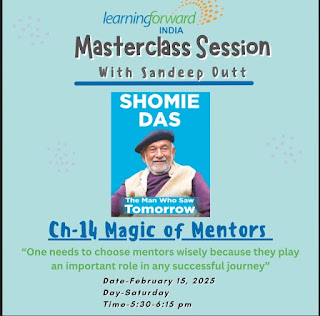
Chapter 14: Magic of Mentors: A Man Who Saw Tomorrow by Naga
The saying that we are the average of the five people we spend the most time with highlights how important our environment and the people around us are. Choosing mentors wisely can have a profound impact, as they shape our mindset, skills, and even our values. Have you had any mentors who’ve made a big difference in your life?
Q1. Mentors play a crucial role in shaping one’s journey to
success. Reflecting on your experiences, have you had a mentor who guided
you during your student life? What qualities do you believe are essential for
an effective mentor?
Q2. As an educator, you interact with students who may not
always recognise their strengths. How do you identify their hidden
potential and provide the proper guidance to help them grow?
Q3. If you had a magic wand to inspire, guide, and unlock
the hidden potential of your students, what would your magic mantra be? How
would you apply it to create a lasting impact on their learning and personal
growth?
Q4. Mentorship goes beyond guidance; it fosters a culture of trust and inspiration. How can you foster a classroom
environment where students feel encouraged to seek and offer mentorship among
peers?
Session Recording
Wednesday, January 15, 2025
Smile Vs. Frown - Sunbeam School Varuna
Founder of Good Schools Alliance, author, educator, and adventurer empowering children to discover the magic of literature.
Friday, December 20, 2024
Fear Vs Courage - Mizan Ali
Fear vs. Courage highlights two contrasting yet interconnected emotions. Fear is like when your heart races, your palms get sweaty, or you feel shaky before doing something that scares you. Fear can impact a person’s life in both positive and negative ways.
Negative:
1. Physical Health leads to chronic stress, high B.P., sleep deprivations, tension, fatigue
2. Anxiety and Depression decrease self-esteem, panic situation
3. Fear can lead to avoiding situations or activities
Positive:
1. It increases awareness, can sharpen focus, and helps people to stay alert.
2. Fear is a natural, subjective feeling; there is no place for objectivity in it. Everyone has this feeling at some point in life.
Courage can be used to handle fear. People believe that courage is the absence of fear. But I think that courage is not the absence of fear; rather, it is the ability to deal with it.
Courageous people do feel fear, but they can manage it. Courage is the willingness to act despite fear.
Finally, fear is normal, but courage is what helps us grow.
Mizan AliSunbeam School Indiranagar
Thursday, December 19, 2024
Smile Vs Frowns- Sunbeam School Indiranagar
"Frowns create wrinkles; smiles create memories"

To understand your thoughts in more detail, I would like to highlight a few points:
Introverted students: A teacher's smile can act as a motivation for introverted students. It boosts their confidence and encourages them to speak up.
Open atmosphere: When a teacher is stress-free and listens to students'; ideas with an open heart, students also speak up without any fear. This creates an atmosphere where students can think and express themselves freely.
Teacher's mood: ki Children are very sensitive and they easily understand the mood of people around them. A teacher's mood directly affects students' learning and development.
Effect of stress: When a teacher is stressed, students become indecisive and are afraid to speak up. This weakens their confidence and disrupts the learning process.
Positive impact: A teacher's smile fills students with positive energy and motivates them to learn. It also helps in building a strong bond between students and teacher.
Conclusion:
A teacher's smile is not only an academic tool but also a powerful social tool. It plays a vital role in the personality development of students and motivates them to become successful individuals.
Listen to our PODCAST here:
Shalini Tiwari
Chandrani Singh
Shilpi Chakraborty
Vijeta Wilson
Sunbeam School Indiranagar Varanasi
Chandrani Singh
Shilpi Chakraborty
Vijeta Wilson
Sunbeam School Indiranagar Varanasi
Saturday, November 30, 2024
Reflections: Masterclass - Saturday 30th November 2024

Chapter 3: Not Another Brick In The Wall
Quick recap
The meeting focused on discussing the structure of an upcoming book, welcoming new team members, and exploring educational philosophies centred on student-centric approaches and the importance of reflection. The team delved into the teachings of renowned educator Shomie Das, emphasizing the significance of creating nurturing environments for students and the role of effective school leadership. They also discussed communication strategies, including using WhatsApp groups and social media for learning opportunities, and planned to share chapter summaries on www.HappyTeacher.in to encourage engagement and reflection.
Next steps
Here are the essential action items from the meeting:
Gurdeep will prepare reflection questions for the chapter and send them to Sandeep Dutt.
Sandeep Dutt will write a chapter summary and post it on happyteacher.in.
If teachers missed the session or didn't have the book, they should read the chapter summary on "Happy Teacher."
Teachers are to send reflections on the chapter after reading the summary.
Teachers are to share relevant pictures related to the chapter topic in the WhatsApp group for discussion.
Teachers should focus on interactions and conversations in the WhatsApp group rather than just sharing greetings.
Summary
Book Structure, Reflection, and AI
In the meeting, Sandeep Dutt and Gurdeep discussed the upcoming book and its structure, focusing on the importance of reflection and AI. They also discussed the need for bilingual conversations to accommodate participants from different regions. Sandeep Dutt introduced Minakshi, who will manage the Afzal Khan Foundation and the Arthur Foot Academy. We need to focus on the teacher's blog and then proceed to read the book, intending to complete a chapter. We discussed the use of WhatsApp for community structure and the transition from Telegram.
New Members and School Partnerships
Sandeep Dutt welcomed new members to the team, including Sneha Singh from Sunbeam Bhagwanpur, Minakshi Prasad from Arthur Foot Academy, and Jugiv Singh. Sandeep expressed the team's commitment to the philosophy of inclusion and the goal of improving partnerships with schools. He also mentioned a forthcoming visit to Sun City and Shangrila, where he will host a school function. The team also welcomed Sunbeam School Sarnath to the group.
Treehouse in Education: Reflections and Philosophy
In the meeting, Gurdeep discussed the last chapter's reflections, focusing on whether education should be student-centric or teacher-centric and the need for a treehouse in education. He shared his thoughts on how a treehouse could provide a magical space for holistic development, including physical, cognitive, and emotional growth. Sandeep Dutt then read a comment from Suman about the importance of a treehouse in education, emphasizing its role in fostering a special bond between students and nature. The team then discussed the chapter, with Jugjiv reading from it and highlighting the importance of the child being at the centre of education, a philosophy that Shomie, the distinguished gentleman they were discussing, firmly believed in.
Shomie Das' Educational Philosophy Discussed
Jugjiv discussed the educational philosophy of Shomie Das, a renowned educator. Shomie believed in each child's comfort and individuality, centring his approach around these principles. He rejected traditional methods of discipline, such as humiliation, and instead focused on creating a safe and nurturing environment for students. Shomie's recruitment criteria for teachers also reflected his emphasis on the importance of character and genuine concern for students. He believed that a teacher's role was not just to impart knowledge but to create good citizens.
Student-Centric Teaching and Leadership
Sandeep Dutt and Jugjiv discussed the importance of student-centric teaching and leadership. Sandeep shared the story of Shomie Das, who grew from a teacher to a headmaster in three places, emphasizing the difference between teaching in a classroom and leading a school. He also highlighted the importance of a teacher's ability to see potential in students, using examples of former students who succeeded in their careers. Jugjiv agreed with Sandeep's points and suggested some edits to the text.
Principal's Role in Child-Centered Environment
Sandeep Dutt discussed the importance of appointing a principal who is well-versed in their subject and has a good reputation in the classroom. He emphasized the need for a child-centred environment where the principal can make time for children and create a nurturing atmosphere. Sandeep also highlighted the significance of the principal's involvement in the school's daily activities, such as playing games with children and ensuring their safety. He shared an example of a principal who adopted a rickshaw as his desk to move around the school and interact with children. Sandeep also discussed the importance of separating administrative responsibilities from academic delivery and how the principal should ensure the school's safety and cleanliness. He concluded by emphasizing that a good administrator should be present at the school gate to ensure children's safety and well-being.
Sandeep's Experiences With Shomie
Sandeep Dutt shared his experiences and insights about his time under the mentorship of Shomi, also known as Captain Bajaj. He highlighted the importance of experiential learning, connecting with children outside the classroom, and the significance of outdoor activities for children. He also shared a story about a challenging trek experience with Shomi, emphasizing the importance of leadership, decision-making, and maintaining morale under pressure. The group agreed to continue the discussion, with only a few pages left in the book.
Shomie Das's Education Impact and Legacy
Sandeep Dutt discussed the significant role of Shomie Das in developing high-quality and globally comparable schools. He praised Shomi's unique balance of traditional values, forward-thinking approach, and commitment to creating a safe learning environment. Sandeep also mentioned Shomi's induction into the Hall of Fame of Indian Education and his receipt of the Education World Lifetime Achievement in Education Leadership Award. The team decided to post a summary of each chapter on Happy Teacher.in, rather than asking questions, to encourage reflection and engagement. They also considered sharing pictures related to the chapter for further discussion.
Enhancing Communication With Whatsapp Groups
Sandeep Dutt and Gurdeep discussed using WhatsApp groups to communicate and share information. They agreed that the WhatsApp group should be a platform for conversations and sharing and be used more frequently. Sandeep also highlighted the importance of social media in learning opportunities and encouraged the use of technology for learning. The conversation ended with Sandeep promising to post details on a link to happyteacher.in blog in the next half an hour.
AI-generated content may be inaccurate or misleading. Always check for accuracy.
Founder of Good Schools Alliance, author, educator, and adventurer empowering children to discover the magic of literature.
Subscribe to:
Posts (Atom)