Showing posts with label potential. Show all posts

Wednesday, February 19, 2025

Masterclass 2024 Feedback: "Wanted: Backbencher & Last Ranker Teacher"- Roza Khan

The session was an eye-opening and inspiring discussion that challenged conventional academic norms. It effectively highlighted how backbenchers and last-rankers—often underestimated in traditional education—can bring unique perspectives, creativity, and problem-solving skills to the real world.

Key Takeaways:

Beyond Academics: The session emphasized that grades do not define intelligence, potential, or future success. Many successful individuals have struggled academically but excelled in unconventional ways.

Creativity & Innovation: Often, those who do not conform to rigid educational structures develop out-of-the-box thinking, leading to ground-breaking innovations and entrepreneurship.

Resilience & Adaptability: Many backbenchers and last-rankers cultivate resilience through failures and setbacks, equipping them with a strong problem-solving mindset crucial for real-world challenges.

The Role of Educators: The discussion underscored the importance of teachers recognizing and nurturing different kinds of intelligence rather than solely focusing on academic performance.

Inspiring Success Stories: Real-life examples of individuals who defied academic odds to achieve greatness made the session relatable and motivating.

Roza Khan
Sunbeam School

Saturday, February 15, 2025

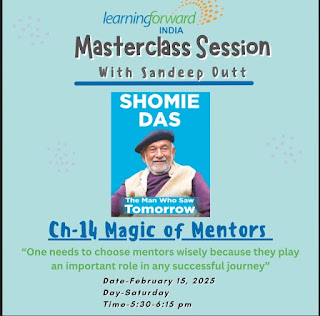
Magic of Mentors: Masterclass Saturday February 15 2025


Chapter 14: Magic of Mentors: A Man Who Saw Tomorrow by Naga 

The saying that we are the average of the five people we spend the most time with highlights how important our environment and the people around us are. Choosing mentors wisely can have a profound impact, as they shape our mindset, skills, and even our values. Have you had any mentors who’ve made a big difference in your life?

Q1. Mentors play a crucial role in shaping one’s journey to success. Reflecting on your experiences, have you had a mentor who guided you during your student life? What qualities do you believe are essential for an effective mentor?

Q2. As an educator, you interact with students who may not always recognise their strengths. How do you identify their hidden potential and provide the proper guidance to help them grow?

Q3. If you had a magic wand to inspire, guide, and unlock the hidden potential of your students, what would your magic mantra be? How would you apply it to create a lasting impact on their learning and personal growth?

Q4. Mentorship goes beyond guidance; it fosters a culture of trust and inspiration. How can you foster a classroom environment where students feel encouraged to seek and offer mentorship among peers?

Session Recording

Thursday, December 28, 2023

Freedom & Peace- Prakriti RPKM

Freedom and Peace  

Part A  

Freedom sets us free from the shackles of being controlled by others and lets us think and act according to our will. There are some instances where I remember that as a student more freedom would have helped me to achieve my goals efficiently and realize my potential in a better way. 

First, the academic pattern in my school was very stiff and rigid, students were supposed to work in circles of that predetermined pattern only, and more freedom in that case would have led to making me a more confident person than I am today. Second, I believe that academics and exams are part of schooling, the whole schooling is not based on these two.

There are other aspects as well that were neglected when I was a student. Children were not free to share their feelings, fears and emotions with the teachers as more emphasis was on performing better in class. So if I had this freedom to be transparent with my teachers or if I had emotionally available teachers, today I would not feel the need to heal my inner child while dealing with the ups and downs of life. 

Third, favouritism and partiality were something that faded out the shine of many. Equal chance to speak out and freedom of participation in discussions and class activities were absent due to which till a certain age I was doubtful and unconscious about my potential. 

Today I understand these things better and I have built myself way stronger and confident so I do not feel or face such circumstances as much. And I try my best not to repeat such blunders with my students. 

Part B

What is it about human behaviour, according to you, that causes people to give up peace and adopt violence? How do you think the classroom can be used to shape peace-loving individuals? 

People give up peace and adopt violence because of multiple reasons. 

1. To talk about a few, the first reason is a lack of patience in people that leads to a lack of tolerance and in turn they move towards the wrong path of violence and harsh behaviour and in turn, they lose their own peace.  

2. The second reason would be a lack of basic necessities of life. It happens that people are not able to earn and get proper resources that are needed to survive due to lack of a proper job (occupation)/ lack of money and there can be a variety of reasons for the same. 

In this scenario, they are forced to adopt the wrong path of snatching or taking things forcibly from others which leads to violence. Such acts don’t help an individual for long and the results are grave. 

3. Lack of proper guidance and education - When people or individuals are uneducated and don’t have proper guidance, they are clueless and shortcuts seem to be the easy way out rather than studying and earning their bread. 

4. One reason might be inheritance or they have seen such behaviour or activities in their family. In particular, youngsters learn and imitate their elders and are quite vulnerable to being attracted by wrong actions. 

The classroom is the best and first place after home to inculcate basic qualities in an individual like patience, honesty, helpful behaviour, compassion etc. In this regard, what the students need to learn is Patience. Patience is the key to being at peace and satisfied in life. Activities can be conducted in class, teaching a child how to be patient. 

If you are not getting something you have to try patiently, keep working towards it and don’t start panicking and complaining.  

We have to teach our students that life is not a piece of cake and we don’t get everything easily. The importance of Hard work and consistency has to be taught and inculcated in the students. 

Firm belief in God- The superpower is one of the integral ways to stay calm and at peace. We have to teach our students that we have to believe in destiny and that things will fall our way with the right efforts and at the right time. We can only get something before the destined time and more than what we deserve.


Prakriti @ RPK Moradabad

Naushaba, Isha, Suman Singh, Naina Soni, Rekha Kapoor, Siddhi, Dheeraj


Monday, June 19, 2023

Power of Enterprise - Readiness to Explore - Dipty Ahuja

As a commerce postgraduate, the Power of enterprise means the power of running a legal entity possessing the right to conduct business on its own, keeping supply-demand in that area, input-output, SWOT analysis, and Profit-Loss in consideration.

However, from the session with Bhairavi Ma’am, I could understand that everybody has the ‘Power of Enterprise’ skills. We need to discover those skills in ourselves and use them as an opportunity to better ourselves and the people around us.

The power of enterprise can be done by setting up a new idea and acting on that idea effectively or by using your enterprise skills in your existing work life. In teaching, I always try to keep myself upgraded as per the demand of today’s era. Especially when one can get an abundance of information with a click.

As a Pre-primary teacher, how best I can adapt and bring new innovative ideas to inculcate holistic values in their formative years of life. Along with new ideas, readiness to adapt to any recent changes required, risk executing it better with lots of logical approaches and keeping a check on the results simultaneously. When we know both parents are working, it becomes our responsibility as a part of an educational institution to work on their discipline, the habit of learning and willingness to try new things, help develop their creativity and curiosity, focus and belief in themselves.

In Gyanshree School, even at the Pre-nursery level, we plan many activities where kids are asked to choose, think critically, and reflect afterwards. One of our favourite preschool critical thinking activities often includes an outdoor picnic. We give our Shreeyans a lunch box to pack and suggest relevant and irrelevant items to a picnic, and we let them tell us which items are suitable and why, Shape Hunt games etc.

With Pahale India, I understood that everybody needs to collaborate as a team to achieve a common goal or overall development. In this scenario, after identifying the problem or target to achieve, we should use our individual potential, which includes not only teaching staff but students who should also be involved, which will, in return, make them responsible. They will feel part of it in the path of accomplishment of their success goals. The light of the ray might be from educators, but the goal achievement would be in collaboration. Everyone can think differently with their experience and skills, which might help solve glitches. Furthermore, involving children in a part of it will allow them to use their minds logically and critically, which can be an opportunity for their future decisions.

To conclude, with the above brief description, we could develop a power of enterprise with constant learning to adapt to all changes required with motivation & passion, critical thinking & logical reasoning with the view of the final goal to achieve in mind in our Shreeyans and amongst of all.

Dipty Ahuja
Gyanshree School

Wednesday, March 1, 2023

Quality and Love - Nitin Sharma


Quality:

"Inclusive, good quality education is the foundation for dynamic and equitable Societies."   

                                                                                                                                  -Desmond Tutu

Quality education provides the foundation for equity in society. Quality education enables people to develop all their attributes and skills to achieve their potential as human beings and community members.

Good quality education is essential for gaining the best knowledge and developing modernization in society. The country's future depends on a quality education provided in every school, which plays a significant role in student education.

Through quality education, individuals can seek better job opportunities, progress with sustainable livelihoods, and have a healthy lifestyle. Best-delivered education spurs innovative minds.

In our school, we practice, preach and promote the 17 Sustainable Development Goals and the goal of the main focus, along with all others, is SDG4, Quality Education, intending to provide quality education to all. Educators put in their best efforts to make that happen in the classrooms, and no stone is left unturned.

While teaching in the classrooms, we as educators come across different types of students. Some may be excellent at doing their homework and class work, while some may be the 'do-it-later' students. But the teacher has an equal eye for all. All the students are similar, and he/she cannot ignore those who aren't good in the academic aspect or the ones who lag in completing their tasks. To deal with such students, a lot of patience is required.

I'd like to add an instance of when I encountered a situation like this. Some students of a class I taught in the previous years fell into the example of 'never-completing-their-notebooks-on-time' students. It was a challenging task to get their notebooks and check them. Not completing their notebooks and tasks was one thing, but all of them were very active students.

One of them, Sartaj, was good at playing band and headed the school band, while another, Aarush, was an NCC cadet and was great at parade. They are very cooperative students, always ahead in taking any responsibility but the last in submitting their assignments. I was never strict and harsh on them but rather appreciated them for the qualities they had. Instead, we agreed on a deadline by which they would finally make submissions.

Love:

"Where there is love, there is life."

Love is the energy of life. Love has its many forms. A mother loves his child, a teacher loves his students, our love for Mother Nature, a soldier's love for his nation and various other forms. Without love, this life is not possible, and the true joy of life cannot be cherished.

Nowadays, many students somehow engage in similar activities at a very young age, such as meeting at hidden places or exchanging gifts with their young lovers.

Here, I would like to share about two students From IX and XI. Avni and Sagar. They used to meet each other on the stairs or during school recess. Our school counsellor was requested to please counsel these students; she talked so well. Even the class teacher and coordinator tried to make them understand their age was inappropriate. Your aim should be to study and achieve your goal. Later on, you can think about it, and after some friendly sessions with the teacher, they were not seen again at the hidden places, and both started to do well in their studies.

~ Nitin Sharma, KNPS Phagwara

Friday, January 29, 2021

Responsibility commands Cooperation- Medley DGS

“Be Responsible” is something we all have been hearing since childhood. It is one of the first few expectations laid upon us from our parents. "at-least take responsibility of your stuff" “be responsible, you are not a kid anymore” and so on, yet it takes ages to understand the simple meaning of this word. 

This year, on Teacher’s day Facebook was full of lovely messages filled with gratitude from students all across the globe for their teacher’s right from primary school to college. One of the messages was, “What I am today is because of my teacher.” It filled me with awe and respect for my profession even more. Then, suddenly a thought struck me and scared me to the core. What about the ones who are in jails, criminals who never got caught, the rapists and murderers, the corrupt bribe takers? Did none of them go to the school and if the answer is NO. Is it not true for them What I am today is because of my teacher”? 

When I asked this to myself, I understood the meaning of responsibility. To be responsible, means to take responsibility of your words, actions, behavior, thoughts and their consequences. That means, my responsibility is not limited to my work, but its result and how this result is impacting other lives. In this sense a teacher’s actual performance will be reflected not with the success of her students but with the development of the society as a whole. But what can I do all alone? This thought put me into a pause. Which got cleared when Sugandha shared her experience, that how one child of her class influenced others.


After hearing her I remembered the famous quote of Mahatma Gandhi “Be the change you wish to see in the world”. And now I know that I just need to take the responsibility and will eventually get cooperation from others as Responsibility commands Cooperation. 

Anubhuti has beautifully captured this video which speaks for itself.

We all have our own stories of this understanding and insight, Kirti had her realization during lockdown when she thought, “it’s a matter of one or two months and after that everything will be okay then I'll be back to the school and will resume the teaching the way I was doing it before.” But when the situation became grave then she took the responsibility of teaching her students through online classes. Which initially was very difficult for her but slowly and gradually with the cooperation from everyone she handled the situation, even the kids became her support system as they too cooperated and enjoyed this new system of learning, now it's been a year that she is able to take the classes efficiently and effectively.

Rudrani realized her full potential when she took the responsibility of looking after foreign delegates during her university seminar. Overcoming her nervousness and under confidence, she not only fulfilled her responsibilities but also enjoyed doing that, and she got support and appreciation from everyone.  

Chandralekha in one of her science class divided the class into four groups and asked each group to prepare a quiz for the other three groups. This exercise became such fun among kids; they not only referred their books but also searched the internet to be creative and innovative with their questions. All the group members cooperated and came up with amazing questions. What a beautiful depiction of responsibility and cooperation shown by young children.

In Mamta’s words:-

जब व्यक्ति किसी कार्य की जिम्मेदारी ले लेता है,

तो वह अपनी उन्नति का मार्ग प्रशस्त कर लेता है।

...किंतु जब हम उत्तरदायित्व लेने में आनाकानी करते हैं,

 तो हम बस दोषारोपण तक ही सीमित रह जाते हैं


सहयोग उत्तरदायित्व हाथ में हाथ डाले चलती है ,

इन दोनों से ही समाज को प्रगति मिलती है।

यदि हम, अध्यापक निष्क्रिय होकर बैठ जाएंगे!

तो आने वाली पीढ़ी को कैसे सद्मार्ग  पर ला पाएंगे!!

Proud to be Educators From Medley DGS at The Doon Girls' School - Anubhuti Sharma, Chandralekha Negi, Kirti Bisht, Mamta Kandpal, Neelam Waldia, Rudrani Ray and Sugandha Ahluwalia.

Monday, July 6, 2020

Humility and Appreciation - Swabhi Parmar

Humility is the quality of being humble and means putting the needs of another person before your own, and thinking of others before yourself. It also means not drawing attention to yourself, and it can mean acknowledging that you are not always right. Humility is often characterized as genuine gratitude and lack of arrogance, a modest view of one’s self. To be humble, we must have faith that God will lead us in the best way to live.  

In every aspect of life,  we should be humble to every living being on this planet. This attribute can make us stand different from others. We can have many examples of the people who had humble qualities in their lives and they stood different and they were loved by all. For example:- Mother Teresa, Mahatma Gandhi, Nelson Mandela and so on. You should have the ability to embrace humility in real life and this could only come to you when you appreciate the efforts of others. 

Both the values of humility and appreciation are interconnected to each other. Appreciation can do wonders. It can motivate a person to a great extent. It can make a person work to its full productivity as it is a fact that every person in the institution has enormous potential in different areas. Appreciation can be characterized by interest, attention, devotion and friendliness. A humble person gets maximum appreciation in life. 

Humility and appreciation go hand in hand. By getting proper appreciation, we feel like we are important in other people’s lives. We all need to be noticed and valued. Appreciation is the core of every healthy relationship and Humility is self-awareness and empathy and these things are in short supply these days but if we have them then they are truly helpful. So we should be humble and appreciate every one. We should try and appreciate small acts of kindness. We should inculcate good values in us before we expect it from others. This is the key to real happiness.

Swabhi Parmar
The Fabindia School
spr@fabindiaschools.in

Thursday, June 18, 2020

Thoughtfulness & Understanding - Penta BHIS


Rediscovering Values
"Too often we underestimate the power of a touch, A smile, a kind word, a listening ear, an honest compliment, or the smallest act of caring, all of which have the potential to turn a life around" ——Leo Buscaglia

Everyday life around us is filled with actions - some momentous, a lot barely noticeable.  As we watch life go by, we understand and value the little, often subtle, actions that punctuate our days. This is an attempt to acknowledge and appreciate others' thoughtfulness.


Please listen to our podcast, prepared with thoughtfulness and understanding!

Penta @ Billabong InternationalHigh School, Thane
- Jeeji Sanjeev, Sanika Joshi, Arpita M.G., Muskaan Menda, Radhika Anand, Supriya Naravankar & Bhavani Swamy.

Wednesday, April 1, 2020

Role Modeling - Kusum Sharma


Role model is a person who has a positive influence and inspired you to be like him. Having a role model in our life is very important. Positive role model influences our true potential and we overcome our weaknesses. A role model shows young people how to live with integrity hope and determination and even they play an essential part in a child’s positive development.

It is very difficult to become a role model of a person because for this a person has to do the right things and to be patient  along with this there are many qualities like confidence, leadership, showing respect and concern for others are required for a role model.

We all want our children to do well or do better than us and for this, they need to see and hear us being the best version of our self as much as possible.
Kusum Sharma
ksa4fab@gmail.com
The Fabindia School, Bali

Blog Archive