Showing posts with label goal. Show all posts

Saturday, February 21, 2026

Reflective Teaching and Relationship Building

Learning Forward Saturday

To define the qualities of an ideal teacher and assign a creative reflection task.

Key Takeaways

  • The Task: Create a teacher-hiring ad based on the unconventional one in Wanted Back-bencher & Last-ranker Teacher. The ad must reflect your personal qualities and include a graphic.

  • The Goal: Shift from passive “note-taking” (session summaries) to active “reflection” (personal application and insight), which is the core of the 3R methodology (Reading, Reflection, Relationships).

  • The Deadline: Submit ads to Manisha via email by February 28. The goal is 50 blog submissions.

  • The Rationale: This exercise directly supports the National Curriculum Framework (NCF) 2022’s focus on application-based learning, ensuring teachers remain relevant in a changing educational landscape.

Topics

The Problem: Passive Engagement

  • The 3R methodology (Reading, Reflection, Relationships) was not being fully utilised.

  • Most “reflections” were passive session summaries (“note-taking”), not deep personal application.

  • This contrasts with the deeper reflections from special projects like Arthur Foot Academy and Sunbeam Grameen School.

  • Why it matters: The program’s purpose is to help teachers improve, not just deliver content. This requires active engagement.

The Solution: Active Reflection

  • The session clarified the difference between note-taking and reflection.

    • Note-taking: Recording facts and concepts.

    • Reflection: Processing, interpreting, and applying knowledge to one’s own practice.

  • A strong reflection example from Sunita Tripathi was shared, demonstrating the desired depth by connecting session insights to personal teaching methods.

  • Why it matters: This shift is critical for implementing the NCF 2022, which emphasises application-based learning. Teachers must model this to avoid redundancy.

The Application: Hiring the Ideal Teacher

  • The discussion centred on the unconventional teacher ad from “Wanted Back-bencher & Last-tanker Teacher,” which sought qualities such as “superior adaptability,” “guts,” and a “shock-proof temperament.”

  • Why it matters: This ad provides a concrete example of thinking beyond traditional CVs to hire for character and relational skills, which the book’s protagonist, Roma, exemplifies.

Next Steps

  • All Participants:

    • Draft a teacher-hiring ad highlighting your personal qualities.

    • Include ad text and a graphic (use AI or other tools if needed).

    • Email the ad to Manisha by February 28.

  • Sandeep & Brinda:

    • Review submitted ads in the next session to close out the month’s theme.

    • Prepare for March’s theme, which will cover the new teacher’s first classroom experience.

Saturday, February 7, 2026

Why We Return to Teachers


Masterclass with Sandeep Dutt

To introduce the book The Courage to be Happy by Ishiro Kishimi and Fumitake Koga, and its core themes.

Key Takeaways

  • New Book Study: The group is starting The Courage to be Happy, the sequel to The Courage to be Disliked, to explore Alfred Adler’s psychology of happiness.

  • Book’s Premise: The book opens with a teacher (Harshita) who, after three years, is disillusioned with Adler’s ideas, finding them impractical in the real world.

  • Core Conflict: The teacher’s main struggle is with Adler’s “no praise, no rebuke” principle, which she feels led to an unruly class and forced her to revert to traditional discipline.

  • Central Theme: The philosopher’s response is that the teacher’s problem stems from a misunderstanding of Adler’s concept of “love,” which is presented as the ultimate test of courage.

Topics

Book Introduction: The Courage to be Happy

  • Context: The sequel to The Courage to be Disliked, this book continues the dialogue between a Philosopher (Sandeep Dutt) and a Youth (Harshita Dalawat).

  • Goal: To find “true contentment” by exploring Adler’s psychology, which the book’s authors claim was 100 years ahead of its time.

  • Key Adlerian Concepts from Book 1:

    • All problems are interpersonal.

    • Freedom is being disliked.

    • Happiness is a choice in the “here and now.”

The Teacher’s Dilemma

  • The Youth (Harshita): Now a teacher, she is disillusioned with Adler’s ideas after three years of trying to apply them in a classroom.

  • Core Problem: The “no praise, no rebuke” principle, which she followed faithfully, resulted in an “unruly class.”

  • Result: She felt forced to abandon Adler’s methods and revert to traditional discipline (rebuke, punishment), viewing Adler’s philosophy as “quackery” and “empty idealism.”

The Philosopher’s Response

  • Adler’s Ideas as a Prescription: The philosopher compares Adler’s ideas to “eyeglass lenses”—a tool that can broaden vision for some but may not be a universal fit.

  • The “Stairway of Understanding”: The philosopher argues that the teacher has not yet found the correct path to understanding Adler.

  • The “Biggest Choice in Life”: The philosopher identifies the teacher’s core issue as a failure to make this choice, which is defined as “love.”

    • Adler’s “Love”: Not a simple emotion, but “the harshest and most courage-testing task of all.”

    • Happiness as a Journey: It requires continuous effort, not a magical, one-time event.

Discussion: Why We Return to Teachers

  • Initial Responses: Participants cited reasons like clearing doubts, seeking advice, or sharing success.

  • Philosopher’s Correction: These are secondary reasons. The primary, unspoken motivation is “love.”

    • Rationale: Love is the pure, powerful bond that attracts students to a true teacher, distinguishing it from a transactional relationship with a tutor.

    • Connection to Adler: This bond of love is the fundamental principle of Adler’s philosophy.

Next Steps

  • All Participants:

    • Read The Courage to be Happy for the next session.

    • Reflect on the concept of “love” in the teacher-student relationship.

  • Diana L Kahmei:

    • Recruit a teacher to join the Masterclass.

  • Minakshi Prasad:

    • Confirm Sunday meeting details with Vikram.

Saturday, January 17, 2026

Ecological Wisdom and Its Application in the Classroom

Learning Forward Saturday and the Wisdom Mandli with Project FUEL

To explore ecological wisdom and its application in the classroom.

Key Takeaways

  • Wisdom is "passed around," not "passed down." Insights come from all ages and experiences, not just seniors or experts.

  • Project FUEL collects ecological wisdom from everyday life (e.g., cooking, gardening) to create lesson plans that strengthen children's connection to nature.

  • A breakout room activity failed due to technical issues and participant confusion, prompting a shift to a main-room discussion.

  • Teachers are assigned homework: collect 2–3 ecological life lessons from their students and post their own lesson on a shared platform.

Topics

Project Fuel's Philosophy: Wisdom is "Passed Around"

  • Project Fuel (PF) collects life lessons from people of all ages and backgrounds.

  • Core Belief: Wisdom is "passed around," meaning valuable insights come from anyone, not just seniors or experts.

  • Goal: Use these real-world lessons to create classroom materials that make the world a "classroom."

Initiative: Collecting Ecological Wisdom

  • PF's current focus is collecting "Paryawranian Wisdom"—ecological insights from daily life.

  • Rationale: To counter children's growing disconnection from nature, which is caused by urban living and convenient services like food delivery apps.

  • Goal: Collect one million ecological lessons from women to build a resource that strengthens children's relationship with nature.

Activity: Ecological Wisdom Flashcards

  • Objective: Share personal ecological experiences using prompt cards.

  • Execution: A breakout room activity failed due to technical issues and participant confusion.

  • Pivot: The session shifted to a main-room discussion of the prompts.

  • Key Insights Shared:

    • Kitchen: A space for creativity, family connection, and stress relief.

    • Stars: A source of wonder and a reminder of childhood memories.

    • Flowers: A metaphor for the life cycle (growth, bloom, fade).

Application: Bringing Wisdom to the Classroom

  • Challenge: How to teach ecological wisdom beyond textbooks.

  • Ideas Generated:

    • Storytelling: Create narratives from nature's perspective (e.g., a flower's autobiography, a mountain's history).

    • Hands-on Experience: Involve children directly with nature to build empathy.

    • Rituals: Connect daily life to nature (e.g., enjoying the first rain after summer).

Next Steps

  • Teachers:

    • Collect 2–3 ecological life lessons from students.

    • Post one personal ecological lesson on the shared platform (link to be sent via WhatsApp).

  • Project Fuel:

    • Share the link and instructions for the ecological lesson platform on the WhatsApp group.

  • All:

    • Reconvene on January 24th to review the lessons learned and brainstorm classroom activities.

      Notes: Courtesy FATHOM AI

Thursday, December 28, 2023

Freedom & Peace- Prakriti RPKM

Freedom and Peace  

Part A  

Freedom sets us free from the shackles of being controlled by others and lets us think and act according to our will. There are some instances where I remember that as a student more freedom would have helped me to achieve my goals efficiently and realize my potential in a better way. 

First, the academic pattern in my school was very stiff and rigid, students were supposed to work in circles of that predetermined pattern only, and more freedom in that case would have led to making me a more confident person than I am today. Second, I believe that academics and exams are part of schooling, the whole schooling is not based on these two.

There are other aspects as well that were neglected when I was a student. Children were not free to share their feelings, fears and emotions with the teachers as more emphasis was on performing better in class. So if I had this freedom to be transparent with my teachers or if I had emotionally available teachers, today I would not feel the need to heal my inner child while dealing with the ups and downs of life. 

Third, favouritism and partiality were something that faded out the shine of many. Equal chance to speak out and freedom of participation in discussions and class activities were absent due to which till a certain age I was doubtful and unconscious about my potential. 

Today I understand these things better and I have built myself way stronger and confident so I do not feel or face such circumstances as much. And I try my best not to repeat such blunders with my students. 

Part B

What is it about human behaviour, according to you, that causes people to give up peace and adopt violence? How do you think the classroom can be used to shape peace-loving individuals? 

People give up peace and adopt violence because of multiple reasons. 

1. To talk about a few, the first reason is a lack of patience in people that leads to a lack of tolerance and in turn they move towards the wrong path of violence and harsh behaviour and in turn, they lose their own peace.  

2. The second reason would be a lack of basic necessities of life. It happens that people are not able to earn and get proper resources that are needed to survive due to lack of a proper job (occupation)/ lack of money and there can be a variety of reasons for the same. 

In this scenario, they are forced to adopt the wrong path of snatching or taking things forcibly from others which leads to violence. Such acts don’t help an individual for long and the results are grave. 

3. Lack of proper guidance and education - When people or individuals are uneducated and don’t have proper guidance, they are clueless and shortcuts seem to be the easy way out rather than studying and earning their bread. 

4. One reason might be inheritance or they have seen such behaviour or activities in their family. In particular, youngsters learn and imitate their elders and are quite vulnerable to being attracted by wrong actions. 

The classroom is the best and first place after home to inculcate basic qualities in an individual like patience, honesty, helpful behaviour, compassion etc. In this regard, what the students need to learn is Patience. Patience is the key to being at peace and satisfied in life. Activities can be conducted in class, teaching a child how to be patient. 

If you are not getting something you have to try patiently, keep working towards it and don’t start panicking and complaining.  

We have to teach our students that life is not a piece of cake and we don’t get everything easily. The importance of Hard work and consistency has to be taught and inculcated in the students. 

Firm belief in God- The superpower is one of the integral ways to stay calm and at peace. We have to teach our students that we have to believe in destiny and that things will fall our way with the right efforts and at the right time. We can only get something before the destined time and more than what we deserve.


Prakriti @ RPK Moradabad

Naushaba, Isha, Suman Singh, Naina Soni, Rekha Kapoor, Siddhi, Dheeraj


Saturday, September 10, 2022

Courage and Patience - Guneet Kaur


Courage
means facing one's fears. It is essential in all spheres of life and leads to a change in oneself, making one stronger. Sometimes one has to get out of one's comfort zone and adjust to a new environment. This, too, is courage. Being honest and believing in one's honesty is also courageous.

Teachers are like mirrors for their students. The students tend to imbibe whatever a teacher speaks through his or her words or actions. Not pretending and being oneself is also courage. A teacher must teach students to accept and be proud of themselves regardless of their weaknesses. They should be cherished for who they are and given the space where they can be more aware of themselves. In no situation should they be afraid or ashamed of accepting the truth about themselves or sharing it with others. Seeking help and shunning one's ego is also courage.  


As teachers, we must ensure that the children feel safe with us. They should be able to have faith in us. Simultaneously, they should learn to believe in themselves. A child asking his or her doubt in class, saying, "I didn't understand", in front of the other classmates, is courage.

Teachers need to be there for the students, make them feel safe and teach them to solve their problems themselves. This way, they will be prepared to bravely face life's challenges. However, if the learners make mistakes in solving their issues, their teachers shouldn't punish them. Instead, as adults, they should stand with them and show them the right path.


Courage also reflects in sharing one's experiences with colleagues or children of how one dealt with a situation. This can also help in inspiring them and getting over their fears. Being silently supportive of our co-workers is also courageous.


Patience is being tolerant and calm in handling situations. It means not getting anxious or annoyed too quickly. It does require a lot of courage to be patient. Not complaining, having a positive attitude, and giving time and space to others all come in the arena of patience.


Patience teaches us to have faith and hope that things will get better. Working with patience leads to growth. On the other hand, losing patience can ruin the task at hand. Most of us end up giving up our patience because of the pressure from society, peers, friends or family. However, if we have the courage and the belief in ourselves, we will not lose our cool, take a stand for ourselves and help to bring about a change.

Inaction should not be misunderstood for patience. Moving towards our goal with perseverance and a peaceful mind, accepting failures as stepping stones to success, and having the will to start all over again with the belief that the result will be favourable is patience.    


The farmer protest in our country is the world's most non-violent and peaceful fight for human rights. The farmers had immense patience and courage that helped them to withstand all sorts of physical, emotional and mental atrocities. They did not get frustrated and were convinced that their voices would be heard one day. 


We often lose our patience when we think we are better than others or deserve much more than others. This attitude leads only to exasperation. Whenever this happens, we should take a step back and introspect. High expectations from ourselves or from others can make us impatient. However, patience helps to increase our power of endurance, persistence and better decision making.   


As teachers, we need to be role models of being patient with our students. Being a good and silent listener and helping the children cope with their worries and hassles will help them become more accepting, contented and forbearing. They will learn to shift their focus from a problem to possible solutions without complaining. This will also teach them to be emphatic.  

Guneet Kaur
Mussoorie Public School
Mussoorie 


Thursday, September 1, 2022

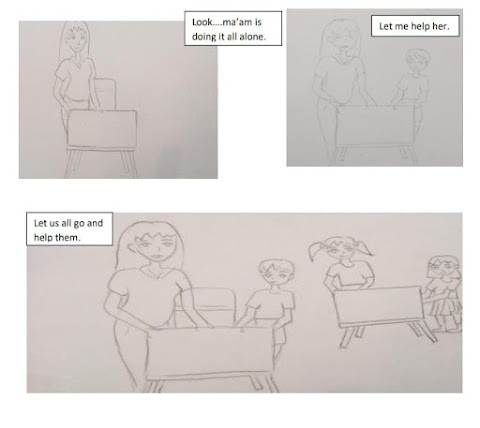
Responsibilty and Cooperation - Shalini Solanki

Responsibility is an essential value as it makes us more focused, goal-oriented, confident and accountable. One cannot succeed without having this quality. It makes a person sorted, away from chaos. Even in challenging situations, a responsible person knows how to stay calm and deal with them. They invest more time in finding solutions and fixing mistakes instead of blaming the time, situation and others. Responsible people motivate not only themselves but also everyone around them.

Making students responsible in school:
Students learn values not by reading, listening or talking about them but by experiencing an environment where they get to live them. Teachers are critical in every student’s life; their teachers are always right and know everything. 

I remember an instance in my class from this session. Children used to keep their other subject books/ notebooks every morning on my table in a very casual manner that would scatter the entire table (I sometimes had to remind them to keep the books on my table). I would then bifurcate them according to different subjects and keep them in the designated cupboards. My students observed for a few days and got an idea of being responsible for their own things. They gradually started keeping the books, not on my table but in the cupboard in the most organised manner without reminding them. Now, they clean their own table before each period or go out of the class for any activity. They saw, they learned.

Cooperation Culture:
Shalini Solanki
Gyanshree School
Happy Teachers JOL Cohort 2022

Blog Archive