Showing posts with label actions. Show all posts

Saturday, December 6, 2025

Learning Forward Saturday

Quick recap

The meeting focused on teaching English language skills to students through various classroom activities, including verb usage, silent letters, and interactive exercises. Brinda and Neelashi discussed plans for future teaching sessions and agreed to meet in Delhi to coordinate further activities. The group also covered teaching methods and classroom enhancements, emphasising the importance of creating engaging learning environments and proper English language instruction.

Next steps

  • Brinda and Neelashi: meet next week to plan future Saturday sessions
  • Brinda: show Neelashi around the school in Noida on a weekday, including the prep section and skilling academy
  • Sakshi: Share photos of classrooms with well-designed classroom libraries for the Learning Forward Saturday group
  • All teachers: create classroom library corners with age-appropriate children's stories and books
  • All teachers: Set up word walls in classrooms for vocabulary revision
  • Teachers: Use the Learning Forward Saturday group to ask questions and share lesson plans with each other

Summary

Teaching Plans and Collaboration Meeting

Brinda discussed plans to teach Damsharaz and related activities to students, focusing on verbs and adverbs. She and Neelashi agreed to meet in Delhi next week to plan further Saturday sessions and potentially visit the school in Noida. Brinda introduced Reena, the principal of Arthur Foot Academy, and other participants to the group. The conversation ended with a discussion on respecting each other and following guidelines for teaching practice.

Classroom Knitting Activity Session

The meeting focused on a classroom activity involving 11 participants, with Neelashi emphasising the importance of keeping cameras on during the session. Brinda guided participants through various activities, including knitting, and encouraged them to practice and perform simple tasks as guests. The discussion included instructions in Hindi and English, with participants engaging in activities like knitting and stitching, and Brinda requesting a repetition of the word "knitting" for clarification.

Silent Letters in the English Language

The group discussed silent letters in English, focusing on words such as "know" and "knowledge." Brinda explained how silent letters can change the pronunciation and meaning of words. The participants practised identifying and pronouncing silent letters in various words. The conversation concluded with Brinda encouraging the group to volunteer and take action, while also mentioning something about Rinajikari and Bhartikha.

English Verbs for Daily Actions

The meeting focused on teaching English verbs related to everyday actions. Brinda guided the participants through examples of verbs like "making roti," "rolling chapati," and "applying lipstick," emphasising correct usage and pronunciation. Participants practised using these verbs in sentences, with Brinda providing feedback and encouragement. The session aimed to improve English language skills by reinforcing verb usage and sentence structure.

Verbs and Adverbs Practice Session

The class practised identifying and using various verbs in context, with Brinda guiding students through actions like dancing, writing, and eating. Students were asked to remember the verbs they learned, which included knitting, making, dancing, cooking, writing, eating, closing/shutting, and applying makeup. Brinda explained the difference between adjectives and adverbs in describing actions, using examples like "cooking nicely" versus "cooking like an expert."

Enhancing Classroom Learning Techniques

The meeting focused on teaching methods and classroom activities, with Brinda and Neelashi discussing the importance of creating a library corner in classrooms and using interactive activities, such as guessing games, to enhance learning. They emphasised the need for teachers to revise key words and sounds in English, particularly through phonetic methods. They highlighted the correct use of capital letters for proper nouns and at the beginning of sentences. The session also covered creating word walls and the importance of teachers learning alongside their students to better understand phonetic sounds and teaching techniques.

AI can make mistakes. Review for accuracy.

Saturday, September 10, 2022

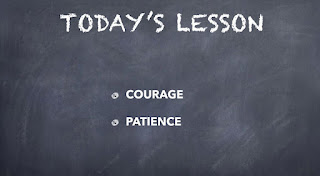
Courage and Patience - Guneet Kaur


Courage
means facing one's fears. It is essential in all spheres of life and leads to a change in oneself, making one stronger. Sometimes one has to get out of one's comfort zone and adjust to a new environment. This, too, is courage. Being honest and believing in one's honesty is also courageous.

Teachers are like mirrors for their students. The students tend to imbibe whatever a teacher speaks through his or her words or actions. Not pretending and being oneself is also courage. A teacher must teach students to accept and be proud of themselves regardless of their weaknesses. They should be cherished for who they are and given the space where they can be more aware of themselves. In no situation should they be afraid or ashamed of accepting the truth about themselves or sharing it with others. Seeking help and shunning one's ego is also courage.  


As teachers, we must ensure that the children feel safe with us. They should be able to have faith in us. Simultaneously, they should learn to believe in themselves. A child asking his or her doubt in class, saying, "I didn't understand", in front of the other classmates, is courage.

Teachers need to be there for the students, make them feel safe and teach them to solve their problems themselves. This way, they will be prepared to bravely face life's challenges. However, if the learners make mistakes in solving their issues, their teachers shouldn't punish them. Instead, as adults, they should stand with them and show them the right path.


Courage also reflects in sharing one's experiences with colleagues or children of how one dealt with a situation. This can also help in inspiring them and getting over their fears. Being silently supportive of our co-workers is also courageous.


Patience is being tolerant and calm in handling situations. It means not getting anxious or annoyed too quickly. It does require a lot of courage to be patient. Not complaining, having a positive attitude, and giving time and space to others all come in the arena of patience.


Patience teaches us to have faith and hope that things will get better. Working with patience leads to growth. On the other hand, losing patience can ruin the task at hand. Most of us end up giving up our patience because of the pressure from society, peers, friends or family. However, if we have the courage and the belief in ourselves, we will not lose our cool, take a stand for ourselves and help to bring about a change.

Inaction should not be misunderstood for patience. Moving towards our goal with perseverance and a peaceful mind, accepting failures as stepping stones to success, and having the will to start all over again with the belief that the result will be favourable is patience.    


The farmer protest in our country is the world's most non-violent and peaceful fight for human rights. The farmers had immense patience and courage that helped them to withstand all sorts of physical, emotional and mental atrocities. They did not get frustrated and were convinced that their voices would be heard one day. 


We often lose our patience when we think we are better than others or deserve much more than others. This attitude leads only to exasperation. Whenever this happens, we should take a step back and introspect. High expectations from ourselves or from others can make us impatient. However, patience helps to increase our power of endurance, persistence and better decision making.   


As teachers, we need to be role models of being patient with our students. Being a good and silent listener and helping the children cope with their worries and hassles will help them become more accepting, contented and forbearing. They will learn to shift their focus from a problem to possible solutions without complaining. This will also teach them to be emphatic.  

Guneet Kaur
Mussoorie Public School
Mussoorie 


Saturday, June 19, 2021

Emotions - Urvish Singh

When we talk about emotions, the first thing comes to our mind is what emotion is? Emotion is a strong feeling of anything such as love, anger, fear, etc.

Emotions play an important role in our lives; how we feel and react or behave, we feel emotions and take actions and influence decisions, these decisions can be big or small. Now let's understand how we feel emotions. 

Emotions are not a simple experience. Whenever we feel anything, our body releases chemicals and undergo certain physiological changes. As a result, we respond, and this response is the emotion that can be emotions of love, anger, or fear.

Urvish Singh
The Fabindia School
ush@fabindiaschools.in

Tuesday, June 30, 2020

Freedom and Peace - Bharti Rao

Freedom and Peace are the two values which go hand in hand. Freedom is the ability of
thoughts and actions to be executed without any unnecessary restrictions. Freedom helps us to blossom and grow positively. 

Freedom of thoughts and actions in classrooms creates a sense of responsibility and a peaceful environment. When we Educators plan engaging activities for our students and give the freedom to share their experiences the students also become active learners.

The students should be free to set their own rules and regulations for themselves so that with a sense of responsibility they will not break the decorum of the classroom. 
It has been observed that freedom builds up a strong relationship between the student and his teacher which gives better learning outcomes. It will remove the fear of their teachers from the students' mind which many children possess. Freedom enhances our thinking skills and becomes self-reliant.

We, teachers, are not there to create robots but instead, we have to groom the students to be decision-makers, self-reliant and good human beings which is only possible when we give them freedom. If you give freedom to the children they start respecting and trusting their teachers. It is the foremost duty of the Educators to inculcate these values in their students because school is the place where the child is nurtured into a good human being. 

By organizing activities like role-playing, storytelling, debate etc. we can inculcate these values in our students. I would like to end by quoting' Happiness, Freedom and Peace of Mind are always attained by giving them to someone else.'

Bharti Rao
The Fabindia School
bro@fabindiaschools.in

Sunday, June 7, 2020

Simplicity and Trust - Monika Vaishnav

We can see simplicity in many aspects of life like in our behaviour, thoughts, living style,
speech etc. According to me, simplicity means clarity of thoughts, clarity in explaining things, making things easier for people to understand something, transparency in behaviour, following simple living style by avoiding show off, showing your real personality without copying others, trying to sort out things in an easy way without making it complicated.

Simplicity brings peace to mind and happiness in our environment.  It makes us calm and helps us to avoid extra expenses which are not required at that time.  If we are clear with what we want to say and make it simpler for the people to understand, people will not only understand you but also have faith in you. It builds a direct connection between a speaker and a listener.  It is the first step to build trust in people for us. Being simple also makes our life easy and helps us to avoid things which are not necessary or have no moral values. 

Trust means having faith in someone. It is the feeling that gives confidence over someone. It is the feeling of being loyal to others.  It is the foundation of every relationship, without trust none of the relations could survive for a long time. We can't develop trust in someone, it is naturally developed when we do something honestly. It is the combination of our speech and actions. If we don't do what we promise to do, then people will lose trust in us. So we must be careful about what we speak and promise to do. If we talk about student, parents and teachers relationships, it is completely based on trust.  Simplicity develops an understanding between people and builds trust as well. 

- Monika Vaishnav
The Fabindia School
mvv@fabindiaschools.in

Tuesday, June 2, 2020

Simplicity and Trust - Shivani Rao

Simplicity is straightforwardness. It means to be the way you are. Being simple means avoiding complexity. Simplicity is an essential ingredient to build trust. Simplicity assists you in creating clear goals, focusing on your actions, and getting done. Today's generation is full of showoffs. It is important to involve the simplicity of thoughts in a kid's life. If you look around you will feel that society is very much affected by appearance. If you have a good appearance, you are appreciated in society.

We need to make our kids understand :
- that never judge on the basis of someone's appearance.
- never make someone uncomfortable if he /she is having a simple lifestyle.
- keep your goal/ work simply in order to achieve.
- while having conversation keep things simple to make people understand.

Trust is the foundation of any relationship. Trust must be shown & reciprocated from one person to another. Trusting someone refers to the acceptance of truth without any evidence.  In society, we are connected through relations and relations are developed on the basis of trust, respect, love & honesty. These four ingredients help to make a sweet dish called trust.

While talking about trust, there are four branches of trust :                                                
 1. Trust yourself - Self-trust means taking care of your needs & safety, you trust yourself to survive in any situation.  It means you refuse to give up on yourself. It increases your confidence.                    
2.  Trust in god- Believing in positive energy even when you lose. Having faith in God that something amazing is planned for you. 
3. Trust in relation - When you believe that your person will never break, they will never be dishonest with you.                                                            
4.  Trust in society - Trusting people whom you don't know. We can also call trust in humanity.

Children in early age trust their teachers and they share everything and teachers trust the children's words. 

Three things related to trust that must be highlighted:
-  ways to build trust.
- learn to forgive if it is broken.
- not to take advantage if somebody trusts you     

How to build trust
Trust is built when you have a clear understanding of someone and keep promises. As a teacher, following classroom activities can be carried out to build trust:
-  debate & discussion in class on trust.
-  arrange a game where one kid is in the centre allowed to fall in backwards & another has to pull him back in the centre.
-team games like football, volleyball, etc. In these games, not only trust among children will increase but unity will also develop.

Learn to forgive
During teenage, children go through many changes. At this phase of life, the right guidance at the right time is very much required. Once trust is broken you cannot fix it as it was. And that broken piece hurts you for the entire life. Forgiveness is not simple but once you forgive it makes your life simple. This should be discussed with the class.

If water is kept in a bowl for a longer period, it becomes poisonous for health so it is necessary to let it go. Same way negativity in the heart destroys your inner strength so it's important to let them flow out.

Never Take advantage of someone's trust:
Many times children take advantage of their friends and parents' trust. It’s important to make them aware that if you will break their trust someday some other person will break yours. 

The relation between simplicity and trust 
Simplicity in appearance & thoughts attracts everyone towards you. When a message is conveyed in simple words, it is understood by everyone. When people start understanding your words, they start trusting their actions. In an organization, if you make things simple & clear, better results are delivered. Simple teaching techniques help kids to understand & develop an interest in the subject. When you make things simple for children, they trust you.  In students' lives, a phase comes when they get stuck in some situation. If children know that you will understand and make things easier, they then will trust you & discuss with you. 

Shivani Rao
The Fabindia School

Monday, May 25, 2020

Simplicity and Trust - Byju Joseph

Simplicity means simple in all aspects and it is the way to live in a society. It is a precious quality to be possessed by each one of us. It is the humble nature of a person. The person who leads a simple life is always humble in his actions. We can find it not only in his appearance but also in his entire behaviour. He always considers others and gives chances to others without thinking of his own profit. He always tries to avoid luxurious life and satisfies with the basic essential resources.

It is not an easy thing to be simple at every time for everyone. Self-control and strong will power are needed to be simple. At the same time, courage and patience are also essential to lead a simple life. Simplicity leads to kindness. Our former Prime Minister, Lal Bahadur Shastri was famous for his simplicity. Although he had all facilities and power he never used his office car for personal purposes. He took out a loan to buy a car for his family. The life of our former president Dr APJ Abdul Kalam is another example of simplicity. He never wished to earn money and properties. His last belongings were some clothes, a watch and books only.
Trust means a strong belief in someone. It is the base of a relationship. Each and every relationship is built on trust. Being human beings we have relations with others. To make the relationship strengthen, trust is very important. Friendships, families, companies, institutions or any such firms exist on trust. It is time-consuming, it takes much time to be created but it takes a moment to be destroyed. So it should be taken care of. In any way, if it breaks, everything will be in vain.  So it is very important to build trust among all stakeholders and it should be strengthened day by day by our actions in an effective way.
Simplicity is an integral part to develop and nurture trust everywhere. Trust among each individual in a firm is very important for success. As an example, in a school, the principal has the trust of each teacher and that’s why he/she designates each teacher for a particular class to teach. Students and their parents also have trust in teachers. Trust is a bonding and it is developed among students, parents, teachers and management. This bonding becomes stronger by the attitude, behaviour, hard work, dedication, understanding etc. of the stakeholders.
As role models, if teachers show simplicity at all times, students will follow and practice it. This simplicity gradually leads to the formation of trust and the same will help the students for their character formation. Teachers’ satisfaction lies in their students' bright future. So let us work hard to achieve the same.
Byju P. Joseph, The Fabindia School 

Sunday, May 10, 2020

Honesty and Respect - Shivani Rao

Honesty means having the courage to speak the truth. An honest person is always respectable and admirable in society. A person with honest behaviour is always appreciated by all. For one to build the character of honesty entirely depends on his/ her family values and ethics of his/ her surroundings. Being honest never means to bear the bad habit of others or bear ill-treated activities.

Honesty is built slowly and patiently first at home and then at school. Home and school are the best place for children to develop their attitudes. An honest person shows good behaviour, always follows rules and regulation, maintains discipline, speaks the truth and is always punctual. An honest person is trustworthy and loyal. Honesty involves the courage to stand against wrong. Wrong is wrong even if everyone is doing it.

You must have seen in the classroom during examinations that many students seem to cheat because of fear of failure in exams. Some students, being honest, inform their teachers about their friend's wrong actions without thinking that their relations with their friends can be jeopardized.

What is respect? Do we need to earn it or we get it by birth? Respect is something that is the result of your good actions. Respect must be shown to the people who impact our lives. One of the best ways of showing respect is by listening carefully to the person even if you do not agree with their points. Respect is a two-way street- Whatever you give, you will get back. It consists of trust, support, safety, cooperation and accountability.

Ways of showing respect
Respect for elders: When you listen and obey them 
Respect for the environment: when you take care of them.
Respect for your equipment: When you value your equipment.
Respect for other efforts: When you appreciate them
Respect for animals: When you feel their pain.
Self Respect: When you believe in yourself even when the world is against you.

Honesty and Respect are directly interlinked with each other. If you are an honest person, people will respect you. They will appreciate you for your honesty. If you are respectful in society, people will be honest with you.

The connection is not built for pleasing people. It happens when you are honest with someone and they respect you for what you are.

Now the question is how these values can be developed in our child? And the answer is 
-open discussion in classrooms. 
-Debates on topics related to honesty and respect.  
-Storytelling on topics by students.
-Solving case studies. 
-Asking them their real-life story when they had been honest and in return they got respect.

Youths are the future of any country so they should be given better opportunities to develop moral character so that they can lead the country in a better way. First and foremost priority is, to be honest with yourself and respect yourself then only you can spread these values.

Shivani Rao
The Fabindia School

Honesty always wins Respect - Bharti Rao

Honesty is not just about telling lies, but it is about being true to yourself and others. Honesty empowers us and promotes our openness. Honesty is a value which brings admiration and respect for you. If you are honest everyone will trust and believe you. We all are familiar with the saying, ‘Actions speak louder than words’. We need to be honest at our workplaces and show our integrity towards the management, staff and colleagues. We should always respect the emotions of others and lend an ear to others.

Communicating honestly and directly with one another helps to create harmonious and respectful relationships. If you are honest and respectful towards yourself, then only others will know that you understand what respect is. There are many instances when our students, colleagues and support staff exhibit their honesty and we respect them for their value.

During the pandemic period, Jeevaramji and Tejaji kept the school intact and thriving by honestly giving their services. Their love for the environment made them the real warriors of COVID-19. We respect them for their honesty. Bhavesh Choudhary from Class X volunteered for Scout and Guide Service Project. He distributed masks at his Village Lunava; these masks have been made at home out of his pocket money. We respect his family for encouraging him. I end by quoting,’ Respect is earned, Honesty is appreciated, Trust is gained, Loyalty is returned.’

Bharti Rao
The Fabindia School  

Tuesday, February 13, 2018

छोटी - छोटी बातो की तरफ ध्यान देना आवश्यक है ।


हम अक्सर छोटी - छोटी बातो की ओर ध्यान नही देते और वही बात आगे चलकर विशाल बन जाती है किसी भी बात को हल्के मे लेना या टाल देने से वह खत्म नही होती बल्कि और अधिक बढ़ जाती है इसलिए किसी भी बात को इगनोर नही करना चाहिए अपितु छोटी से छोटी बात पर भी ध्यान देना आवश्यक है अध्यापक को बालको की हर छोटी बडी बात पर ध्यान देना आवश्यक है बालको की अच्छी- बुरी आदतो को ध्यान मे रखकर उनमे सुधार लाने की कोशिश करनी चाहिए अध्यापको को बालको को प्रोत्साहित करके उन्हे अवसर प्रदान करने चाहिए अध्यापको को बालको की आदते , वाचन , लिखावत आदि पर भी ध्यान देकर उसमे सुधार लाने का प्रयत्न करना चाहिए अध्यापक बालको की भावनाओ पर ध्यान दे और उसकी वजह जाने की क्यो वह बालक ध्यान नही दे पा रहा है शिक्षक उनकी भावनाओ को समझे उसका हल खोजने का प्रयास करे शिक्षको को भी यह ध्यान मे रखना चाहिए की उनकी छोटी से छोटी गलत आदत बालक देखता है और वही सीखता भी है उद्धारण के लिए अगर कक्षा मे अध्यापक देरी से आता है तो वही आदत बालक भी सीखते है बालको को अगर शुरू मे ही सही आदते सीखाई जाए उनकी गलत आदतो पर ध्यान देकर उन्हे सुधारा जाए तो आगे जाके उन्हे दिक्कत नही आएगी शिक्षक छोटी - छोटी जानकारी बालको को दे आगे बढ़ने के लिए उन्हे प्रोत्साहित करे बालको को उनकी छोटी से छोटी गलती का आभास करवाकर उनमे सुधार लाए
हमारी  सीख "आइसक्रीम  मेकर" से सुबीर  चौधरी 
शर्मिला विजयरागी, भारती राव, ऊषा पँवार & कृर्तिका राव - The Fabindia School

Blog Archive