Saturday, June 13, 2026
To Copy or Not to Copy Part 1
Founder of Good Schools Alliance, author, educator, and adventurer empowering children to discover the magic of literature.
Sunday, November 16, 2025
Who am “I”? - Akanksha Pandey
1. I realised that many of my worries exist because I care too much about how others see me. If I stop overthinking people's reactions, many of my problems will be reduced.
Founder of Good Schools Alliance, author, educator, and adventurer empowering children to discover the magic of literature.
Thursday, January 9, 2025
Copy vs Not to Copy: A Moral Lesson
In a thought-provoking and engaging scene enacted by three teachers, students are taught the importance of integrity and the consequences of dishonesty during examinations. The short play "The Choice is Yours" explores the dilemma of copying versus honest effort and leaves a lasting impact on everyone who watches it.
The scene is set in a classroom during an examination. Teacher 1, known for strict but fair demeanour, reminded the students about the importance of honesty, urging them to rely on their preparation and trust in their abilities. Shortly the teacher stepped out, leaving the students under the supervision of Teacher 2, a lighthearted and mischievous character. Teacher 2, pretending to represent the tempting voice of shortcuts, humorously encouraged the idea of peeking at a friend’s answers, suggesting it was a harmless and quick solution.
However, Teacher 3, the calm observer, questioned this mindset, and pointed out the deeper implications of such actions, asking whether copying truly helped in the long run or merely set students up for failure when no one was there to assist them.
The turning point came when Teacher 1 returned and caught a student (imagined) red-handed in the act of copying. They sternly explained the consequences, underscoring that dishonesty leads to failure and regret. Teacher 2, acting as the enabler, tried to defend the action, suggesting that it was common and insignificant. Teacher 3, in a composed manner, delivered the moral of the story, stating that true growth comes from hard work and honest effort, not shortcuts.
The scene concluded with a powerful message from all three teachers. They highlighted the importance of choosing integrity over dishonesty, even when it feels challenging. The enactment ended with a meaningful quote:
“Integrity is doing the right thing, even when no one is watching.” – C.S. Lewis
The impactful performance a reminder to the students that while the path of honesty may be difficult, it is the only one that leads to true success and self-respect. It encouraged everyone to embrace integrity as a core value in their academic journey and beyond.Sunbeam English School Bhagwanpur, Varanasi
Tuesday, November 14, 2023
Honesty and Respect- Sharda Pullabhatla
1. Common Instances of dishonest behaviour shown by students in class-
Actually, I believe in the fact that – “Honesty is the fastest way to prevent a mistake from turning into a failure”. So I try my best to motivate students to be honest while dealing with any type of situation.
Be it young or old students, when it comes to giving answers they try to hide things and in that process, they tend to be dishonest at times, which may be unintentional. I feel, in such instances, they lack the thought of the consequences of being dishonest.
Let me share a few situations where students tend to be dishonest in the classroom -
a. When students do not complete their work (homework) they start making excuses like we were not at home, Oh! I forgot to bring my notebook I had completed the task though.
b. When students do not like food that their mother has sent in their lunch box, they do not want to eat and start making excuses, that they have stomach aches, they do not feel like eating their lunch.
c. Students of grades XI / XII give dishonest answers while they are late to class. While they move to optional subject classrooms for different subjects, they do not report on time. On enquiring by the teacher, they tend to give dishonest answers or hide the truth – by saying – “was in the washroom”, or “I was drinking water”.
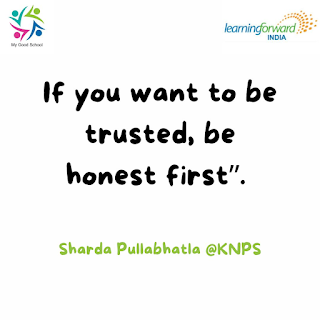
We as educators should always try our best to make students understand the importance of being honest at all times. We should teach students in all situations and all aspects – “If you want to be trusted, be honest first”.2. Show respect to earn respect in the classroom Respect is a two-way process – give and take.
The same goes in classrooms also. Nowadays, students have become outspoken. They want to express what is in their head and heart, the fear of being judged in less. Hence at times, we feel they are disrespecting, however, I feel it’s the liberty that they take with teachers whom they adore, especially in higher classes. In junior classes till grade 8 or 9 still students maintain cordial relations with teachers.
As they are more into adolescence, they tend to have good sharing relations with educators. In my grade XI while I was teaching in class, a student shouted suddenly with a loud voice on his friend as they were sitting on the last bench and arguing about something. When I asked them to share with me in front of the class, they did not want to share.
I gazed at the situation and counselled both of them and made them sit. While the period was over I called them both in the staff room and spoke to them about it. I also told them I didn’t want them to be embarrassed or made fun of by their friends as I wanted to keep their respect. They understood it and promised not to repeat this behaviour again in class. They requested kindly not to share with our parents, but I didn’t.
They always behave well in my class and if I meet them anywhere, they show respect and listen to me if I guide them or ask them to complete any task. We educators should be friendly with students but not be their friends, as we have to still guide them on the correct part by differentiating between right and wrong.
Sharda Pullabhatla @ KNPS Phagwara.
Sunday, May 14, 2023
Honesty and Respect - RPK School Moradabad
Nidhi, Shefali, Beena, Ekta, Rashmi and Evon
Manisha, Natasha, Meeta, Nishi,
Founder of Good Schools Alliance, author, educator, and adventurer empowering children to discover the magic of literature.
Saturday, September 10, 2022
Courage and Patience - Guneet Kaur
Courage means facing one's fears. It is essential in all spheres of life and leads to a change in oneself, making one stronger. Sometimes one has to get out of one's comfort zone and adjust to a new environment. This, too, is courage. Being honest and believing in one's honesty is also courageous.
Teachers are like mirrors for their students. The students tend to imbibe whatever a teacher speaks through his or her words or actions. Not pretending and being oneself is also courage. A teacher must teach students to accept and be proud of themselves regardless of their weaknesses. They should be cherished for who they are and given the space where they can be more aware of themselves. In no situation should they be afraid or ashamed of accepting the truth about themselves or sharing it with others. Seeking help and shunning one's ego is also courage.
As teachers, we must ensure that the children feel safe with us. They should be able to have faith in us. Simultaneously, they should learn to believe in themselves. A child asking his or her doubt in class, saying, "I didn't understand", in front of the other classmates, is courage.
Teachers need to be there for the students, make them feel safe and teach them to solve their problems themselves. This way, they will be prepared to bravely face life's challenges. However, if the learners make mistakes in solving their issues, their teachers shouldn't punish them. Instead, as adults, they should stand with them and show them the right path.
Courage also reflects in sharing one's experiences with colleagues or children of how one dealt with a situation. This can also help in inspiring them and getting over their fears. Being silently supportive of our co-workers is also courageous.
Patience is being tolerant and calm in handling situations. It means not getting anxious or annoyed too quickly. It does require a lot of courage to be patient. Not complaining, having a positive attitude, and giving time and space to others all come in the arena of patience.
Patience teaches us to have faith and hope that things will get better. Working with patience leads to growth. On the other hand, losing patience can ruin the task at hand. Most of us end up giving up our patience because of the pressure from society, peers, friends or family. However, if we have the courage and the belief in ourselves, we will not lose our cool, take a stand for ourselves and help to bring about a change.
Inaction should not be misunderstood for patience. Moving towards our goal with perseverance and a peaceful mind, accepting failures as stepping stones to success, and having the will to start all over again with the belief that the result will be favourable is patience.
The farmer protest in our country is the world's most non-violent and peaceful fight for human rights. The farmers had immense patience and courage that helped them to withstand all sorts of physical, emotional and mental atrocities. They did not get frustrated and were convinced that their voices would be heard one day.
We often lose our patience when we think we are better than others or deserve much more than others. This attitude leads only to exasperation. Whenever this happens, we should take a step back and introspect. High expectations from ourselves or from others can make us impatient. However, patience helps to increase our power of endurance, persistence and better decision making.
As teachers, we need to be role models of being patient with our students. Being a good and silent listener and helping the children cope with their worries and hassles will help them become more accepting, contented and forbearing. They will learn to shift their focus from a problem to possible solutions without complaining. This will also teach them to be emphatic.
Friday, July 8, 2022
Honesty and Respect - Jaspreet Kaur
1. What are the most common instances of dishonest behaviour shown by students in class? (Pick 3 such instances and try to analyse the reasons behind such behaviour)
One day I gave a class test on English in Grade IV.
I observed one student looking here and there while taking the test. I had doubts, I checked his desk, and to my surprise, he had opened a fair notebook inside the desk. I counselled that child about honesty. The reason can be performance anxiety and fear of failure. As educators, we should counsel the parents not to compare their kids with other students. The best way is to compare the child with his/her own previous performance.
Second, I was teaching in Grade V, and one of my students came to me and was very sad. I asked her why she blamed her co-partner for taking her pencil without permission. I asked her co-partner about this. She denied it, and both students started arguing. I told them to honestly let us know about pencils, but all in vain. I had no option; I divided the pencil into two pieces and gave them to both students. The reason can be peer pressure; students want everything their classmates have.
Finally, after the Pandemic, when offline exams were taken, few students allowed other students to see their answer sheets. That is also dishonesty, and the reason could be performance anxiety.
2. How far is it true that you must show respect to earn respect in a classroom? Give an instance where you saw this play out?
It is observed that when one student respects another student, that particular student definitely helps that person when he/ she is in need. As educators, when we respect the student’s needs, feelings and emotions, they automatically connect to us. When we earn respect, then students share their every problem with us.
Jaspreet Kaur
Kamla Nehru Public School, JOL Cohort 2022
Founder of Good Schools Alliance, author, educator, and adventurer empowering children to discover the magic of literature.
Thursday, July 7, 2022
Honesty and Respect - Welham Boys' School
A. What are the most common instances of dishonest behaviour shown by students in class? Pick three such examples and try to analyse the reasons behind such behaviour.
Dishonesty comes from not only students but parents also. I have encountered some of these instances, which I am mentioning in this essay. One of my students, X, was tampering with her test scores due to her family pressure. Her family expected her to score well in exams, but she performed poorly, changed her scores, and was caught. Her parents did not accept that she could do something like this, but later, when they showed proof, they were distraught with their daughter.
In one of the instances, the parent was found supporting their child while he was lying to his teachers. The kid wanted to go on a family vacation to Mauritius with his parents and therefore submitted a fake covid report to the school, which his parents approved of. He bunked school for the trip and gave an unreal excuse that was fully supported by his parents. In some situations, not only the students are dishonest, but they also have the full support of their parents to lie to the teachers and the faculty.
In another instance, one of the kid's friends made a prank call to me, stating how bad the kid was and listing many negative points. He talked to me as a family member of the kid and said some nasty things about him. I immediately caught the kid lying and called his parents to tell him about his son's endeavours. His parents denied that their kid does not have my number, which is not valid. All the parents and kids have a teacher's number who teaches them. B. How far is it true that you must show Respect to earn Respect in a classroom? Give an instance where you saw this play out.
Mutual Respect is a value we must adopt to live in a society. Moreover, Respect is essential to interpersonal relationships and personal identity.
There have been numerous examples of receiving and reciprocating Respect in a classroom scenario. However, I vividly remember one of them. Once while I was teaching grade 8, a student of mine volunteered to solve a question on the board. While I watched him solve, I kept cross-questioning him at every step of the solution, thinking why would he use a different method which has never been taught in the classroom. Before he could finish solving the question, I stopped him and asked him to use the usual way of solving the question. The child sat back in his seat politely, saying, "okay, ma'am." The next class had started as the bell rang, but the thought was never-ending, hovering in my mind. After researching and solving the question with a different method, I came to a realisation of understanding my student's perspective. So, when I returned to teach the same class, I apologised and told him that none of the methods was wrong. Just as we all are individuals, we look at things differently. We all have different perspectives, and there are no correct or incorrect answers. The lesson I took from this incident was mutual Respect, how the student politely and respectfully sat down on the chair without answering, and how I realised my mistake and apologised.
Neelima Parmar, Vandana Sahay and Monika Gupta
Welham Boys' School
JOL Cohort 2022
Founder of Good Schools Alliance, author, educator, and adventurer empowering children to discover the magic of literature.
Saturday, July 2, 2022
Honesty and Respect In The Classroom - Rishona Chopra
Honesty and Respect are two equally essential values that go hand in hand. Respecting these two values in the classroom and trying to inculcate them is vital.
Honesty is being true to ourselves. We can lie to the world but not ourselves and deceive ourselves when we lie to others and think we have fooled them. We can lie to others but not to ourselves. The trust that one builds on the other is because we will be honest with them. We often lie to fit in the society, but that is not needed; we should be who we are.
Being bullied by children in class, is quite common but we should never lie about ourselves to be like them and fit in their company, if you are the odd one out, it doesn't matter because being odd or unique is a good thing and that is also the reason why I personally like odd numbers.
You would have often heard people say they don't get into trouble when they do something wrong and tell the truth, but I think that's not how it works. Like in stories, it says that we did a bad thing, said the fact and got chocolate, but those are not practical. We should always be honest, but not necessary to help us escape trouble. We still might face the consequence, so we should not be honest, thinking it will get us out of trouble. Accept your mistake and improve. Even if your teacher doesn't appreciate you when you are honest and gives you a scolding for what you did, be happy because, on the inside, the teacher would be equally happy that you told the truth.
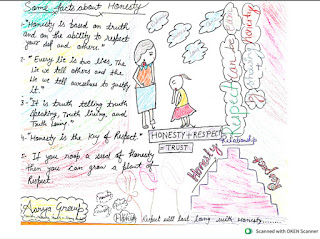
Respecting others in the classroom is very important. Respecting your teachers, colleagues, and peers is excellent. Honesty is based on truth and the ability to respect yourself and others.
Respect is earned, Honesty is appreciated, Love is gained, and Loyalty is returned.
Rishona Chopra
Grade VI
Gyanshree School
Thursday, June 30, 2022
Honesty and Respect - Ruchi Chaudhary
Talking about Honesty and Respect, one name comes to my mind, a girl in class 10th, Shivika. Teaching her since class 8, have never seen such an honest girl with so much Respect in her eyes for every teacher.
Recently during her unit test, Geography, she was surrounded by many students who were disturbing her a lot by asking questions as she was concentrating on a topographical map; two students sitting nearby bothered her a lot so that she was not able to complete her test on time and the first time she got fewer marks. I asked her reason for not getting good marks, but she said nothing to me during the time of the parent-teacher meeting; her mother emphasized that please check why she got fewer marks in one subject only. After asking many times, she shared all about that day and said please do not blame the teacher who was on duty on the Geography test day, I saw Respect and honesty in her eyes, and I did the needful.
As a human being, we have a right to take a stand on a matter which is wrong around us. But together with this, we have to show Respect to the person who actually teaching us and helping us to make our future. Shivika showed the virtue of honesty when she explained the reason for not getting good grades in my subject, and she showed Respect for the teacher in whose presence cheating was going around in the classroom.
I feel so proud to be a teacher when I encounter such a good student.
Founder of Good Schools Alliance, author, educator, and adventurer empowering children to discover the magic of literature.
Wednesday, June 1, 2022
Honesty and Respect - Maithreyi Venkataraman
Honesty means being truthful and developing a practice of always speaking the truth. An honest person shows good behaviour and maintains discipline. Honesty is one of the most critical values inculcated in a child. As unfortunate as it may seem, the fact that we cannot turn a blind eye is that dishonesty is seen in abundance in today's world. It has infested the world to such an extent that the adults do not even realize that they are doing an immoral act. Hence, there is an urgent need to teach this vital virtue.
As a mentor, I have encountered many instances wherein the students have been dishonest. In my formative years as a mentor, while I was gaining maturity as a teacher, I was very strict with my students about being dishonest, but it was not that effective. With experience, I learned the right way to handle the situation: to understand the reason behind the act and not the reason for the action.
The most common situation when a student is dishonest is when they have not done their homework or any other such assignment assigned to them with a specific timeline. The way by which a child covers his act is by making excuses which are not valid. And, invariably, the only reaction they get from their teachers is a strict scolding or any other such form or reprimand method for being dishonest. As teachers do so with the best intention of the student in mind, of correcting them and teaching them the right thing to do, we mentors must always observe if a behaviour change has occurred in these students.
It has been observed that behind every action of a child, an adult indeed has a role to play - young minds learn a lot through imitation; they are constantly monitoring and imitating the adults who they look up to, it could be a parent, a family member or a mentor.
It is essential to teach a child that when a person is honest, it enhances their confidence and makes them brave. Everyone is fond of such a person, and an honest person generates trust in the hearts and minds of others. It is essential for both mentors and parents always remember that if a child is being dishonest, it is not always the fault of the child- it is also because we adults have not created the trust in those young minds that we can handle the truth. We have created a fear in the children's minds, and the fear of our reaction discourages them from telling the truth.
The most effective way I have learnt to inspire children to be honest, is by telling them how they enhance their individual personalities by being honest and making them realize that by telling a lie, they are not fooling the person but are breaking trust. We mentors should also tell the students that a lie can provide temporary relief, but it actually only puts them into more trouble. As one lie can easily lead to a hundred more lies. Hence, one must be truthful from the beginning, and it will result in them having very good lifelong friends and make their lives very happy.
Respect is a feeling one holds as regard for the other. Respect is not just restricted to actions and not bounded by age or gender. It is a fundamental right of every living being, and it is essential that students need to learn and understand the need and manner to show respect to all.
Respect can be broadly classified into two aspects they are – a) self–respect and b) respect we give to other living beings.
Self–respect reflects respect for oneself and behaving with honour and dignity at the same time. A child must have self-respect as only then will they understand and realize the need to give respect to others. Respect should be taught to a child so that it should be perceived as a fundamental human quality that is the basic identity of a human being.
As mentors, we need to teach the children that respect is expressed in many ways and is not restricted by age. The child must understand that every action they exhibit in the company of their friends, family, teachers or any stranger reflects the respect they show towards that particular person. Even simple steps like –listening to a person when they speak and maintaining eye contact with those when they talk to you. ... show respect.
As mentors, we have the added responsibility to make our students understand that it is essential that they show respect to their peers and their elders and that they will be treated with respect. An effective way to teach this in class will be by allowing children to do a self-analysis. Give them situations they may have faced in school or at home and encourage them to express how they felt when they were not given any heed or when they were treated rudely. Did they feel bad or left out? Moreover, ask them to compare the same to situations when they felt happy and vital.
The students should further be asked to express the feeling they desired more, the happy feeling or the time they felt left out.
These questions and activities will initiate the child to think, realize, and empathize with people who are not being treated with respect. And it will, in turn, also discourage them from being disrespectful to others and make them realize that – "If they want to be treated with the respect, they need to first give respect and that respect should consistently be earned, never forced.
As mentors and adults, we shoulder a huge responsibility toward our students and children. To inculcate both the above-discussed virtues, we have to realize we can never be hypocrites and always be role models as every action of ours is observed, noticed, learned and imitated by our children.
Maithreyi Venkataraman
Gyanshree School
JOL Cohort 2022
Founder of Good Schools Alliance, author, educator, and adventurer empowering children to discover the magic of literature.
Honesty and Respect - Roopa Bhattacharyya
1. What are the most common instances of dishonest behaviour shown by students in class?
Children's behaviour is a reflection of the society that we live in. Some common instances of dishonest behaviour are – copying from another student during a test or allowing another to copy your work, unauthorized collaboration (sometimes even taking the help of commercial players for projects) on individual assignments to get high scores and sometimes even forgery!
Even small children believe that high scores/grades are most important ...... this is a reflection of the society we live in and particularly the values that the children imbibe at home.
A few years back in grade 2, a very naughty student used to do most of his classwork and get his notebooks corrected, but he rarely did his homework. He was always up to mischief and used to disturb other children. Children being naughty is normal, and other than counselling for disruptive behaviour, there is little that teachers can do.
He scored 6 out of 10 in English during the mid-term assessment, and his bench mate scored 10 on 10. What the child next did was shocking – he stole the answer sheet of his bench mate and replaced the name with his; he also rubbed out his name from his own answer sheet and replaced it with his bench mate's name and put the answer sheet in the bench mate's bag.
The truth emerged only during the next parent teacher meeting; when the bench mate's mother expressed surprise at his low score, I was surprised, as I vividly remembered giving him 10 on 10, and even the records showed 10 on 10. So, on examining the answer sheet, it was evident that the name had been rubbed out and over-written.
The child in question was counselled along with his parents and has not repeated such acts.
However, it is essential to understand why a 7-year-old would indulge in such an act of forgery... The reasons are:
a. Peer pressure to get high scores.
b. Living up to parents' expectations, even if the expectation is unrealistic.
c. Normalization of incorrect/illegal behaviour at home. A child does what he
sees, not what he is told!
2. How far is it true that you must show respect to earn respect in a classroom? Give an instance where you saw this play out.
You must indeed show respect to earn respect in a classroom. Respect encourages students to do their best. A teacher should keep calm, listen to students, use humour, not sarcasm, provide corrective feedback to foster student effort, and acknowledge student growth. Earning your students' respect requires you to be consistent, keep your word, control your frustration, learn who your students are, be patient and be kind. The key is to create the right environment where students are encouraged to ask questions and share their thoughts and ideas without the fear of being ridiculed or discouraged.
In grade 3, a student always raised his hand to answer in the class discussion but was always off the mark and talked about something unrelated to the topic. However, I ensured that he was always given a chance. One day I took him aside and explained that if he paid attention to the lessons and came prepared to the class, his contribution to the discussion would be better, and even other students would appreciate him. Within a few days, I noticed a marked change in his contributions to discussions.
When we examine this case, we realize that the student was seeking attention and once appropriately guided, he could bring out the best. A little bit of respect and trust is all it takes to create the right environment.
Roopa Bhattacharyya
Ahlcon Public School
JOL Cohort 2022
Founder of Good Schools Alliance, author, educator, and adventurer empowering children to discover the magic of literature.
Tuesday, May 31, 2022
Honesty & Respect - Ms Nitin Sharma
Founder of Good Schools Alliance, author, educator, and adventurer empowering children to discover the magic of literature.
Monday, May 30, 2022
Honesty and Respect - The Doon Girls' School
Some section of school policy suggests implementing honesty and responsibility on the students. The students may forget about it and start to do things that lead to academic dishonesty or simply lying. They may begin to cheat by copying each other's homework, using their notes on a test without teachers' permission or having someone else write the paper. The students may bribe someone to do their work or let them copy their homework. They may start to submit the same paper to two different classes. They can also tend to plagiarise and present their work without changing any lines. Students may commit these dishonest things under peer pressure or anxiety about getting good grades. One of the most common reasons for academic dishonesty is students' ability to manage the pressures of their social and educational lives. Some students genuinely may not know what constitutes cheating or plagiarism and may not ask the course instructor for clarification.
I have experienced this kind of situation. Once in my class, there were two kids. Both of them were very hardworking; however, one was a bright child, and the other was very weak. They both were close friends and used to sit together. At the beginning of the class, they were not together, and their result differed. Since the day they sat together, their results were equal. Every test I took had the same mistakes, scoring the same marks. I did not say anything and kept on noticing the two girls. Their half yearlies were near; they both were appointed at different places at the opposite corners of the class. When the result came, I got a little worried because the weak girl had scored significantly less, and the bright one had scored well. I was just waiting to make them realise their mistake and learn from them.
According to the incident, the intelligent girl's first dishonest behaviour was shown. The girl should have warned the weaker girl about the consequences she might face shortly. She should have told her that you are not doing the right thing by copying from me because it will affect her future. You will be deprived of the proper knowledge. I asked her why did she do this. She told me that she was insecure about her friendship with the girl as she did not have many friends.
The weaker girl showed dishonesty because she was afraid of getting bad marks on her tests as her parents were stringent in this matter. The girl was also insecure about not being able to set a good example to her younger siblings as she was the eldest in her family.
One example of academic dishonesty is disrespecting the teachers and their fellow classmates.
I had been teaching the junior school and now was deployed to teach the seniors after 2 years. Everyone knows how many handful teenagers can be. Being promoted from middle school to senior school, the children were disrespectful towards me and used to disturb the class and not allow me to teach peacefully. But, slowly and gradually, most of the children accepted me and started giving me respect. Still, one of the girls asked silly questions and tried to disturb the class. One day she came to ask about some of her quarries which I simply explained to her, and she was pretty satisfied with my way of teaching, which changed her attitude towards me. She became quiet and did not cause any trouble in the class anymore.
Sometimes children do not accept a junior teacher and show respect to teachers who teach them. So we should deal with patience and give them time to adjust to the situation. Slowly and gradually, good relations are developed between teachers and the students.
THE DOON GIRLS SCHOOL
Friday, May 27, 2022
Honesty and Respect - Shalini Solanki
1. The most common instances of dishonest behaviour shown by students in class
There are some common instances of dishonest behaviour in class like not speaking the truth, making mistakes and not admitting, taking each other’s things and not returning, and blaming each other for any misbehaviour. I would like to share one instance in my class last year.
I still remember a child in my class from the previous session who was intelligent and enthusiastic. She was expressive and overconfident about her academic performance. She got her all spell check words correct the entire session without even a single mistake. She was happy with her performance in the class. Towards the end of the session, post the pandemic, our school opened offline for teachers and gradually for students. This child started coming to school. She was a very fun loving student. We had a good time with each other for about 2 weeks. She used to discuss a lot. Once she came in the morning and confessed that she never got all the words correct in spell check during the online classes, and she lied to everyone. This, she spoke in front of the entire class with confidence. We did not ask her why, but she wanted to tell herself. She did not get scolded. In fact, she was appreciated for having the courage and being honest to speak the truth.
There were specific reasons behind her behaviour:-
- She was scared of getting judged.
- Her mother used to hit her for any mistake, so she cheated to keep her mother happy.
- She said that she used to pray to God to get me as her teacher since Grade K.G. and wanted to create the best impression in front of me. She never wanted me to dislike her.
Some common reasons behind dishonest behaviour:
- Children want to create a good impression on their peers and teachers.
- They do not want to get judged; hence they make a different impression in front of the class.
- They are scared of losing friends and feel that speaking the truth or being honest may take them away from their friends.
Sometimes they are not honest because this is what they observe in their surroundings.
When children do not get a healthy response to their honest behaviour, they avoid speaking the truth.
When elders do not trust them, children avoid speaking the truth.
2. we must indeed show Respect to earn Respect in a classroom
It is essential to give Respect to everyone, including children, as Respect cannot be snatched but earned. We have always heard the phrase ‘Give Respect to Earn Respect. Earning needs hard work, patience, dedication, collaboration and confidence. We sometimes make mistakes assuming that ‘Giving Respect’ is not our job but receiving ‘Respect’ from everywhere is our right. It is 2-way traffic where coordination and collaboration are required.
I have an example of sharing from my class a few years ago-
A new angry child entered the classroom on the first day of the session. He didn’t ask for permission to enter the room; he didn’t wish his teachers and classroom nanny and threw his bag near the dustbin. He then came to me and said that he wanted to go back home and will not stay in the class. Now, I had to show that I was his teacher, got a little firm and asked him to go out of the class with his bag and ask for permission to come into the classroom. This child did not listen to me and started howling. This continued for many days. He was regular with his behaviour of not respecting teachers, and I was firm every time in making him follow the rules and respect everyone and everything in the classroom.
Things were not working, and then I thought of changing my strategies. I started wishing him myself; initially, he didn’t respond, but gradually he started wishing back. I appreciated his written work, drawing and involvement with his peers. Magic... He was a changed personality. Started wishing all the teachers, nannies and peers. He used to share many things and help everyone in the classroom. It has been 5 years now, and he still comes to wish me every morning. Sometimes, It is more important not to think like teachers but any individual struggling to adjust. We can’t even get closer to the insecurities that ultimately captured the child. We must give Respect, time and opportunities to others to receive the same.
Shalini Solanki
<shalini@gyanshree.in>
Founder of Good Schools Alliance, author, educator, and adventurer empowering children to discover the magic of literature.
Wednesday, February 24, 2021
Humility and Appreciation - Flyers DGS
विद्या ददाति विनयम,
विनयम ददाति पात्रता।
Humility means being humble or grounded. It means putting others’ needs before our own and acknowledging that I am not always right. Humility enables us to stay open to new learning. It prevents us from judging others, serves others and wins people. Humility makes us real & hopeful and gives us peace. Humility doesn’t mean to think about yourself, but to think less about yourself and more about others. It is the foundation stone of all the virtues. We cannot have a good personality if we are not humble. It helps us to think wisely. It means to appreciate others’ strengths and accept your mistakes or weaknesses.Humble people do not try to impress others with titles, money, achievements, in fact, they just pull out the best in others. They are more responsible and handle stress more effectively.
Appreciation is a feeling of gratefulness. Appreciation makes us feel valued, responsible and acknowledged. It gives us confidence and motivates us to work hard. The word “appreciation” fills us with joy and zeal. It is difficult to work wholeheartedly in the absence of appreciation. Somewhere in the corner of our heart, we crave appreciation, it’s like medicine. But appreciation that is not real or honest loses its value. Only a real critic can honestly appreciate you.
One of our member shares, “Humility is the only virtue that can be practised in both success and failure. When I meet someone who radiates humility, my shoulder relaxes, my heart beats a little more quietly, and something inside me lets go. Why? Because I know that I'm being heard, fully seen and accepted for who I am. It allows my protective walls to come down. The same treatment I would like to give people who meet me or are in my circle. Humility allows us to make real-world. I accept the strengths and limitations of other people and of my own as well without defensiveness or judgement.
Appreciation has magical powers. I often appreciate things,
behaviours and deeds that I want the person to repeat till it becomes his/her
habit. If there are some vices that I
want the person to change, I appreciate his other qualities but remind him/her
that his qualities are bigger than the small vices he/she has."
Today, the daughter -in law is the finest cook for family
today.
प्रोत्साहन एक ऐसी चिंगारी है जो जीवन की निराशा, हताशा, नीरसता को एक ही शब्द से दूर भगा देती है ।जब व्यक्ति इस परिस्थिति से बाहर आता है तो वह समझ पाता है कि प्रोत्साहन देना ,प्रोत्साहित करना, प्रोत्साहित होना कितना बड़ा गुण है , कितना बड़ा सहारा है, संबलता का प्रतीक है। किसी भी सफल जीवन में विनय तथा प्रोत्साहन चोली दामन का संबंध रखते हैं। एक ही सिक्के के दो पहलू हैं।इन्हें समझना, संवारना तथा उपयोग में लाना मनुष्य के लिए अति आवश्यक है।
संक्षिप्त में यह कह सकते हैं कि जहां हतोत्साहित करने वाले अपनी कल्पना में हारने वाले व्यक्ति के नुकसान को देखते हैं वही विनम्र तथा प्रोत्साहित करने वाला व्यक्ति भावी भविष्य की उड़ान की परख रखते हैं।
Our humility teaches us to appreciate others’ qualities. One cannot appreciate anything until and unless one is humble. That means humility and appreciation go hand in hand. Our Humility makes us approachable and Appreciation helps us to win hearts.
Written with co-operation by FLYERS DGS - Vijaya Jugran, Nandini Arora, Urvashi Uniyal, Vandana Goel, Bhumika Vyas & Ritika Tyagi - at The Doon Girls' School in Dehradun.
Saturday, December 26, 2020
Simplicity and Trust - Flyers DGS
सादगी और विश्वास- यह कोई नया विषय नहीं है बल्कि इतिहास के पृष्ठों पर अटल स्मृतियां हैं। बंदर जाति, साधारण- पर राम का विश्वास पाकर समुद्र पर पुल बांधा। मुरा साधारण व्यक्तित्व, चाणक्य का विश्वास पाकर चंद्रगुप्त को महान सम्राट बना गई। अहिंसा पर विश्वास करने वाले महात्मा गांधी-पर स्वराज्य का स्वप्न पूर्ण किया। साधारण व्यक्तित्व की पन्नाधाय- उदय सिंह को पुनः राज्य प्राप्ति। दूर क्यों जाएं, वर्तमान में हमारे प्रधानमंत्री सादगी और विश्वास की प्रतिमूर्ति।
गुदड़ी के लाल की यह पहचान, विश्वास व सादगी है जिसकी शान ।
Simplicity and trust are two beautiful values which we require to build strong inter and intra-personal relationships. We easily trust people who are simple in their thoughts and reflect honesty. We asked a few questions related to these two values from the members of our group and they came up with beautiful replies.
1. What do simplicity and trust mean to you?
Simplicity means being simple, real and natural. It means being what you are, what you think and what you feel.
Urvashi: I would definitely look for the qualities that the person is truthful about himself/herself as well as others. Always keeps his/her words. It is someone in whom you can confide your deepest secrets without giving a second thought. I can trust someone who avoids water cooler gossips and rumour-mongering. Last but not the least beliefs in long term relationships than short term gains.
Vandana: Simplicity and trust complete each other. If a person is simple transparent and clear in his thoughts and actions, he is bound to be trustworthy and hence both go hand in hand. Cunningness and complexity in nature of an individual cannot win him trust and he himself can’t feel the pride of his own Being.
Bhumika: This question makes me wonder, aren’t we all given a blank sheet of paper when we are born which is absolutely simple and while we grow up, that simplicity stays with a few and a few people are multifarious. But does that mean with a few people with whom simplicity continues to be a part of life are not Smart? Smart people are generally simple and for me, the definition of simplicity goes hand in hand with smartness. A simple and a smart person comprises of a person who is compassionate, thinker, kind, loving, trustworthy, adaptable and honest. Therefore, it’s easy to conclude that Simplicity and Smartness is effortless,
and they are a part of each other.5. Why is it important for children to learn these two values -Simplicity and trust?
Blog Archive
-
▼
2026
(146)
-
▼
July
(32)
- Reflections from Emerging Literacies Session - 18t...
- When You Grow Up, You Might Not Have A Job
- Heart Versus Mind - मंजुला सागर
- मुस्कान, संवेदनशीलता और संतुलित शिक्षण की प्रेरक स...
- संवेदनशील शिक्षा और विवेकपूर्ण जीवन का संतुलन - सु...
- My Reflection for the Emerging Literacies Session ...
- A Good School, Twice Defined
- Potato Crisps at the Learning Forward Retreat 19-2...
- Cheeselings at the Learning Forward Retreat 19-21 ...
- Reflection on Good School Alliance Training 19-21 ...
- Taking my Learning Forward - thank you note from K...
- Thinking Beyond Labels: Lessons from the Liberal S...
- What Does It take to Make Happy Teachers?
- The Retreat was a treat!
- संवेदनशील शिक्षक: शिक्षा से पहले समझ - सुनीता त्रि...
- Is Your Child Ready to Face the World?
- The Learning League
- Team Sunbeam reflects on the Learning Forward Retr...
- Reflections from the Learning Forward Retreat at D...
- Reading the World Before Facing It: Is Your Child ...
- Spark-Plugs @School
- India must look backward to move forward
- Jammu Literacy Project Workshop and reading ‘Disil...
- “Heart vs Mind” reading ahead teenage behaviour an...
- Disillusionment: Embracing Change Through Lifelong...
- Teaching Beyond Textbooks for the 21st Century- Re...
- मन सही सोच देता है और हृदय सही दिशा - मंजुला सागर
- Introduction to Emerging Literacies and "21 Lesson...
- Heart vs Mind Part 1 - Student discipline and teen...
- Heart Vs Mind - Sunbeam School Mau
- शिक्षा का वास्तविक उद्देश्य - सुनीता त्रिपाठी
- Welcome to Ballia - Literacy Project for Educators...
-
▼
July
(32)