Showing posts with label respect. Show all posts

Saturday, March 28, 2026

Violence as an Immature Communication Strategy


Masterclass

To reframe violence as an immature communication strategy and advocate for student self-reliance. Reading from the book The Courage To Be Happy by Ichiro Kishimi and Fumitake Koga

Key Takeaways

  • Violence is an immature communication strategy. It’s a low-cost, high-effort shortcut to force submission when verbal consensus fails. This includes non-physical acts, such as rebuking, which Adler called “anger that pulls people apart.”

  • Shift from cause to goal. Instead of focusing on who is to blame (“bad person” vs. “poor me”), guide students to focus on “What should I do from now on?” to foster responsibility and self-reliance.

  • Educators must foster self-reliance. The core task is to help students gain the awareness that they can accomplish things on their own. This requires a horizontal relationship, not a vertical one built on authority.

  • The reward is the feeling of contribution. Expecting student gratitude hinders self-reliance. True happiness comes from contributing to their growth, not from being thanked.

Topics

Violence as an Immature Communication Strategy

  • Violence is a shortcut to force submission when verbal communication fails to achieve consensus.

  • This includes non-physical acts, such as rebuking, which is a low-cost attempt to force submission.

  • Adler’s view: “Anger is an emotion that pulls people apart.” It invites contempt and reveals the adult’s immaturity, undermining respect.

The “Triangular Column” Framework

  • This framework helps analyse conflict by identifying three perspectives:

    1. “That bad person”: The perceived aggressor.

    2. “Poor me”: The perceived victim.

    3. “What should I do from now on?”: The forward-looking, goal-oriented perspective.

  • Focusing on the first two only yields excuses. The goal is to guide students to the third perspective.

Fostering Self-Reliance

  • Problem: Adults often hinder self-reliance by creating dependence.

    • Reason 1: Fear of losing authority in a vertical relationship.

    • Reason 2: Self-protection—avoiding responsibility for student failures.

  • Solution: Create a horizontal relationship where students can make their own decisions.

    • Separation of Tasks: Don’t intervene in tasks where the student bears the final responsibility.

    • Support, don’t control: Provide knowledge and experience, but let students choose their own paths.

Next Steps

  • Gurdeep Kaur: Write a reflection on the quote “Anger is an emotion that pulls people apart.”

  • All Participants:

    • Join the “My Good School” session tomorrow.

    • Continue the discussion in the WhatsApp group.

  • Sandeep Dutt: Resume the masterclass on Saturday, April 4, from the current bookmark.

FATHOM AI-generated notes, read with care.

Saturday, February 28, 2026

The Subjective Past: A Narrative of “Me Now”

Masterclass with Sandeep Dutt

To explore Adlerian psychology’s concepts of empathy, teleology, and the subjective nature of the past.

Key Takeaways

  • Empathy is a Skill, Not Sympathy: Empathy is the active skill of imagining another’s life to understand their perspective, distinct from passive agreement (sympathy).

  • Teleology Over Aetiology: Behaviour is driven by present goals, not past causes. The past is a tool used to justify current choices, not a determinant of them.
  • The Past Is Subjective: Memory is a narrative constructed to affirm one’s “self now.” This explains why people recall strict teachers with gratitude (to affirm their current success) or resentment (to justify current dissatisfaction).

  • Respect Is Contagious: Educators must model respect as an equal to students. This practice, like courage, spreads and builds a foundation for all relationships.

Topics

Empathy vs. Sympathy

  • The session began by defining empathy as an active skill rather than a passive feeling.

  • Empathy: The skill of imagining another’s life to understand their perspective.

    • Example: To understand a student who doesn’t study, imagine their specific life circumstances (age, home, friends) to grasp their motivations.

  • Sympathy: Passive agreement with another’s opinions or feelings.

  • Actionable Insight: Educators must “dive in” and show concern for students’ concerns, interacting with them as equals to build respect.

Teleology: The Power of Present Goals

  • Adlerian psychology’s core principle is teleology—the idea that human behaviour is driven by present goals rather than past causes.

  • Contrast:

    • Teleology (Future-focused): We act to achieve goals.

    • Aetiology (Past-focused): We are determined by past events.

  • Example: A person with a “dark personality” isn’t a victim of a bad home environment (aetiology). They chose that personality to achieve the goal of avoiding hurt (teleology).

The Subjective Past: A Narrative of “Me Now”

  • The past is a subjective narrative constructed to affirm one’s “self now.”

  • Mechanism: To justify current choices, people select events from the past and assign meaning to them, while ignoring or erasing contradictory events.

  • Example: A man bitten by a dog initially recalled only the attack, which supported his view of a dangerous world. When his worldview shifted to a safer one, he recalled being helped by a stranger, creating a new, affirming narrative.

  • Application to Education: This explains why students recall strict teachers differently:

    • Gratitude: To affirm their current success.

    • Resentment: To justify current dissatisfaction.

History as a Manipulated Narrative

  • The group discussed how this subjective principle applies to collective history.

  • Insight: History is a “grand story” manipulated by those in power to legitimise their rule.

  • Examples:

    • NCERT textbooks are periodically rewritten to reflect current political sentiment.

    • British history curricula often omit colonialism.

  • Conclusion: The past, both personal and collective, is a tool for the present, not an objective reality.

Next Steps

  • Priyanka Rathore: Share handwritten notes from the session in the WhatsApp group for collective reflection.

  • All Participants: Review the session recording and notes before the next meeting.

  • All Participants: The next masterclass is scheduled for March 7, 2026.

Fathom AI Notes, read with due care.

Saturday, February 21, 2026

Teachers must respect students unconditionally

Sandeep Dutt’s Masterclass 2026
February 21, 5:20 pm, 51 min

Sandeep Dutt led a masterclass on respect in education, emphasising its role in fostering interpersonal relationships. He stressed the need for teachers to respect students unconditionally, without imposing their own values. Dutt used the analogy of a flower bed to illustrate the diverse growth of students, underscoring that respect is practised, not preached. He also discussed social feeling, advocating concern for others’ concerns. The session featured insights from participants, including Naman and Subham, who shared their experiences and reflections on respect in teaching. The masterclass aimed to encourage respectful interactions and self-reliance in students.

We apologise again for the poor quality; due to unstable bandwidth at our studio in Dehradun this evening.


Friday, December 12, 2025

Reflection from the Master Class of 6th Dec 2025


It's important to maintain clear personal boundaries — whether at work, at home, or in any other space. Many confrontations and arguments, especially with children or students, can be avoided when elders refrain from imposing their own goals under the pretext of "it's for your good." Respecting individual choices and not intruding into their lives leads to healthier, more harmonious relationships.

We must also learn to untangle complicated situations with fresh thinking, just as the Gordian Knot was resolved with a new approach. And perhaps the most valuable lesson of all: don't fall into the trap of trying to please everyone — because in the end, the only person who ends up unhappy is YOU!!.

Shalini Gupta

Tuesday, July 1, 2025

Not All School Essentials Come in a Pencil Case! - Manisha Khanna


🎓 Case Study: The Invisible Tools of Class 6B

School: Gita Tatva Vidhyalaya
Grade: 6B
Project Theme: “Our Green Planet” – A class exhibition on environmental issues

Background:

Class 6B was preparing for its annual exhibition. Every group had to create a display on an environmental issue of their choice. One group—made up of five very different students: Tia, Arjun, Farah, Neil, and Riya—chose the topic “Waste Not, Want Not,” focusing on waste management and recycling.

But early meetings were full of frustration. Tia wanted everything to be perfect. Arjun kept interrupting. Farah barely spoke. Neil was more interested in doodling than planning. Riya tried to take charge but got ignored.

They had the glue, the cardboard, the charts—but they lacked something crucial.

What Made the Difference: The Unseen Essentials

💬 Respect

In one heated discussion, Tia snapped at Arjun for not listening. That evening, she reflected and returned the next day with a quiet, “Sorry for yesterday.”
The group agreed on one rule: “No interrupting—every voice matters.”
From that day, everyone started listening.
➡️ Respect built the foundation for teamwork.

Confidence

Farah had great ideas but rarely shared them. One afternoon, Riya turned and said, “Farah, I think you have something to say—go on.”
Farah hesitated, then suggested turning an old shoebox into a 3D recycling bin. Everyone loved it.
➡️ Confidence grew when others believed in her.

🔍 Curiosity

Neil, while sketching for the poster, asked, “Why is plastic hard to recycle?”
This led the group to conduct further research and add a quiz section to their display. They even discovered a new type of biodegradable plastic and included it in their project.
➡️ Curiosity sparked real learning.

💛 Kindness

When Arjun missed a day due to illness, the team didn’t grumble. Instead, they left space in the model for him to contribute later and sent him a video update.
➡️ Kindness kept the group united.

🎯 Responsibility

As the deadline approached, they met early before school, divided tasks clearly, and checked every detail twice. No one blamed or waited for others to fix problems.
➡️ Responsibility meant showing up for the team.

Exhibition Day: More Than Just a Display

Their table wasn’t the flashiest, but visitors stayed longer. People loved how clearly they explained everything and how each member had a role. A judge remarked,

“This group shows what learning really looks like—not just knowledge, but collaboration.”

Reflection: What They Truly Carried

None of these students packed extra bags. What they did bring were invisible tools: their attitudes, their values, and their willingness to grow.

These five qualities—respect, confidence, curiosity, kindness, and responsibility—don’t weigh anything, but they carry us the farthest.

Inspired by the idea of abstract nouns—qualities we can't see, but feel—and the values that build strong character in every student.

Manisha Khanna


Monday, July 29, 2024

Respect- Sunbeam International Varuna


In this heartwarming video, teachers of Sunbeam International Varuna showcase the importance of respecting everyone in our community. Through a poignant depiction, they highlight the vital role of community helpers, such as cleaners, gardeners, and support staff, who are often overlooked.

The video demonstrates how students observe and learn from the way these helpers are treated by teachers and peers. By promoting respect and kindness towards all individuals, regardless of their position or status, we can create a truly inclusive classroom environment.

Join us in this inspiring journey towards fostering empathy, understanding, and a culture of respect for everyone.

Masterclass 2024 
Sunbeam International Varuna

Wednesday, June 19, 2024

Respect - Sunbeam Varuna

 
Behavioural issues in students often arise from emotional suppression and exposure to parental conflict at home. When children witness frequent arguments or tension between their parents, it can create a highly stressful environment. 

This stress, combined with the need to suppress their own feelings to avoid adding to the conflict, can lead to a range of behavioural problems at school. These issues may manifest as aggression, disrespect, withdrawal, anxiety, or difficulty in concentrating, impacting their academic performance and social interactions.

Moreover, the lack of a stable and supportive home environment can also hinder a child's emotional development. When children are unable to express their feelings openly, they may struggle to develop healthy coping mechanisms. 

This suppression can build up over time, leading to outbursts or other negative behaviours as they seek ways to release their pent-up emotions. Addressing these underlying issues through counselling by a teacher or a school counsellor as per requirement and creating a more supportive school atmosphere can significantly improve their overall well-being and behaviour in school.

Sunbeam Varuna Team 
Reflection - Masterclass 2024

Tuesday, June 4, 2024

War vs Peace - Ranjana Singh

As an educator, I feel students need a lot of support from their teachers. Today's classrooms are full of diverse learners, geniuses, talents and imaginative minds. With the advent of the AI and Machine Age, children have also lost patience. Therefore, classroom conflicts become inevitable, providing ample opportunities for teachers to cultivate a peaceful and respectful environment.

Teaching for me is a passion and a very noble act of working for society and the nation. Thus I'm trying to put a close view on the topic mentioned above. Adults feel that they live in a bitter world and are surrounded by infinite problems, but the truth is that students today are living with multifarious issues that need to be addressed. Unfortunately, some of us do not understand that.

No teaching-learning can happen if students are not at peace. We, as teachers, can play a vital role in fostering a harmonious classroom ambience.

Thus comes the concept of Happy Classrooms. A classroom, where teaching-learning happens.

I remember when I joined Red Rose School as a class teacher of class 4 grade, the students were initially very quiet and introverted. Gradually they started loving me, as my classes were full of fun and play. 

I taught them but in a very sporty manner. I never studied child psychology, but from 7 o'clock to 2 pm the student's behaviour gave me enough information about them. I loved them and they became fond of me.

I learned that to create a teaching ambience, I need to create trust. To build trust, I needed to understand them and that was only possible if the class became interactive. Therefore I spoke less and gave opportunity to my children to speak. I realised they needed to be heard and I learned patience to hear them and they followed me.

To bring harmony to my class I promoted teamwork. Students enjoyed that. There were some rules which students made and the first rule was to respect each other's ideas.

Today I'm a class 12 teacher, but my methods are the same with little difference. Whatever conflicts arise in my class, my children sit together and resolve them as the first rule is still the same; to respect each other's ideas.

I ensure that each student has the opportunity to speak and be heard. I equip them with problem-solving skills through certain activities like brainstorming where children come up with a myriad of new solutions quickly. In group brainstorms, I allow everyone to state ideas. I appreciate all answers and avoid criticism. Then, organize solutions into groups around common themes. In today's scenario, it is an extremely required skill. 

Thus I'm able to overcome conflict in my classroom and my classrooms become the happy ones.

Ranjana Singh
Sunbeam Varuna.

Saturday, May 25, 2024

Respect - Leena Bhattacharya


Teachers can make a profound impact by fostering a supportive and inclusive environment where students feel valued and respected. They can offer guidance, encouragement, and mentorship, helping students develop both academically and personally.

Additionally, teachers can cultivate a sense of community among colleagues, promoting collaboration and shared learning experiences. 

By demonstrating empathy, understanding, and a genuine interest in their well-being, teachers can create lasting positive effects on the lives of their students and colleagues.

Leena Bhattacharya
Sunbeam Suncity

Friday, May 24, 2024

Respect - Sunbeam School, Bhagwanpur

Respect is a fundamental value that encompasses various behaviours such as listening attentively, valuing other's opinions, showing kindness, and maintaining courteous behaviour.

Parents often serve as the first role models for children. When parents show respect to each other and to their children, they set a standard for behaviour.

Respectful behaviour at home translates into respectful behaviour in school. However teachers today face numerous challenges in maintaining respect in the classroom. Some students may display overt disrespect through talking back, noncompliance, or negative attitudes, making it difficult to maintain a positive classroom atmosphere.

Here are some strategies to foster respect:

1. Fairness and Consistency -Teachers should ensure that all students are treated equally and justly.

2. Conflict Resolution -Address conflicts calmly and fairly. We should use conflicts as teaching moments to discuss respect and understanding.

3. Encourage Participation-Teachers should create an inclusive classroom environment where all students feel valued and encouraged to participate.

4. Building Relationship-Take the time to understand student's backgrounds, interests and challenges. This personal connection can build trust and respect. By implementing these strategies both students and teachers can create a respectful and supportive classroom environment that enhances learning and personal growth.

Team Bhagwanpur, Masterclass 2024
Sneha Singh, Sanyogita Dubey and Reeta Tiwari.

Saturday, May 18, 2024

Respect - The Heartbeat Of School Harmony

Respect by Paul Puthenveetil Variath

The Heartbeat Of School Harmony

Read on Substack

In this reflection from Masterclass 2024, Paul Puthenveetil Variath considers respect's role in school and life. Respect can help create harmonious relationships, especially in schools where diversity plays a prominent role. Paul is the Head of QC and R&D of the Sunbeam Group educational institutions. He is a passionate educator who has climbed the ladder with passion and commitment from a teacher to a principal and Head of Quality Control at the Sunbeam Group.

Paul is one of our best pupils for Masterclass 2024!

Tuesday, November 14, 2023

Honesty and Respect- Sharda Pullabhatla

 1. Common Instances of dishonest behaviour shown by students in class-

Actually, I believe in the fact that – “Honesty is the fastest way to prevent a mistake from turning into a failure”. So I try my best to motivate students to be honest while dealing with any type of situation.

Be it young or old students, when it comes to giving answers they try to hide things and in that process, they tend to be dishonest at times, which may be unintentional. I feel, in such instances, they lack the thought of the consequences of being dishonest.

Let me share a few situations where students tend to be dishonest in the classroom - 

a. When students do not complete their work (homework) they start making excuses like we were not at home, Oh! I forgot to bring my notebook I had completed the task though.

b. When students do not like food that their mother has sent in their lunch box, they do not want to eat and start making excuses, that they have stomach aches, they do not feel like eating their lunch. 

c. Students of grades XI / XII give dishonest answers while they are late to class. While they move to optional subject classrooms for different subjects, they do not report on time. On enquiring by the teacher, they tend to give dishonest answers or hide the truth – by saying – “was in the washroom”, or “I was drinking water”. 

We as educators should always try our best to make students understand the importance of being honest at all times. We should teach students in all situations and all aspects – “If you want to be trusted, be honest first”. 

2. Show respect to earn respect in the classroom Respect is a two-way process – give and take. 

The same goes in classrooms also. Nowadays, students have become outspoken. They want to express what is in their head and heart, the fear of being judged in less. Hence at times, we feel they are disrespecting, however, I feel it’s the liberty that they take with teachers whom they adore, especially in higher classes. In junior classes till grade 8 or 9 still students maintain cordial relations with teachers. 

As they are more into adolescence, they tend to have good sharing relations with educators. In my grade XI while I was teaching in class, a student shouted suddenly with a loud voice on his friend as they were sitting on the last bench and arguing about something. When I asked them to share with me in front of the class, they did not want to share. 

I gazed at the situation and counselled both of them and made them sit. While the period was over I called them both in the staff room and spoke to them about it. I also told them I didn’t want them to be embarrassed or made fun of by their friends as I wanted to keep their respect. They understood it and promised not to repeat this behaviour again in class. They requested kindly not to share with our parents, but I didn’t. 

They always behave well in my class and if I meet them anywhere, they show respect and listen to me if I guide them or ask them to complete any task. We educators should be friendly with students but not be their friends, as we have to still guide them on the correct part by differentiating between right and wrong. 

Sharda Pullabhatla @ KNPS Phagwara. 

Wednesday, November 8, 2023

Honesty & Respect - Indu Mehta


What are the most common instances of dishonest behaviour shown by students in the class?

Dishonest behaviour can vary among students, here are the most common instances of dishonest behaviour shown by students in class:

  • One of the most common forms of dishonest behaviour is cheating during tests or exams. This can involve copying answers from another student's paper. 
  • Sometimes students submit work that someone else wrote, whether they paid for it or not. They present work or ideas as their own without giving proper credit. This can include copying and pasting text from websites, books, or other sources. They submit someone else's work as their own.
  • Some students engage in dishonest behaviour by fabricating data or information in assignments or research projects. This can involve making up experimental results, falsifying survey responses, or manipulating data to support desired outcomes.
  • Students lie intentionally providing false information or misleading others. In an academic setting, this can involve lying to teachers or administrators about reasons for missed assignments, falsely claiming to have completed work, or providing misleading information to gain advantages.

It's important to note that these behaviours are not representative of all students and many students exhibit honesty and integrity in their academics.


2. How far is it true that you must show respect to earn respect in the classroom?

The statement "You must show respect to earn respect in the classroom" is generally true. Respect is a two-way street, and students who demonstrate respectful behaviour towards their teachers and peers are more likely to receive respect in return.

In my class, there was a student who consistently interrupted the teacher during lectures, talked back in a disrespectful manner, and disregarded classroom rules. Their behaviour showed a lack of respect towards the teacher and disrupted the learning environment for others.

On the other hand, there was another student who actively listened to the teacher, participated in class discussions, and treated both the teacher and fellow students with respect. The second student’s behaviour demonstrated a respectful attitude and contributed positively to the classroom environment.

In this scenario, it was likely that all the teachers and other students developed a more positive perception of the second student and her respectful conduct. All started listening to her opinions, assisting when needed, and engaging in respectful interactions. Conversely, the first student’s disrespectful behaviour led to strained relationships, lack of support, and potential disciplinary actions.

By showing respect to others, students can foster mutual respect and cooperation in the classroom. It creates a conducive environment for learning, encourages positive interactions, and helps build strong relationships between teachers and students as well as among peers.


Indu Mehta @KNPS Phagwara


Sunday, May 14, 2023

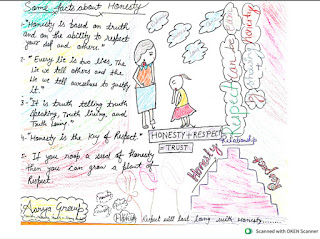
Honesty and Respect - RPK School Moradabad


Joy Of Learning Cohort 2023 - 24

Somya RKPM
Nidhi, Shefali, Beena, Ekta, Rashmi and Evon

Aarya RKPM
Manisha, Natasha, Meeta, Nishi, Jyoti, Kaplna and Rashmi

Siddhi RKPM
Sanskriti, Swati, Priyanka, Lovely, Manjeet, Soni, and Sadhna

Aavighina RKPM
Ritika Wadhwa, Neeru Lathey, Shwetank, Deeksha Bhatia, Saymeen Akhtar, Neha Singh and Swadha 

Wednesday, May 3, 2023

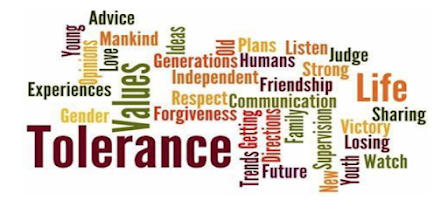
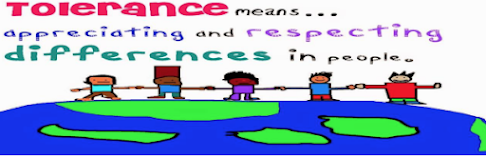
Happiness and Tolerance - Ashtalakshmi RPKM

Image copied from www.dreamstime.com

Dealing with hate and intolerance in the classroom is a crucial issue for teachers, as it can negatively impact the learning environment and the well-being of all students.

Teachers should establish clear expectations and guidelines for behaviour in the classroom, including a zero-tolerance policy for hate speech or discriminatory behaviour.  

Address incidents promptly: When an incident of hate or intolerance occurs, it's essential to address it promptly and directly with the students involved. This can be done privately or in front of the class, depending on the situation.

Encourage dialogue and understanding: Teachers should create a safe space for students to have open and respectful conversations about sensitive issues. Encouraging dialogue can build empathy and understanding among students.

Model respectful behaviour: Teachers should model respectful behaviour in the classroom and avoid making insensitive or discriminatory comments themselves.

Involve parents and school administrators: In severe incidents of hate or intolerance, it may be necessary to involve parents and school administrators to provide additional support and resources.

Addressing hate and intolerance in the classroom requires a proactive and ongoing effort from teachers, students, and the wider school community. By promoting respect and understanding and responding promptly and appropriately to incidents.


Once, I encountered an intolerant student who often showed verbally and physically abusive behaviour. My classroom's atmosphere was deteriorating because of him. He used to cry whenever I addressed his problem but would not say anything. He used to seek attention. Whatever the situation was, he wanted to be the talk of the class. From my experience, I suspected that he quest for validation and attention from everyone.

Upon meeting his mother, I got to know about his family's condition that his father is suffering from cancer, due to which he's often neglected by his family. He subconsciously chased attention so much that the consequences didn't matter. I started motivating him to give his best and made sure to constantly hear his heart out. Within a few days, he started showing improvement. So, there's always a reason behind everything, and we should pay more attention to the journey and how we can change someone's behaviour rather than just the outcome. The classroom should be a place where each student should feel safe and appreciated.

When talking to an agitated student:
  • Introduce yourself if you still need to learn the student.
  • Maintain a calm and reassuring voice. 
  • Speak calmly, but only do some of the talking. 
  • Allow the student to vent.
  • Ask questions; this shows that you are concerned. 
  • When asking questions, use the student's name.
  • Listen carefully to the student's concerns and take them seriously. 
  • Paraphrasing what the student says can help show that you are listening.
  • If emotions escalate, acknowledge them. "I can see that you're angry about the ..."
  • Maintain appropriate eye contact. 
  • A direct and uninterrupted stare may feel threatening to the student.
  • Be natural in your gestures and speaking tone.

Tolerance Requires Virtue
Tolerance, in and of itself, is not a virtue. If a student tolerates drinking and driving, his tolerance is not virtuous. Tolerance is neutral. Tolerance derives its value from what the student takes and how the student expresses his tolerance and intolerance. This involves character.

When a student uses a racial slur, his problem is not a lack of tolerance but a lack of kindness and a problem with pride (the root of belief in racial superiority). When a student makes fun of a classmate's point of view during a class discussion, his problem isn't a lack of tolerance but a lack of courtesy.

When one student spits on another student because he thinks his schoolmate is gay, tolerance isn't the issue so much as self-control. Proper tolerance is the outgrowth of moral character qualities such as kindness, patience, courtesy, humility, love, self-control, and courage. Even intolerance should be expressed through these qualities.

Students need to be taught that tolerance arises from character. If they don't understand this, they will think they are being tolerant when they are actually only expressing indifference ("whatever") or apathy ("who cares?"), or even recklessness ("Why not?"). Improperly taught "tolerance education" can disarm students of their proper convictions.

When students are happy, they are better able to solve problems, they are more open to critical thought and reasoning, their focus is more in tune, and their ability to retain and recall information is heightened. A happy child is likelier to be motivated at school, collaborate and build friendships with classmates, and troubleshoot and solve social and academic dilemmas. Biologically, happiness and other emotions are critical in cognitive functionality and processing.

Teachers need the knowledge to teach successfully in different areas, for example, feedback and praise, handling mistakes, student questions, and clearly structured lessons. Also, areas reducing anxiety, motivation, humour, and active learning time are essential for teachers.

Praise is most effective when it is sincere and natural. They should use appropriate gestures and actions to accompany them. Teachers should motivate the students so that the students are more likely to pay attention. To be respectful towards the children is also very important. To react positively to wrong answers is a way to teach simply. The relationship between students and their parents is necessary. Students like it when the teacher uses their names. The classroom climate is so important. Creating a positive classroom climate is why children like to go to school and want to learn.

Ashtalakshmi @ RPK School Moradabad
Ritu Goyal, Poonam Sharma, Meenakshi, Sonia Gupta, Tabinda Jabeen, Charu Sharma and Krishangi Sharma.

Blog Archive