Showing posts with label understand. Show all posts

Thursday, October 16, 2025

Experiment: Learning Nouns through Productive Failure - Raksha Rajdev


Experiment: Learning Nouns through Productive Failure

Subject: English Grammar
Topic: Nouns
Class: 5
Time: 40 minutes
Groups: Two (Group A and Group B)

Aim

To find out which method helps students understand nouns better —

1- Productive Failure: Students try to find the rule first.

2- Traditional Teaching: The teacher explains the rule first.

Materials

1-Board or chart paper

2- Marker

3- Worksheets or notebooks

4- Sentences for practice

Group A – Productive Failure

Step 1- I gave an A4 sheet to my students wherein the following sentences were written-

1- India won the match.

2- The boy runs fast.

3- Laughter fills the room.

Step 2- I asked students to guess what kind of words are in bold.

Step 3- They discussed and shared ideas (some were right, some wrong).

Step 4- After the discussion, I explained the concept.

GROUP B - Traditional Teaching

Step1 - I explained the concept with examples.

“A noun is a person, place, thing or animal.”

Step 2 – I will ask students to pick out the nouns from the same sentences given to Group A.

Note- This time, no words will be in bold.

1- India won the match.

2- The boy runs fast.

3- Laughter fills the room.

Result

Students who tried first and failed (Group A) understood nouns better and remembered them for a longer time.

Conclusion

Allowing students to think and try before teaching helps them learn grammar more deeply and with greater interest.

Research done by

Raksha Rajdev
Sunbeam School Lahartara

Saturday, October 11, 2025

Applying Productive Failure in Class II English - Annie Mahajan

A Step-by-Step Case Study Report with Real-Life Classroom Application

Introduction

This research report presents a detailed case study conducted in a Class II English classroom, focusing on the practical application of Productive Failure (PF) as described by Manu Kapur. The study demonstrates how students learn English grammar concepts more effectively through initial struggle, peer collaboration, guided reflection, and teacher facilitation. The classroom activity was intentionally designed to allow students to fail productively before reaching conceptual understanding. The entire research is based on real-life school situations where engagement, exploration, and collaboration were central to learning.

Case Study 1 – Activation

Grammar Topic: Nouns & Verbs

Objective

To help students explore and form meaningful sentences by identifying nouns and verbs through guided discovery, peer discussion, and reflection rather than direct teaching.

Step-by-Step Research Methodology

1. Introduction to Task (Initial Challenge):

Students were given sets of picture cards showing various objects (nouns) and actions (verbs). They were asked to form sentences using these pictures without any prior explanation or instruction from the teacher.

2. Observation of Productive Failure:

During the first attempt, most students struggled to correctly combine nouns and verbs. Some created incomplete sentences or mismatched words (e.g., 'Boy eats ball'). This stage of failure encouraged curiosity and discussions among peers as they tried to make sense of sentence formation.

3. Guided Reflection and Peer Collaboration:

After the initial struggle, students shared their attempts and reflected on what worked and what didn’t. The teacher then facilitated a short discussion highlighting sentence structure using examples from the students’ work. Through group sharing, students realised their errors and collaboratively corrected them.

4. Reinforcement through Practice:

Students were given a second set of picture cards and asked to form new sentences, now applying what they had learned from the earlier discussion. This time, most students were able to identify nouns and verbs accurately and use them correctly.

5. Assessment and Reflection:

A post-test was conducted to measure improvement in understanding and application. Students were also asked to share one thing they learned from their initial struggle. Most responses reflected a deeper conceptual understanding of how nouns and verbs work together in a sentence.

Student Data Table

Student                             Pre-test                       Post-test                     Improvement

Aarav                                     4                                 8                                     4

Ishita                                     5                                 9                                     4

Manan                                  3                                 7                                      4

Dhruvika                              4                                  8                                     4

Ekanshi                                5                                  9                                     4

Paarth                                  3                                  7                                     4

Observation and Analysis

Initially, students found it challenging to combine nouns and verbs in a meaningful way. However, after

reflection and guided facilitation, they began recognising patterns and correcting themselves. The overall improvement in post-test scores shows that failure, when channelled productively, enhances conceptual learning rather than discouraging learners. The process nurtured confidence, curiosity, and active participation in the classroom.

Conclusion

This case study highlights that productive failure enables students to construct knowledge through experience and reflection. When applied to English grammar learning, it not only improves accuracy but also fosters independent thinking, collaboration, and deeper understanding. Real-life classroom implementation showed that initial failure led to meaningful learning outcomes.

Annie Mahajan
Sunbeam School, Lahartara

Saturday, May 10, 2025

Failing To Transfer

Saturday Masterclass, 10th of May 2025.

Let's reimagine learning that truly transfers.
Sandeep led a discussion on the challenges of productive failure in teaching, emphasising the importance of understanding why this failure occurs and how to address it. He also discussed the concept of situated cognition, where learning is linked to the environment and experiences, and the importance of context in learning and transfer. The conversation ended with Sandeep expressing gratitude for the support and resilience of teachers and encouraging everyone to participate in the Masterclass certification program.

Key Takeaways
1. We fail to remember because of low retrieval strength. However, forgetting can be good because retrieval practice effectively increases storage and retrieval strengths.
2. We fail to understand because, as novices, we do not have the prior knowledge to see and connect with new knowledge. Therefore, when learning something new, we should prepare to see and not go straight into teaching or telling.
3. We fail to transfer because learning is situated in the context in which we learn, which means that if the context of learning and the context of use or transfer differ, transfer becomes hard.

Saturday, April 26, 2025

The Problem and Its Solution: What stops us from Learning?


Recording Summary
Sandeep discussed the importance of live streaming on YouTube, the need for structured research and experimentation, and the concept of memory and its implications on learning. He also emphasized the importance of embracing mistakes as learning opportunities, the use of pen and paper for better thinking and memory retention, and the need for acknowledging AI assistance in assignments. Lastly, he provided information about various resources available to participants and encouraged them to attend the Global Educators Fest in August.

Part I – The Problem and Its Solution | Chapter 1: The Problems of Learning
It is very important to define the problem before we think of its solution. This is the hardest part.
In this session, we explored the core problems that stand in the way of effective learning:
๐Ÿ”น Failing to Remember – Struggling to retain information over time.
๐Ÿ”น Failing to Understand – Struggling to make meaningful sense of what we learn.
๐Ÿ”น Failing to Transfer – Struggling to apply knowledge and skills to new situations.

We discussed forgetting things in detail during this session.

Trick to remember: Learn ➔ Forget ➔ Retrieve ➔ Relearn ➔ Repeat over time.

We will explore failing to understand and failing to transfer in our next session.
I'm looking forward to continuing our journey of deeper learning together!

Gurdeep Kaur
Ambassador The Teacher's Academy

Tuesday, September 10, 2024

Fear VS Courage- Sunbeam School Sarnath

"Each of us must confront our own fears, must come face to face with them. How we handle our fears will determine where we go with the rest of our lives. To experience adventure or to be limited by the fear of it."–Judy Blume.


"Stage fright can be devastating both professionally and personally, but it's not considered a full-blown phobia. However, an extreme fear of public speaking is a phobia called glossophobia. Glossophobia is a subset of social phobia or the fear of social situations where one is being watched or judged by others".

An amazing introspective video by the teachers of Sunbeam School Sarnath about how to conquer anxiety by careful preparation.

Ms. Roza Bano
Ms. Rinku Mishra
Mr Ankit Mishra
Mr Gautam

credit: https://www.inc.com/sims-wyeth/17-inspiring-quotes-to-help-you-face-your-fears.html
https://www.psychologytoday.com/

Wednesday, May 3, 2023

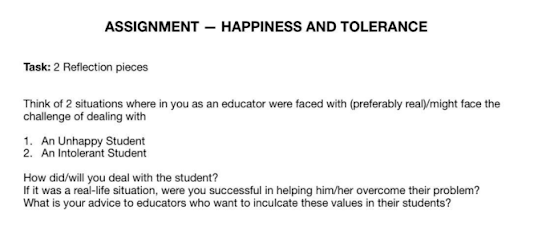
Happiness and Tolerance - Avighna RPKM


SITUATION 1
Last year, one of the teachers found a student who could neither study nor socialise with her peers. She was not interested in any of the schoolwork or homework. When the exams came up, she got failed. When the teacher asked her why, she didn't say a word and remained silent. So the teacher tried to call her parents, but no response was received from them.

On the day of the PTM, the teacher talked with her cousin (who came to attend the PTM). She then learned that the child's parents abandoned her, and she no longer lives with them. She feels more lonely after seeing other students having a good time with their parents. Days and nights, she is spent crying, missing her parents. She is no more willing to do anything that anyone is asking her to do.

How did the teacher deal with the student in this situation?
The teacher asked her peer group -
• to make her feel included every time and be a little polite towards her so that she will feel less lonely (VALUE- Love and Affection).
• Invite her to various group & solo activities (VALUE - WORKING TOGETHER).
• Have lunch with her (VALUE-SHARING).
• Try to be as much friendly as they can (VALUE - FRIENDSHIP/ BEING FRIENDLY).
• Make every moment special for her (VALUE- IMPORTANCE).

If it was a real-life situation, were you successful in helping him/her overcome their problem? 

Yes, it was a real-life situation, and the teacher could help that student, and she even showed significant improvement in her studies and other curriculum activities. Even she started feeling important in her class and improved her loneliness.

Advice to the educators:
Before scolding or giving any sort of punishment -
• talk to the child
• understand his/her situation
• make him/her feel at home at school.
• act like his/her mother or father when required.
• stop comparing the students with each other.
• motivate them

         
SITUATION 2
A student used to continuously disturb the class between lectures, roaming here and there unnecessarily, not completing his work, and not bringing his books and notebooks. Sometimes he misbehaved that he used to get scolded by everyone, but his behaviour remained unchanged, and instead of showing improvement, he got worse and was getting intolerable. Even his parents were very disturbed by his behaviour.

How does the teacher deal with the student in this situation?
One day the teacher decided to confront and counsel him after the class.
• Firstly, she pampered him.
• Then, politely, she asked him about the reason for his behaviour and if something was troubling him. And when she heard his reply, she was astonished. He confessed some heart-touching feelings. It was that whether it was at home or school, the child was facing negligence. Due to the lack of attention, he started behaving savagely; all the frustration he got from people who made him feel unwanted and unnoticed was bursting. Even when he wanted to confess his feelings, there was no one to hand an ear to him and the irony was everyone now became harsh and rude towards him. So he got habitual to this new behaviour cycle.

- By listening to these words, the teacher decided -
• to talk with his parents (VALUE - DISCUSSION) regarding what he shared.
• Instead of scolding him, she gave him more positive attention (VALUE - IMPORTANCE).
• Started analysing his behaviour and giving him personal advice (VALUE - GUIDING).
• In front of the class, instead of scolding and giving him punishment, the teacher started
appreciating him for his little efforts(VALUE - APPRECIATING). 

If it was a real-life situation, were you successful in helping him/her overcome their problem?

Yes, this is a real-life situation, and the teacher was able to help that student. It took a lot of time & effort to improve that child, but in the last, he improved his academics and became one of the best and most lovable children in the class.

Advice to the educators -
Everyone has a story, and so do the students. So instead of reacting,
• First, as a human, understand the reason behind every child's act.
• Secondly, discuss as many things as possible with the parents regarding the child's behaviour
and counsel them and their parents.
• Instead of scolding, find a way to help the teacher, parents, and child overcome
such a situation with a positive attitude.


Avighna @ RPK School Moradabad
Ritika, Neeru, Shwetank, Evon, Swadha, Saymeen and Deeksha

Saturday, August 28, 2021

Quality and love - Neelam Bhardwaj

The word Quality can be defined in two aspects -

  • The degree of excellence in the work undertaken.

  • Distinct virtue or characteristic - Discipline, Hard Work, Diligence, Sincerity etc.

Image from Shutterstock.com

A teacher deals with all kinds of students and no two students are the same. There are times when the children come up with untidy or incomplete work. So how a teacher can enhance the various qualities in the children to get a good quality of work from them.

There can be many reasons, for which a teacher needs to find the solutions as well.

1. Unclear concepts

Sometimes the child does not understand the concepts and finds it difficult to complete the given work. A teacher needs to find the learning styles of the students. For that matter, a teacher needs to be supportive and encouraging. There are some slow learners who may need extra help. The teacher should give them individual time, and may even need to adjust some assignments for them. 

2. Too much workload

Sometimes it is hard for the children to give good results in their work as they get overburdened by the work. Rather than teaching 2 or 3 topics together, the teacher should limit the learning to just one topic. Students will give a better quality of work as their focus remains on a single topic. Homework should be given, but limited. It is just a mode for the children to revise and retain what they learned in the class. Homework is given to set a system of learning, which helps the children to develop discipline and self-confidence.

3. Home is a place for relaxation

It is hard for the kids to focus at home. When the child is in the classroom there aren't a lot of distractions and  Learning is structured and organised. As soon as the children reach home their brain clicks to relaxing mode. They intend to do what they feel like. For this, the parents need to assist their child at home and teachers should make sure to check with the parents. Under the guidance of the parents, the children can give better results in their work.

4. Lack of interest

At a point in time, the children really lose interest in doing their work. A teacher needs to have discussions, not lectures. Some group activities, project work, outdoor walks, social experiments, should be included in the teaching to make the learning interesting and exciting for the students. This will definitely give good outcomes and improve the quality of work. 

5. Lack of understanding between teacher and student

Students are more inclined to complete assignments when teachers and students respect one another. Students sense when teachers care about them and want them to do their best work. Even the students will try harder if they know that the teacher cares about them and respects them not just as students but as human beings as well.

Classwork and homework can bring together children, parents and teachers in a common effort to improve students' learning. Teachers are the vital link in making this happen. Qualities like self-discipline, responsibility, love of learning, sincerity, punctuality which they learn at school benefit them throughout their lives.

Love

Love makes not just the world go around, but our perception of everything in the universe as well.

Love is a word that does not have a definition. It is more easily experienced than defined. It is multidimensional and complex yet simple and powerful. It takes on different forms. 

Middle school or High school is when many teenage students start to explore love and romance. This may seem silly but for a teen student, it is one of the most important steps in the journey of growth. This is the time when they are going through hormonal changes.

Image: Pinclipart

For teachers talking on a topic like love is as important as teaching any biology lesson. Teachers have a great role in helping students understand what love is and its various aspects. 

The conversation about love should start before the students reach that stage of getting into any romantic relationship. A teacher should define love to the students in different aspects. Having someone's help, enjoying a game together and sharing lunch is a way of showing love. It is the love that we share with our family, friends and pets. In another aspect- dancing, painting, travelling, gardening, shopping is also love because love is what you like. Doing something for the love of it is the most divine, wonderful, powerful way of doing it. Another form of love that generally attracts teenagers is the romantic form of love. The children need to know that love is not always about romance. 

Love and relationships can be difficult, especially in the teenage years. Budding romances can be fun but also confusing. In these moments of confusion, students often turn to friends or the internet. In that case, Students can be best guided by the teachers, as they spend most of their time in school.

Teachers need to counsel the children about love and infatuation. Even talk to the parents. Tell the children what is right and wrong for them. Needs to show the students that they value their opinions and keeps the door open to more conversations.

Images: Shutterstock.com

Teachers and parents can still have rules for the children to be safe, healthy and moral while communicating in a mutually respectful way.

 - Neelam Bhardwaj@JMMS, John Martyn Memorial School, Salangaon, Dehradun

Tuesday, July 27, 2021

Thoughtfulness and understanding - Neelam Bhardwaj

Thoughtfulness

Thoughtfulness is acting with thought and good sense. An important component of thoughtfulness is showing concern.

The 3 tools that can be used in the classroom to inculcate thoughtfulness about the right things among the students.

1. Be a helping hand

Being helpful means doing all it takes to care for others, be it your family, friends or community. It is a gesture of showing concern out of kindness. There are many ways children can be taught to be helpful. Children repeat words and actions they admire hence the best way to teach students to be helpful is by example. Children want to be involved. The teacher should start encouraging them to find ways to help others. Get along with the students and ask them to help in rearranging the tables and chairs, put up the charts in the classroom, emptying the dustbins, and put them in proper places. Do some activities in the classroom to stimulate creativity and get everyone involved in active ways. The children learn and begin to help others.

2. Celebration of togetherness

We live in a country with diversity. Students come from different religious backgrounds and cultures. Every culture and religion has its own faiths and beliefs, and the children should be taught to respect every religion. The best way to learn about other cultures is by celebrating the festivals together. Celebrating or talking about other religions allows the students to appreciate and respect others' faith. It is the best way to make them understand the fact that all religions spread peace and respect. Students come together to celebrate the festivals in the school. In this way, they become thoughtful and kind towards everyone without any kind of discrimination.

3. Get to know each other

Every student is different. Still, they all are equal in the eyes of a teacher. Children come from different backgrounds. To understand the students better, a teacher needs to spend individual time and communicate with the students. It helps to develop an awareness of students' challenges and needs. In this way, a teacher can help the students. When the teacher and the students have a better understanding, they build trust. Every individual feels genuinely valued for who they are and what they contribute as a unique individual.

Understanding

Understanding is the agreement of opinions or feelings. It's the adjustment of differences. To be understanding towards the world around you, you need to develop empathy.

Here is one of the many classroom activities that can be performed to encourage empathy among the students.

Circle Time

Kindness is a natural human response that doesn't need much encouragement. However, it is something that should be practised regularly. Kindness and empathy can be taught in the classroom.

Circle time is one of the activities that can be conducted in the classroom to encourage understanding of the world to the children.

This activity can be performed in the classroom or outside on the ground. Ask the students to sit in a circle. Every child should have a paper and pen where they have to write.

Someone you helped on  that day

Somebody helped you on that day.

It can be any big or small act of help. After writing, they all will share about it in the circle one by one. Other students must listen quietly. As everyone shares their incidents, they can relate them to one another and experience different emotions. They understand what it feels like to help someone and how it feels when someone helps you in need.  In the end, the children will come to the centre one by one and speak out about anyone emotion they felt or understood during the session and all those who felt the same emotion will raise their hands. 

This activity is a good way to encourage understanding and kindness among the students. Sharing nice and positive things with others makes them feel heard and affirmed by others.

- Neelam Bhardwaj @JMMS, John Martyn Memorial School, Salangaon, Dehradun

Thoughtfulness and Understanding - Bharti Dangwal

Understanding

Understanding is deeper than knowledge. Many people know you, but very few understand you.

This is one of the many thoughts that tells us that it is not necessary to have a lot of knowledge when understanding others. As nothing makes you a better person than being understanding towards others. A knowledgeable person doesn't need to always understand you. It needs a lot more than knowledge to understand others.

Understanding comes through communication, and understanding we find the way to peace. 

Also, if you need people around you and your surroundings to be happy, you first need to understand them and empathize with them. Then, only you will be able to figure out their problems and needs. 

As a member of the staff of my school, I know my students. I understand them, their behaviour, their mood, their problems, their attitude and their anger. Everything they are going through. I can do it as I try to understand them and think according to their perspective. 

I am also fully aware of the behaviour changes of my family members. Their needs and problems. I know when my sons are happy or sad or angry. I am also able to figure out why they have those mood swings. 

I also know how my cows are doing. What they need and why they are behaving strangely. 

This is all because I am staying with them from the start. I have been taking care of them since I found them. I have always tried to understand them. 

Understanding is fundamental and why it is important is because we live in a world that has become selfish and only thinks about ourselves. The emotions like anger, happiness, sadness, irritation, compassion, and understanding are part of the social world. 

To maintain balance in the world, it is essential to have an understanding of nature. 

Understanding brings kindness, happiness, compassion and cares to others. Understanding can also help us to reason out our anger also and keep ourselves and the other calm. All the emotions are interlinked with understanding.

Thoughtfulness

To be thoughtful means to be full of thoughts, and it also means to be considerate of others. It also indicates that we are kind or sympathetic towards each other.

We could also say that thoughtfulness includes doing good things for others without any selfish motive and expecting something in return. Sending flowers or gifts to others to make them happy, smile, or wish them whenever you meet them shows your thoughtfulness towards them. Thinking about others is also a part of thoughtfulness. It also means helping others in their difficult times or taking care of your family. Students need to have sympathy, kindness and care towards others, which can only come when they are thoughtful and think about others. For inculcating thoughtfulness in the student's many activities can be done in class, making a student kind, motivated, and helpful. 

The activities such as teachers can narrate them moral stories or stories related to kindness or watch movies that motivate them or be aware of others. We can ask them to do role plays where they can show some kindness or the act of caring for others. 

Teachers can have fun games for students regarding thoughtfulness. They can make a kindness tree in their class to write good things about their classmates every day. Each day they can write for different people. By doing such activities, they will know what others are doing for them and what they are doing. 

Motivation can be inculcated in students through rewards or praises. For example, whenever the students answer in class, they can praise them or provide stars or stickers.  The students can also appreciate the kid by giving positive feedback or giving applause to the student. Also, if a student gives a wrong answer, the teacher should not criticise him for the wrong answer but appreciate an answer, and the other students should not laugh or humiliate each other. In this way, students enjoy the class, but they get motivated to answer more and interact more.

So being thoughtful towards your surroundings is the best thing to make the world a better place for you and the people.

- Bharti Dangwal@JMMS, John Martyn Memorial School, Salangaon, Dehradun

Tuesday, June 15, 2021

Unity and Caring - Visionary JMMS

เคœเคฌ เคนเคฎ เคฆूเคธเคฐों เค•ी เคชเคฐเคตाเคน เค•เคฐเคจा เคถुเคฐू เค•เคฐเคคे เคนैं, เคคो เคฏเคน เคนเคฎें เค‰เคจเคธे เคœोเคก़เคคा เคนै เค”เคฐ เคนเคฎ เคเค• เคฎเคœเคฌूเคค เคฌंเคงเคจ เคฌเคจाเคคे เคนैं เคœो เคเค•เคคा เค•ो เคฆเคฐ्เคถाเคคा เคนै।

เคฆेเค–เคญाเคฒ เคช्เคฏाเคฐ เค”เคฐ เค•เคฐुเคฃा เค•ी เคญाเคตเคจा เคนै। เคฎुเคธ्เค•ुเคฐाเคคे เคนुเค เคšेเคนเคฐे เค•ो เคฆेเค–เค•เคฐ เคนी เคชเคคा เคšเคฒ เคœाเคคा เคนै เค•ि เค…ंเคฆเคฐ เคเค• เคฆेเค–เคญाเคฒ เค•เคฐเคจे เคตाเคฒा เคต्เคฏเค•्เคคि เคนै।

Mohit is a happy child ,always full of energy, he has a great love for drawing. The bell rang and it was time for the art class. Mohit seemed uninterested and lost in the class. The teacher noticed and asked the reason as she had never seen him like that, and that too in his favourite class. Tears rolled down from Mohit's eyes as he could not hold them back and said ' I don't want to go home, I don't like my neighbours.' The teacher somehow managed to calm him down and gave him a colouring sheet to deviate his mind and emotions.

Next morning Mohit's parents were at school to unenroll him. The teachers knew about the incident which happened in the class the day before, and were a  little startled by their sudden decision. 

Everyone in the school knew that Mohit was specially abled and had a speech disorder which never made any difference in the school. He was treated just like other children.

Soon the teachers got to know the real reason, they were the neighbours whom he was talking about, the children in his neighbourhood used to tease him and never included him in their games. Mohit felt lonely and that's why he was refusing to go back home. Because of this his parents decided to shift to a new place. 

The teachers managed to make them realise and reflect on their decision and told them to support him as they have been doing, try to make a happy environment around him and ignore what others think or say. Finally Mohit's parents withdrew their decision

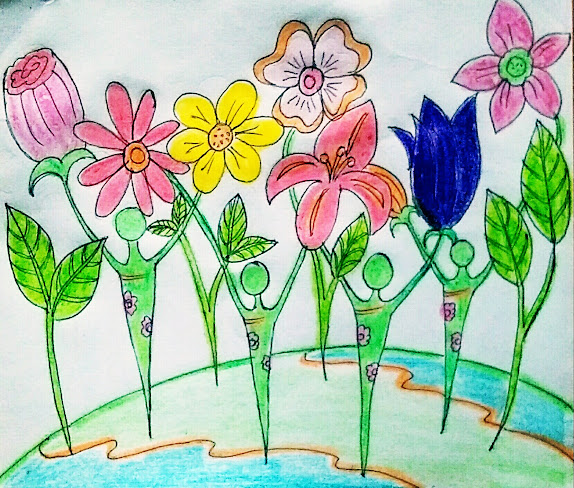
At school it is the responsibility of the teacher to teach the children to appreciate differences, encourage them to recognise that we all are different yet we all are the same on the inside. But the learning doesn't limit to the school, the society and the people living in the society should also understand that everyone is unique and together we are like the flowers in a beautiful garden. 

Today we are living in a society where at some point we too had negative impacts on our well-being. In these circumstances we should believe in ourselves, stay with the ones who support us and care for us.

Different things can live together. When we all will understand this we can get along well with each other and start cooperating and caring without judgement.

'I can do the things you cannot, you can do the things I cannot; together we can do great things.' ~Mother Teresa

Visionary JMMS@John Martyn Memorial School, Salangaon, Dehradun - Neelam Bhardwaj, Pareenita Negi, Manmohan Kaur, Ambika Gurung, Bharti Dangwal

Friday, January 29, 2021

Responsibility commands Cooperation- Medley DGS

“Be Responsible” is something we all have been hearing since childhood. It is one of the first few expectations laid upon us from our parents. "at-least take responsibility of your stuff" “be responsible, you are not a kid anymore” and so on, yet it takes ages to understand the simple meaning of this word. 

This year, on Teacher’s day Facebook was full of lovely messages filled with gratitude from students all across the globe for their teacher’s right from primary school to college. One of the messages was, “What I am today is because of my teacher.” It filled me with awe and respect for my profession even more. Then, suddenly a thought struck me and scared me to the core. What about the ones who are in jails, criminals who never got caught, the rapists and murderers, the corrupt bribe takers? Did none of them go to the school and if the answer is NO. Is it not true for them What I am today is because of my teacher”? 

When I asked this to myself, I understood the meaning of responsibility. To be responsible, means to take responsibility of your words, actions, behavior, thoughts and their consequences. That means, my responsibility is not limited to my work, but its result and how this result is impacting other lives. In this sense a teacher’s actual performance will be reflected not with the success of her students but with the development of the society as a whole. But what can I do all alone? This thought put me into a pause. Which got cleared when Sugandha shared her experience, that how one child of her class influenced others.


After hearing her I remembered the famous quote of Mahatma Gandhi “Be the change you wish to see in the world”. And now I know that I just need to take the responsibility and will eventually get cooperation from others as Responsibility commands Cooperation. 

Anubhuti has beautifully captured this video which speaks for itself.

We all have our own stories of this understanding and insight, Kirti had her realization during lockdown when she thought, “it’s a matter of one or two months and after that everything will be okay then I'll be back to the school and will resume the teaching the way I was doing it before.” But when the situation became grave then she took the responsibility of teaching her students through online classes. Which initially was very difficult for her but slowly and gradually with the cooperation from everyone she handled the situation, even the kids became her support system as they too cooperated and enjoyed this new system of learning, now it's been a year that she is able to take the classes efficiently and effectively.

Rudrani realized her full potential when she took the responsibility of looking after foreign delegates during her university seminar. Overcoming her nervousness and under confidence, she not only fulfilled her responsibilities but also enjoyed doing that, and she got support and appreciation from everyone.  

Chandralekha in one of her science class divided the class into four groups and asked each group to prepare a quiz for the other three groups. This exercise became such fun among kids; they not only referred their books but also searched the internet to be creative and innovative with their questions. All the group members cooperated and came up with amazing questions. What a beautiful depiction of responsibility and cooperation shown by young children.

In Mamta’s words:-

เคœเคฌ เคต्เคฏเค•्เคคि เค•िเคธी เค•ाเคฐ्เคฏ เค•ी เคœिเคฎ्เคฎेเคฆाเคฐी เคฒे เคฒेเคคा เคนै,

เคคो เคตเคน เค…เคชเคจी เค‰เคจ्เคจเคคि เค•ा เคฎाเคฐ्เค— เคช्เคฐเคถเคธ्เคค เค•เคฐ เคฒेเคคा เคนै।

...เค•िंเคคु เคœเคฌ เคนเคฎ เค‰เคค्เคคเคฐเคฆाเคฏिเคค्เคต เคฒेเคจे เคฎें เค†เคจाเค•ाเคจी เค•เคฐเคคे เคนैं,

 เคคो เคนเคฎ เคฌเคธ เคฆोเคทाเคฐोเคชเคฃ เคคเค• เคนी เคธीเคฎिเคค เคฐเคน เคœाเคคे เคนैं


เคธเคนเคฏोเค— เคต เค‰เคค्เคคเคฐเคฆाเคฏिเคค्เคต เคนाเคฅ เคฎें เคนाเคฅ เคกाเคฒे เคšเคฒเคคी เคนै ,

เค‡เคจ เคฆोเคจों เคธे เคนी เคธเคฎाเคœ เค•ो เคช्เคฐเค—เคคि เคฎिเคฒเคคी เคนै।

เคฏเคฆि เคนเคฎ, เค…เคง्เคฏाเคชเค• เคจिเคท्เค•्เคฐिเคฏ เคนोเค•เคฐ เคฌैเค  เคœाเคंเค—े!

เคคो เค†เคจे เคตाเคฒी เคชीเคข़ी เค•ो เค•ैเคธे เคธเคฆ्เคฎाเคฐ्เค—  เคชเคฐ เคฒा เคชाเคंเค—े!!

Proud to be Educators From Medley DGS at The Doon Girls' School - Anubhuti Sharma, Chandralekha Negi, Kirti Bisht, Mamta Kandpal, Neelam Waldia, Rudrani Ray and Sugandha Ahluwalia.

Saturday, September 26, 2020

Happiness and Tolerance - Magnets DGS


A dialogue between a teacher and a student

Student: As I look out of the class and watch the birds fly past, the squirrel run up and down from the tree to the grass, that is happiness for me! 

Teacher: I see you look out of the window and not at the board, the window to the world, that I worked all night in the cold, for you my child and yet not say a word, that is tolerance for me!

Student: Do you know, teacher? Much as I would love to hop, skip and jump, walk forward and backwards and then take a turn and run, I walk in a line, one foot behind the other, with a body like a pole, from head to toe, that is tolerance for me!

Teacher: I know my child, I understand what you say, for I have seen you jump in the puddles, as you go walking in the rain, my childhood memories come flooding back again, that brings happiness to me!

Student: Oh really, teacher? You too were a child like me, in school, and listened to your teachers without being naughty? Then why don’t you let me be ME?

Teacher: I wish I could get off the silly-bus, my child, that we call the syllabus and let you experience the world unfold, just the way, YOU want it night and day, for happiness leads to tolerance and tolerance leads to happiness, is what we believe and say!

We as educators understand that happiness comes from contentment and achievement of goals, happiness leads to tolerance and tolerance comes with understanding, understanding the perspective of the people around us. So, let us set realistic goals and work towards tolerance.

Magnets DGS: 
Kiran Juyal, Manju Srivastava, Mezhu Chopra, Pooja Sharma, Renu Sundriyal
The Doon Girls' School, Dehradun

Friday, September 25, 2020

Happiness and Tolerance - Medley DGS

Robert Collier said, “Success is the sum of small efforts, repeated day in and day out.
If success brings happiness, the persistency that leads to this happiness comes only with tolerance. Without being tolerant, happiness is a misunderstood act and if one is not happy about being tolerant then it is anything but tolerance.

For class 7th girls happiness was about making fun of the poor accent of Rohini, they would not include her in their games or their study groups. Until their class teacher, Kirti decided to teach them the lesson they will remember for a lifetime. Kirti started taking extra classes with Rohini and started preparing her for the assembly conduction in English. With this motivation from the teacher, Rohini also got her confidence back and started putting more efforts.


She learnt quickly and the day she conducted assembly the whole school was surprised, the Headmistress too praised Rohini and everyone applauded for her performance and attitude. That day, when she entered the class she was not only welcomed but also respected. Children often confuse happiness with having fun even if it is at the cost of someone’s emotion so it is important to make them understand that happiness without tolerance is not only incomplete but also fake and short-lived.


Mamta has been teaching primary and pre-primary classes in a boarding school, her role in the school and her student’s life has been beyond teaching which was inspiring yet challenging. In her third year of teaching she had a new admission in her class 1, a sweet little girl from a small town near Kolkata, who could not speak or understand anything except Bangla. The girl had left her parents for the first time; she was emotionally disturbed as why she had been sent far from her parents and withdrawn herself from everyone. Mamta was her teacher but before getting into teaching, she had to break that emotional barrier and with language gap, it seemed to be an impossible task. She learnt a bit of Bangla, got a few sentences translated into the language so she could communicate with the child. With her affection, persistent efforts and tolerance for the child, she broke that barrier. Today that girl is an all-rounder; she is not only good in studies but has won lots of prizes in Music and Art as well. Because of Mamta and other teachers of the school, she understood why she was sent here and now her younger brother is also a part of the school, who again speaks only BanglaJ.

While talking about Tolerance and Happiness, it is worth mentioning the remark of a co-teacher who said, “If Happiness is the centre of a circle then Tolerance is the circumference”. And, I feel that at school we are tied with a stretchable string. We keep bouncing back to the centre and take the further leap to make the circle bigger every time.   
  
Proud to be Educators From Medley DGS - Anubhuti Sharma, Chandralekha Negi, Kirti Bisht, Mamta Kandpal, Neelam Waldia and Sugandha Ahluwalia

Wednesday, September 2, 2020

Thoughtfulness and Understanding - Richa Solanki

Thoughtfulness is a feeling of thinking before we act. Thoughtfulness is a way to encourage love and appreciation for others. It is thinking to change the world for better. A way to show thoughtfulness is to help someone and it helps us feel better. By thoughtfulness, you can neutralize the negativity.

When someone doesn’t act with respect or kindness, at that time how you react.  Anger – an emotion that can cause so much damage and hurt at school. You think about people other than yourself. This is thoughtfulness. 

Sometimes we act before we think. This can hurt other people, so think and then react. We always need someone who thinks from our perspective in any situation that will give us pain but people who think in favour of others is always loved by everyone.

Most of us feel many different emotions in our daily life and this changes our moods and we talk according to that only. Like if we are happy then if a  situation is sad we will handle it joyfully. Like if we are angry and anyone comes to talk to us if we answer rudely we just put out all stress on that person even if the person had no mistake. But in this, we need someone who understands that we need some space or need to understand our mood and linger out our thoughts. Emotions can be mild, emotions depend on the situation and on the person. There are ways to express emotions. It is like a skill to be able to understand emotions.

All emotions tell us something about ourselves and our situation. But sometimes we find it hard to accept what we feel. We might judge ourselves for feeling a certain way, like if we feel jealous. Instead of ignoring, we must notice how others actually feel. 

It's harder to move on from difficult feelings and allow them to fade if we don't face them and try to understand why we feel that way. But if a person loves to understand everyone, there must be an understanding between them and there will be no misunderstanding, blames and no doubts. Understanding is feeling towards a person whom we trust and if we trust them, we leave all things on them only to see how much they respect us without breaking our trust and this shows love and understanding.

Richa Solanki
The Fabindia School
rsi4fab@gmail.com

Blog Archive