Showing posts with label guidance. Show all posts

Tuesday, July 21, 2026

Taking my Learning Forward - thank you note from Kratika


Reflection on “My Good School”

Dear Sir, 

Thank you for conducting such an insightful and thought-provoking workshop on “My Good School”. The session was much more than a discussion about a book—it was an opportunity to reflect on the true purpose of education and the role each one of us plays in shaping young minds.

One of my biggest takeaways was the idea that a good school is not defined merely by academic excellence, but by the values it nurtures, the relationships it builds, and the environment it creates for every learner. The emphasis on kindness, gratitude, responsibility, and character-building resonated deeply with me.

The workshop also encouraged me to introspect on my own teaching practices. It reminded me that as educators, we are not just facilitators of knowledge but mentors who inspire curiosity, empathy, and lifelong learning. Small, intentional actions in the classroom can have a lasting impact on students’
lives.

I truly appreciate the interactive nature of the session and the practical insights shared. It has motivated me to consciously incorporate the principles of “My Good School” into my daily teaching, helping create a classroom culture where students feel valued, respected, and encouraged to become responsible citizens.

Thank you once again for your guidance and for inspiring us to strive towards making our schools places where every child can truly flourish.

Warm regards,

Kratika Singhal
DPS Abu Road

Sunday, July 12, 2026

“Heart vs Mind” reading ahead teenage behaviour and relationships

Learning Forward Saturday focused on reflections from the book “Wanted Back-bencher Last-ranker Teacher” and on reading a chapter about Roma’s experience with teenage relationships. Brinda led the session by having participants share their reflections on the “Heart vs Mind” chapter, in which Rekha Sharma and Sneha shared insights into teachers’ responsibilities for understanding and supporting students’ emotional well-being. The group then read a chapter where Roma counselled two students, Arjun and Rakhi, about their romantic relationship, and later met with the students’ parents to discuss appropriate consequences. The discussion highlighted Roma’s mature approach to working with both teenagers and their parents, explaining the psychological and biological factors behind teenage behaviour and relationships. The session concluded with a brief discussion about Roma’s upcoming confrontation with a senior teacher, Simon Sir, regarding allegations about her behaviour with students.

Next steps: Brinda Conduct all future reading sessions on Saturday at 3:30pm. Collaboration All participants: Write and share reflections on the chapter read in the meeting, focusing on takeaways and personal insights as teachers, parents, or people who deal with teenagers. Summary Heart versus Mind Reflections The meeting focused on participants’ reflections on the chapter “Heart vs Mind.” Rekha Sharma shared that the chapter deepened her understanding of a teacher’s responsibilities, emphasising the importance of emotional security for students and balancing both heart and mind in teaching. Sangeeta Singh’s reflection highlighted the need for emotional support and understanding during adolescence, noting that students perform better when they feel valued and emotionally secure. Both reflections emphasised the importance of connecting with students’ emotions before addressing their behaviour and the role of both teachers and parents in nurturing emotionally strong individuals alongside academic excellence. Teen Relationship Counselling Discussion The meeting focused on reading and discussing a book called “Wanted Back-bencher Last Ranker Teacher” by Roma. The group read a chapter involving two teenagers, Arjun and Rakhi, who were caught by a teacher and discussed their relationship and the challenges it presented. Roma, the non-teacher protagonist, counselled the teenagers and later met with their parents to address the situation. The discussion highlighted the complexities of teenage relationships and the need for understanding and support from both parents and teachers during this developmental phase. Teenage Relationships and Behaviour Guidance The meeting focused on discussing teenage relationships and behaviour, with Roma providing insights on how to handle situations involving young students like Arjun and Rakhi. Roma explained that teenagers often seek emotional support through relationships and suggested that parents should communicate openly with their children rather than prohibit relationships. The discussion also covered how teenage brains are still developing, particularly in areas related to emotions and decision-making. The conversation ended with a brief discussion about a staff situation involving Roma and Simon Sir, regarding allegations that they took students to Club Paradise. Zoom notes AI can make mistakes. Review for accuracy.

Sunday, July 5, 2026

Heart Vs Mind - Sunbeam School Mau


Reading the chapter “Heart Versus Mind” made me reflect deeply on the responsibilities of a teacher. The chapter beautifully shows that every child carries emotions, fears, dreams, and struggles that are not always visible. As a teacher, I believe that before correcting a student’s behaviour, I must first understand the reason behind it, as Brinda Ma’am said. Young children need emotional security more than strict discipline. If a child cries, becomes silent, or behaves differently, I would patiently listen, comfort them, and make them feel safe rather than scold them. A classroom should be a place where children feel accepted, respected, and confident to express themselves. 

A student’s emotional well-being is the foundation of meaningful learning. At the same time, senior students need guidance, trust, and motivation as they face academic pressure, peer influence, and personal challenges. Instead of judging them for their mistakes, as a Pastoral Guide, I would encourage open conversations, appreciate their efforts, help them set realistic goals, and remind them that failures are opportunities to learn. 

The title “Heart vs. Mind” reminds me that a good teacher should never choose one over the other. The heart teaches us to be kind, compassionate, and understanding, while the mind helps us remain fair, responsible, and thoughtful in our decisions. A balance of both qualities enables a teacher to create a positive learning environment where students not only achieve academic success but also grow into confident, responsible, and emotionally strong individuals. 

This chapter has strengthened my belief that the greatest achievement of a teacher is not producing high scorers but touching students’ lives with empathy, patience, and genuine care.

Rekha Sharma

As I read this part of Heart vs Mind, I was reminded that adolescence is one of the most sensitive phases of a student's life. As an Academic Head and an English teacher, I often observe that students need not only academic guidance but also emotional support, understanding and someone who listens to them without judgement.

What impressed me most was Roma Mathur's approach of understanding her students before correcting them. She looked beyond their behaviour and recognised their emotions, fears and hidden potential. This reflects the true essence of education—that every child deserves empathy, trust and an opportunity to grow.

In my experience, students perform their best when they feel valued and emotionally secure. Meaningful conversations, encouragement and a positive teacher-student relationship often create a greater impact than mere classroom instruction. This chapter also reminds us that when teachers and parents work together with patience and understanding, children develop the confidence to make responsible decisions.

For me, education is not only about academic excellence but also about nurturing emotionally strong, responsible and compassionate individuals. Heart vs Mind beautifully reinforces the belief that before shaping a student's mind, we must first connect with their heart.

Sangeeta Singh

Thursday, July 10, 2025

🌕 Guru Purnima Tribute to Sandeep Dutt 🌕


On the sacred day of Guru Purnima, we take a moment to honour and express heartfelt gratitude to a guiding light in our lives — Sandeep Sir.

A Tribute on Guru Purnima

A true Guru does more than teach — they nurture, guide, and walk alongside us as we learn to navigate life. Mr. Dutt, you have embodied this role with quiet strength and deep humility. Your presence in our lives has been a gift, not just for what you’ve taught us, but for how you’ve taught us to believe in ourselves.

With patience and clarity, you’ve helped shape minds and build character. You’ve never needed to raise your voice to make an impact — your actions, your discipline, and your unwavering belief in your students have spoken louder than words ever could. You’ve shown us how to lead, not by instruction, but by example.

Each lesson from you carried more than knowledge — it took a message of integrity, of perseverance, of compassion. Even when we faltered, you saw something in us worth nurturing. You never imposed answers — instead, you encouraged us to think, to question, to find our own truths.

On this Guru Purnima, we offer our deepest gratitude. Thank you for being a guiding light — not just in the classroom, but in life. Thank you for inspiring us to grow not just in intellect, but in spirit.

Wishing you continued strength and fulfilment on your path. May your wisdom continue to shine in the lives of many more.

"A true Guru doesn't show you the path — he walks beside you until you find your own."

With heartfelt respect,
Manisha Khanna

Saturday, May 24, 2025

Turning Direct Instruction on its Head

Masterclass Session with Sandeep Dutt

As educators, we often face a dilemma: Should we pursue direct instruction or embrace the uncertainty of productive failure?

Pressed for time, and sometimes driven by the belief that students can't learn without explicit guidance, many of us default to direct instruction. But in doing so, are we boxing their thinking, limiting their potential to explore, connect, and construct meaning independently?

Can productive failure truly work in all situations?

Which approach actually leads to deeper, transferable learning?

We will explore these questions together as we delve into Chapter 2, "The Solution—Productive Failure,"  from Manu Kapur's acclaimed book Productive Failure.

The dynamic book discussion will help you reflect, rethink, and redesign learning that empowers students to think beyond instructions.

Summary of the session

Sandeep introduced the Teachers Academy Blog and discussed the concept of productive failure in learning, contrasting it with direct instruction and explaining its potential benefits for students' conceptual understanding and problem-solving abilities. He outlined the key elements of designing robust experiments to compare teaching methods and emphasised the importance of statistical significance and effect size in research findings. The session concluded with a discussion on the effectiveness of combining inquiry and direct instruction for deep learning, and the importance of how foundational knowledge is acquired for creativity and understanding.

Key Takeaways

Chapter 2: THE SOLUTION: PRODUCTIVE FAILURE 

1. Direct Instruction trumps pure discovery learning. But that does not make Direct Instruction the most optimal learning model.

2. Productive Failure designs for and bootstraps failure for learning. Even though students fail at solving problems targeting concepts they have not learned yet, the failure is designed to prepare them to learn from subsequent instruction.

3. Productive Failure trumps Direct Instruction. Robust evidence shows that Productive Failure produces significantly better understanding and transfer outcomes than Direct Instruction.

4. Making learning easy does not necessarily make it easy. There is a time for failing and a time for telling.

Saturday, February 15, 2025

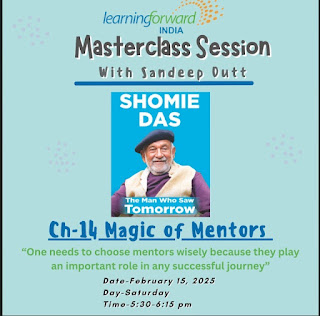
Magic of Mentors: Masterclass Saturday February 15 2025


Chapter 14: Magic of Mentors: A Man Who Saw Tomorrow by Naga 

The saying that we are the average of the five people we spend the most time with highlights how important our environment and the people around us are. Choosing mentors wisely can have a profound impact, as they shape our mindset, skills, and even our values. Have you had any mentors who’ve made a big difference in your life?

Q1. Mentors play a crucial role in shaping one’s journey to success. Reflecting on your experiences, have you had a mentor who guided you during your student life? What qualities do you believe are essential for an effective mentor?

Q2. As an educator, you interact with students who may not always recognise their strengths. How do you identify their hidden potential and provide the proper guidance to help them grow?

Q3. If you had a magic wand to inspire, guide, and unlock the hidden potential of your students, what would your magic mantra be? How would you apply it to create a lasting impact on their learning and personal growth?

Q4. Mentorship goes beyond guidance; it fosters a culture of trust and inspiration. How can you foster a classroom environment where students feel encouraged to seek and offer mentorship among peers?

Session Recording

Sunday, February 2, 2025

Right Vs Wrong - Sunbeam Bhagwanpur

Teenagers who struggle to differentiate between right and wrong often find themselves making impulsive decisions without fully understanding the consequences. This confusion can stem from various factors, including peer pressure, lack of guidance, exposure to negative influences, or simply the inexperience that comes with youth.

At this stage of life, they are exploring their independence and forming their own identities, but without a strong moral foundation or proper role models, they may be easily swayed by what seems exciting or socially acceptable rather than what is truly right. Sometimes, they justify their actions by following the crowd, seeking approval, or prioritizing short-term pleasure over long-term consequences.

Smriti Tiwari
Ayushi Chowdhry
Sunbeam Bhagwanpur

Thursday, January 30, 2025

HeArT vs MiNd

HEART VS MIND
       
# Navigating the Emotional Labyrinth: A Modern Guide to Adolescent Parenting
Modern parenting requires a shift from authoritative leadership to thoughtful facilitation. While parents naturally draw from their personal experiences, offering well-intentioned advice based on past situations, this approach needs careful consideration in our rapidly evolving society. What worked for one generation may not adequately address the challenges faced by the next, as social structures, technology, and cultural norms continue to transform.
However, amid these changes, emotions remain a constant thread connecting generations, though their expression varies across different life stages. Adolescence, in particular, emerges as a critical period characterized by intense emotional experiences. During this phase, young people navigate complex territories: peer competition intensifies, romantic feelings emerge, and questions of personal identity become paramount through exploration of appearance and style.
The digital age has amplified these challenges, with social media creating new dimensions of peer pressure and emotional complexity. Simple friendships can evolve into deeper emotional attachments through constant digital connection, while the desire for validation and acceptance takes on new forms.
In this landscape, parents and educators must adapt their approach. When confronted with teenage mistakes or unexpected behavior, responding with patience and empathy becomes crucial. Rather than immediate judgment or quick solutions, creating space for understanding and dialogue proves more effective.
The key lies in helping adolescents maintain their sense of self while navigating emotional turbulence. 
Parents can achieve this by:
- Maintaining open communication without judgment
- Validating feelings while helping maintain perspective
- Supporting identity exploration while reinforcing core values
- Teaching emotional regulation while allowing for authentic expression
Success in modern parenting comes from finding the balance between providing support and allowing independence. By understanding emotion as a bridge between generations while acknowledging its evolving expression, parents can better guide their children through the complexities of contemporary adolescence.

Ankit Khare
Sunbeam School Sarnath

Thursday, January 2, 2025

Reflection on a year of Transformation: By Sanyogita Dubey and Reeta Tiwari


Attending multiple learning sessions from Masterclass 2024 is a transformative experience for us.

We have gained many skills under the guidance of our mentors which enhanced our teaching learning process. We have learnt how to write creative blogs? How to be a good videographer?How to work in a podcast?  and How to be a good story teller? Blogging, serve a plateform to share teaching strategies, Classroom experiences or other insights.
These skills helped us in creating educational video for students which make our class more interactive and interesting and promote the student's to make their own videos and blogs.
Now we are able to think outside the box and bring fresh ideas into our classroom.
Masterclass has proven to be a plateform that not only enhance our personal skills, self esteem, our confidence but also revitalizes our teaching approach to resonate with modern learners. We would like to show our gratitude to all my mentors.And we are so privileged that we are the part of this learning session.
Thank you and Jai hind.
Reeta Tiwari 
Sanyogita Dubey
Sunbeam English School Bhagwanpur.

Tuesday, August 8, 2023

A fearful student & an impatient student: Aadhya RPKM

Situations where you as an educator are faced with the challenge of dealing with -

1. A Fearful Student 

2. An Impatient Student 


How did/will you deal with such kinds of students? 


As teachers, we deal with both kinds of students; In case of a fearful student, we can initiate the conversation. To understand the situation, we can do the following things: 


1. Asking about their fears - We usually  ask the child to speak up about his/her fears. What are the challenges or fears that he/she is facing? As teachers, we will try our best to help the student to overcome that fear. 


2. Connect with parents and ask them the reason- If the child does not respond about his/ her fears, we will try to connect with his/her parents to understand the actual reason behind the fearful behaviour of the child.


3. Identify the possible solutions- As teachers, we will try our best to find out the best possible solutions for helping the child. 


4. List the pros and cons of each solution- To remove the fear from the fearful student, we should make a list of all the pros and cons of the solution. It is to help teachers and the student to be mentally prepared for the consequences.


5. Create an action plan - To deal with such kinds of students, a teacher needs to prepare an action plan so the student can be more frank and outspoken to the teacher. 


6. Implement the action plan - After creating an action plan, every teacher must try their best method to implement the action plan. 


7. Help them to build self-confidence - To remove the fear from the fearful student, the teacher should be very open and frank. The teacher should  encourage such students to actively participate in all classroom activities. This will help the student develop self-confidence; His/her morale will also boost. 


Impatient Student

How to deal with impatient students- 


1. By praising them: By saying “Thank you for waiting so calmly for your turn”. For impatient students, it is one of the best ways to praise them to make them feel appreciated by their teachers. With time, they will self-generate this feeling of being praised and their habit of being impatient will slowly decrease. 


2. Help them to develop self-control - This method will be initiated by the teachers by keeping extra classes or some activities which will initially improve self-realisation and self-control among the impatient students. 


3. Motivate them to meditate daily to build inner calmness- It is one of the best and most important ways to deal with an impatient student. There must be 3-4 minutes of meditation sessions daily before starting the classes to help students develop inner calmness.


4. By telling them stories on how waiting for things sometimes makes us happier in the long run - We can deal with such kinds of students by telling them moral stories or stories which will prove beneficial for developing self-confidence subsequently leading them to become a good child with good moral values and positive attitude. 


5. Teach them to concentrate on learning rather than focusing on the outcome - To deal with such students, a teacher needs to teach them that learning is more important for them than the result or the outcome they seek in learning. We should teach them that learning improves their vision for achieving higher goals in life. 

Aadhya @ RPK Moradabad, India Deepa Khanna, Rachna Bisht, Asma, Farida, Sushma, Kulmeet, Krishangi.


Saturday, August 28, 2021

Quality and love - Neelam Bhardwaj

The word Quality can be defined in two aspects -

  • The degree of excellence in the work undertaken.

  • Distinct virtue or characteristic - Discipline, Hard Work, Diligence, Sincerity etc.

Image from Shutterstock.com

A teacher deals with all kinds of students and no two students are the same. There are times when the children come up with untidy or incomplete work. So how a teacher can enhance the various qualities in the children to get a good quality of work from them.

There can be many reasons, for which a teacher needs to find the solutions as well.

1. Unclear concepts

Sometimes the child does not understand the concepts and finds it difficult to complete the given work. A teacher needs to find the learning styles of the students. For that matter, a teacher needs to be supportive and encouraging. There are some slow learners who may need extra help. The teacher should give them individual time, and may even need to adjust some assignments for them. 

2. Too much workload

Sometimes it is hard for the children to give good results in their work as they get overburdened by the work. Rather than teaching 2 or 3 topics together, the teacher should limit the learning to just one topic. Students will give a better quality of work as their focus remains on a single topic. Homework should be given, but limited. It is just a mode for the children to revise and retain what they learned in the class. Homework is given to set a system of learning, which helps the children to develop discipline and self-confidence.

3. Home is a place for relaxation

It is hard for the kids to focus at home. When the child is in the classroom there aren't a lot of distractions and  Learning is structured and organised. As soon as the children reach home their brain clicks to relaxing mode. They intend to do what they feel like. For this, the parents need to assist their child at home and teachers should make sure to check with the parents. Under the guidance of the parents, the children can give better results in their work.

4. Lack of interest

At a point in time, the children really lose interest in doing their work. A teacher needs to have discussions, not lectures. Some group activities, project work, outdoor walks, social experiments, should be included in the teaching to make the learning interesting and exciting for the students. This will definitely give good outcomes and improve the quality of work. 

5. Lack of understanding between teacher and student

Students are more inclined to complete assignments when teachers and students respect one another. Students sense when teachers care about them and want them to do their best work. Even the students will try harder if they know that the teacher cares about them and respects them not just as students but as human beings as well.

Classwork and homework can bring together children, parents and teachers in a common effort to improve students' learning. Teachers are the vital link in making this happen. Qualities like self-discipline, responsibility, love of learning, sincerity, punctuality which they learn at school benefit them throughout their lives.

Love

Love makes not just the world go around, but our perception of everything in the universe as well.

Love is a word that does not have a definition. It is more easily experienced than defined. It is multidimensional and complex yet simple and powerful. It takes on different forms. 

Middle school or High school is when many teenage students start to explore love and romance. This may seem silly but for a teen student, it is one of the most important steps in the journey of growth. This is the time when they are going through hormonal changes.

Image: Pinclipart

For teachers talking on a topic like love is as important as teaching any biology lesson. Teachers have a great role in helping students understand what love is and its various aspects. 

The conversation about love should start before the students reach that stage of getting into any romantic relationship. A teacher should define love to the students in different aspects. Having someone's help, enjoying a game together and sharing lunch is a way of showing love. It is the love that we share with our family, friends and pets. In another aspect- dancing, painting, travelling, gardening, shopping is also love because love is what you like. Doing something for the love of it is the most divine, wonderful, powerful way of doing it. Another form of love that generally attracts teenagers is the romantic form of love. The children need to know that love is not always about romance. 

Love and relationships can be difficult, especially in the teenage years. Budding romances can be fun but also confusing. In these moments of confusion, students often turn to friends or the internet. In that case, Students can be best guided by the teachers, as they spend most of their time in school.

Teachers need to counsel the children about love and infatuation. Even talk to the parents. Tell the children what is right and wrong for them. Needs to show the students that they value their opinions and keeps the door open to more conversations.

Images: Shutterstock.com

Teachers and parents can still have rules for the children to be safe, healthy and moral while communicating in a mutually respectful way.

 - Neelam Bhardwaj@JMMS, John Martyn Memorial School, Salangaon, Dehradun

Sunday, November 22, 2020

Thursday, July 9, 2020

Making Thinking Visible - Bharti Rao

Life as a teacher begins when we realize that we are learners. Learning is a lifelong process
which continues until the end. The period of COVID -19 has given ample opportunities to the Educators to enrich themselves in many ways through webinars, workshops, personal development programs and training. This experiential learning has brought a great change in them and also helped them to bring in a transition in their kids too. 
  
Transition in Kids from ‘I can’t do it!’ to be proactive that ‘I can do !’ is necessary. For this it is necessary for students to think why they are stuck and what should they do to get out of this? For this, they need to learn to think about their own thinking. This can only be possible with the proper guidance from elders. Teaching reading to students will help to make thinking visible. 

How can students’ thinking be made visible? This can be made visible by reflecting on our thoughts. Reflecting and thinking are a powerful tool which helps a student to overcome obstacles, be more resilient and successful. Educators should organize activities and give a text to them to read. After reading the text the student needs to relate it with any instance similar to it. 

Then he needs to think and answer the questions so the best ways to think is by reading, listening, questioning and documenting. This helps a student to make his thinking visible and understand his learning. Some examples of to think visible are field trips, learning through theatre,   engaging activities, exploring etc. 

Courtesy:  Re-Orienting English Curriculum by U Catapult

Bharti Rao
The Fabindia School
bro@fabindiaschools.in

Sunday, March 1, 2020

Homework and Tuitions: Prerna Rathod


Homework and tuitions are the terms connected with the school. Homework is an essential part while tuition is an imposition. If a school handles homework in the correct way, then there is no need for tuition.

Many times homework is given and students don’t do it. There may be many reasons for this like student may not have understood it or he has forgotten or he needed guidance but he did not get help for parents. Homework must be given in such a way that students can do it easily and independently. It should be interesting so that he is eager to do. Too much homework should not be given otherwise the student will think it as a burden and not do it. Homework should be given to developing skills in a student like reading, creative writing, thinking skills, etc. In Mathematics sums should be given which have been taught in the class and students have understood it properly. This will help them to practice sums and improve it. Thus, a school must have qualified, compassionate, hardworking and caring Educators who will set homework keeping in mind their students. If homework is given keeping time in mind, then the child will get time to play, spend time with family and friends and do work which he likes.

Tuition, on the other hand, are an extra burden for the child. Nowadays, it has become a fashion to go for tuition. In some cases, parents send their child thinking this will help their child to get good marks. While sometimes, a child joins tuition because all his friends are going so he joins too. If a child is attentive in class and concentrates while the teacher is teaching then there is no need for tuition. Tuitions are necessary only for those children who really can’t do learning on their own and needs guidance. Parents should understand this and not put their child under stress.

If a child is able to do his homework on his own, then it is a sign that your child is going in the right school and is making progress. Also, your child does not need any tuition. It is important that your child becomes a good human being by developing skills rather than just mugging up notes.  
Prerna Rathod
prd4fab@gmail.com
The Fabindia School, Bali

Tuesday, November 12, 2019

Anjali Keshwani: Spiritual Awakened Path

My happiness lies in the next job,
I will be satisfied when I open the nob,

My physical well being is a priority,
I will be fit when I exercise and eat healthily.

My knowledge defines wisdom and intellect,
I will be learned when I can preach and direct.

My responsibilities for my family to nurture,
I will be glad if I can develop that culture.

My traditions, beliefs and customs are an asset,
I will be appreciated by people is all a mindset.

My idea of happiness lay embedded in destination addiction,
My day to day activities is governed by materialistic inclination.

A day dawned upon and awakened me at the core,
Inner peace, contentment, servility and to be pure.

These pursuits are rich sources to nourish the soul,
Humility, chastity and to love humanity as a whole.


My Master’s, support, enlightenment and guidance,
create a catalyst, and paves my path for sustenance.


Anjali Keshwani, 
Middle School Coordinator 
Darshan Academy
anjali.keswani@yahoo.in

Friday, June 21, 2019

Letter for parents: Take off and land as a winner

Dear Parents,

All the best for your wards'  Exams, fasten your seat belt as the Exams take off and kindly follow the rules that you can read and watch below... 

You have to wear an oxygen mask of Tolerance when your child is angry, anxious and stressed. 

In case of Emergency of your child's Low grades in examination, do not forget to wear the life jacket as it posses three most important elements to save you and your child to drown in life and they are love, care and justice...

In our journey of examinations, you will be provided with the delicious cuisine of Guidance, tips to stress-free examination and lots of love which would make your journey calm and composed.

In case you need to do an Emergency landing to the examination without preparation of examination, we will be providing you enough time to prepare and also an opportunity to land at the safest place in Examination whenever you are prepared. This journey of Examination will not give the assessment of your intelligence, it will be the assessment of your Behavior to deal with all situations and come out as a great winner with safe landing...

Let your child Take off on this flight of Examination with ease and happiness...
And land with safety, courage and immense success.

Best Regards,

Tazeen Siddiqui
Principal, HPS Kids

Post filed by Tazeen Siddiqui of Mansha Vision India fortazeen@gmail.com

Blog Archive