Showing posts with label ideas. Show all posts

Thursday, January 2, 2025

Reflection on a year of Transformation: By Sanyogita Dubey and Reeta Tiwari


Attending multiple learning sessions from Masterclass 2024 is a transformative experience for us.

We have gained many skills under the guidance of our mentors which enhanced our teaching learning process. We have learnt how to write creative blogs? How to be a good videographer?How to work in a podcast?  and How to be a good story teller? Blogging, serve a plateform to share teaching strategies, Classroom experiences or other insights.
These skills helped us in creating educational video for students which make our class more interactive and interesting and promote the student's to make their own videos and blogs.
Now we are able to think outside the box and bring fresh ideas into our classroom.
Masterclass has proven to be a plateform that not only enhance our personal skills, self esteem, our confidence but also revitalizes our teaching approach to resonate with modern learners. We would like to show our gratitude to all my mentors.And we are so privileged that we are the part of this learning session.
Thank you and Jai hind.
Reeta Tiwari 
Sanyogita Dubey
Sunbeam English School Bhagwanpur.

Sunday, July 31, 2022

Simplicity and Trust - Shalini Solanki

Simplicity Through Complexity – Contingencies Magazine

Simplicity is beautiful as it is away from all complications, complexities, distractions and confusion. Simplicity and Trust go hand in hand. It is difficult to achieve simplicity ultimately. But regular practice makes one closer to it.

Activity: We recently conducted an exercise on simplicity and Trust. The name of the activity was 'Scavenger Hunt', where students were asked to draw clues on A4 sheets like walls of mirrors, beds, many books, computers, flowers and bushes, water, a smart board etc. They were asked to leave some space to write after each image. The children were very excited and curious about the next step. They were informed that they would be going for a school round, where they were asked to observe their surroundings and find out the room or place matching the images drawn by them and tick the same. They were discussing with their peers, excited to find something resembling their drawing, listening to the teacher and each other, using each other's back to tick, disciplined, happy and trusting each other for their ideas.

We returned to the classroom, and the children wrote the room names or places where they saw the things drawn by them. We discussed the entire activity, and without opening any book or smart board, we were done with the topic of 'Different Places in School'. I was pleased and satisfied with my students' clarity of concept and responses. It is fantastic that we can simply make little ones understand anything with clear and simple ideas. C:\Users\GS111\Downloads\WhatsApp Image 2022-07-31 at 2.32.19 PM.jpeg


Initial responses from students: They were curious, excited, happy and eager.

My role: Facilitator 

Impact on students: They were more observant and calculative (e.g. they found 5 rooms of mirrors, where I was expecting one) 

My Learning: By being simple or making things simple, we can build Trust and make anyone understand, even the most challenging problems/ situations.

Shalini Solanki
Gyanshree School
JOL Cohort 2022

Monday, September 27, 2021

Making Others Happy - Pinkee Chouhan

Happiness is liked by every person, and it is also the right of every person to be happy. Making others happy is the greatest thing in the world. To see someone smile, inspire someone or make their day is really something to live for.  If you try to keep others happy and yourself, then positive emotions will remain around you and the happiness doubles.  It gives you a sense of accomplishment and purpose, to know that you have made someone else's life a little easier.  It helps to defeat your own bad days, depression and sadness.  We can give happiness to our family members, friends and people around us even with small efforts.  As a teacher, I keep making similar efforts in general.  I definitely give chocolates, toffees to the children for their excellent work.  I pat the children of my class on the back, listen to them, praise them, help them on many subjects, support them emotionally, and always try to make them happy with new ideas.  .  Believe me, happiness infuses inspiration in children, and their joy fills us with energy and fun.

I would like to tell you about my attempt to give happiness to others through an example from my life. Some time ago, a labourer family came and settled near my house.  The family consisted of a husband, wife and their three daughters.  The age of the daughters was between 7 and 11.  The father of the children used to go to work, and his mother used to clean the surrounding houses.  The three girls used to spend their entire day playing around the hut made of tarpaulin.  I came to know from their mother that due to the Corona epidemic, those children have missed school, and the education, has completely stopped. Parents being illiterate were unable to help them in teaching, and online education was out of their control due to financial weakness.  Then I decided to help them.  I arranged clothes and books for them and took care of their studies till the school opened.  I did many creative activities with my children, gave them free tuition in all subjects, which is still going on.  Now his parents are very optimistic about his future.  My small initiative brought a smile to his face. Today everyone in the whole locality helps him in one way or another, and I feel immense joy seeing the happiness of that family.

People are happy when their expectations are fulfilled; we can make others happy by fulfilling their expectations.  Sometimes happiness is found in even the most minor things; your one effort fills someone's life with joy.  Happiness and joy are what others need.  If our surroundings are pleasant, then it is also very beneficial for our mental health. By giving happiness to others, we also fill ourselves with happiness in a way, our kindness can become such a virtuous circle that lasting happiness and benevolence promote unity.

American researcher Mila Titova says that giving happiness to others makes you happier than giving yourself.  Making others happy is more meaningful to people than just socializing with them or doing something to improve their happiness.  When we aim to please others, we feel connected to them, our individual needs are better met by those that are important to us.  She suggests that if you are not having the best day, then instead of focusing on yourself, think about doing something nice for your significant other or your peers.  It is effective for giving happiness and also for one's own happiness.

Pinkee Chauhan
The Fabindia School
pco@fabindiaschools.in

Monday, August 2, 2021

Thoughtfulness and Understanding- Nandini Arora

Thoughtfulness means being considerate or reflective. It is the state of mind when we think carefully about someone or something. It means thinking about others’ benefits and interests and making others happy. Thoughtfulness means offering service, giving attention, and make others feel comfortable. Being thoughtful we can make others feel better about themselves, make them feel special.

When we are careful about our thoughts, it is our thoughtfulness. Our thoughtfulness takes us to the path of serenity. 

When we become thoughtful for others, we create a difference in others’ lives. Our thoughtfulness helps us to discover the best in others as well as in ourselves. Our thoughtfulness leaves a great impression on others’ hearts. We can occupy the biggest space in others’ hearts by doing little things for them. Thoughtfulness is much more valuable than wealth.

When we talk about family, we are always thought of one another, which helps us to live healthy lives. Our thoughtful mind has many great thoughts, but they are useless if we do not plan our actions accordingly.

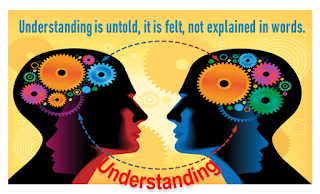
Understanding means showing compassion and sympathy towards others. As we all are unique, it’s better to understand others, rather than judging them. Being understanding we focus on the situation from other’s points of view. It is the state of mind when someone hurts you for some reason and you try to understand their circumstances instead of getting hurt or hurt them back and show maturity.

Self-understanding is very important because when we understand ourselves, we are able to experience ourselves as different individuals. Then we are able to empower our own strengths and improve our weaknesses.

Mutual understanding is the great support of any relationship, it is important to be understanding but it will be the best to avoid misunderstanding because true love is born with understanding. When we love, trust and respect someone, we understand their untold stories.

Knowing and understanding are two different things. It is not necessary if we know something, we also understand it. We may know many things but there is no use in it if we do not understand them. It is true that we can know someone, but it is not possible to understand a person completely, because every person is different and has his own personality, truths, and stories that cannot be shared.

Thoughtfulness and understanding are best friends. They walk hand in hand. Thus, our understanding and thoughtfulness help us to overcome any difficult situation and provide us peace of mind and keep us free from tensions. Our life has become very fast, as we are running a race and moving faster than our understanding and thoughtfulness. We need to be thoughtful and understanding if we need to succeed in our lives.

- Nandini Arora, Flyers, Doon Girls School

Wednesday, May 5, 2021

Stretching Your Learning Edges: Growing (Up) At Work

Personal growth animates professional growth; professional growth animates personal growth. This book offers mindsets and practical resources for guiding and stimulating your learning journey and illuminates the intertwined nature of individual and organizational development.

Richly rooted in adult development theories, Jennifer Abrams defines five facets of what it means to grow (up) in a work context:

Facet #1 – Know Your Identity Facet #2 – Suspend Certainty Facet #3 – Take Responsibility Facet #4 – Engage in Reciprocity Facet #5 – Build Resiliency

You’ll find rubrics for self-assessment and exercises for each of these qualities interspersed with videos, stories, and quotes that illuminate and educate.

This book will reframe your ideas about professional relationships and provide resources for navigating the inner and outer tensions of working productively with teammates and colleagues.

This is a book for self-study and for shared learning with colleagues. It offers a treasure trove of insights, actions, and options for educators seeking greater self-awareness, and increased emotional and mental resourcefulness to meet the challenges of these demanding times.

Jennifer Abrams is an international education and communications consultant for public and independent schools, hospitals, universities, and nonprofits. She trains and coaches teachers, administrators, nurses, hospital personnel, and others on new employee support, supervision, being generationally savvy, having hard conversations, and collaboration skills.

Jennifer’s publications include Having Hard Conversations; The Multigenerational Workplace: Communicate, Collaborate, and Create Community; Hard Conversations Unpacked: The Whos, the Whens, and the What-ifs; and Swimming in the Deep End: Four Foundational Skills for Leading Successful School Initiatives.

To order or learn more visit www.miravia.com

Thursday, February 4, 2021

Believe in Yourself - Swabhi Parmar

Courtesy: https://images.app.goo.gl/JGZJPT1j8pXNKRDN9
We could all do with a little more self-belief. Well, that is because: Nothing can be done without believing in yourself first.
True, they are a lot of factors that will contribute to your success but the biggest factor that will determine whether you achieve something significant or not is self-belief.

How much of what you will achieve will mostly depend on how much you believe in your abilities. And yet most of us, me included, often lack self-belief during the times when we need it the most.

We could all do with a little more self-belief. Well, that is because: Nothing can be done without believing in yourself first. True, they are a lot of factors that will contribute to your success but the biggest factor that will determine whether you achieve something significant or not is self-belief. How much of what you will achieve will mostly depend on how much you believe in your abilities. And yet most of us, me included, often lack self-belief during the times when we need it the most. Rather than having unshakable confidence, we often allow doubt and insecurities to easily shake our resolve and make us believe that we are not capable of achieving whatever it is we have set out to do.

I can clearly understand why that is the case, we all do something wrong quite a number of times in our life span and this will make us question our abilities. We know it and we have been told so on numerous occasions. But then again, we also do a lot of things right too. And this is a fact that we often forget. We all have shortcomings and strengths but most times on our journey in life, our brain will choose to believe the negative, the shortcomings, and the anxiety and so on instead of choosing to believe in our natural ability to overcome all our obstacles. And because they may have failed or are currently struggling to succeed, people will often point out your faults and constantly remind you of your failures. Couple all that with jealousy, it will be very hard for you to find someone who genuinely believes in you especially if you do not have any record of public success.

It is no wonder why most of us are lacking in self-belief. But, as stated earlier if you won't achieve anything worthwhile: You have to believe in yourself first before anyone else ever does. And you have to do it more than anyone else ever will. A lack of belief in yourself will limit you no matter how great the ideas or opportunities are that you are exposed to.

Fortunately for us, believing in yourself is a skill that can be learned. The only catch is that ‘it takes time’.
Here are a few other reasons why you should believe in yourself first. It is the first step to success. How else will you take the first step towards your goals if you don’t even believe you will do it? The biggest most important questions that you will have to answer at the beginning of your journey are mostly about self-belief.

Am I capable of achieving this? Can I really do it? Can my idea really work? Once you really believe that you can do it, you will find a way to make it work. You will navigate through all the problems and get up when you fail. No idea will work for every person on the planet, but many ideas can work for most people … if you believe that you can make them work. You have to be willing to not just think differently, but to also to experiment with new ideas and trust that you’ll discover a way to make them work.

Believing in yourself is the first step to success.

Courtesy Source: https://medium.com/@cshikati/why-you-need-to-believe-in-yourself-more-than-anyone-else-does-d64e78fc25ec

Swabhi Parmar
The Fabindia School
spr@fabindiaschools.in

Tuesday, May 5, 2020

Happiness and Tolerance: Kavitha Devda

Children always grasp things in different ways which may not always be what we would like
to give them. As teachers we are expected to maintain a balance between children's happiness as well as discipline. Happiness and Tolerance are like two sides of the same coin where the children as well as the adults  may face difficulty in applying them in their every-day lives. An  incident  which I  want to share as a short story.

It was  Friday and  Class Three had their Music lesson. The students  lined up outside their respective class waiting for their teacher to escort them . Music Sir was absent.  So  I was given a substitution lesson.  It was very hot inside the classroom, so I took them outside and  made them  sit under the tree.  I thought about having a conversation with children. So I just started with the word “Happiness”. The students were very eager to explore this topic. I just began with simple questions.   What makes you happy?

 The students came up with some very interesting ideas about happiness. Naksh said, “I feel happy when I laugh." Priyanshi said, "Music makes me happy." Surender said, I  am only happy when I eat. Krishna  said, " I feel happy when I play my favourite games." Garv said,  "When I sleep I am very  happy."  Vratika said, "Happiness means when we get something and we are satisfied from the inner side of us."  Abhimanyu said, "When I draw something  and add colours to it, this makes me happy."  Alveera said, "When I see butterflies and birds flying, it makes me happy. Like this everyone shared  what makes them happy.  I  was very happy with their responses. While I was still discussing the same, the bell rang ending the class midway.

On the very same day, I had English  lesson  with grade One  in the last lesson . As I entered the class I said children please get ready. I am going to take up the lesson about "The Animals and their Young Ones' '. The students followed the instructions and were ready to understand the topic. As I was showing the pictures of the animals and their young ones, I noticed that Neeraj and Himanshu were busy scribbling in their notebooks and giggling. I asked both of them to stand up. Then I asked, "Why aren’t you paying attention?’’ They said, "Ma'am,  we are drawing the animals." Neeraj said,'' Ma'am I drew a cub, but Himanshu is telling me that it's a cat." Everyone laughed at them.

 Suddenly I said Himanshu to go and get four charts from the Art room. The students looked surprisingly  at this sudden reaction  by me.  Himanshu  followed my  instruction and brought the charts. I divided the students into four groups and gave them charts and asked them to  draw any two animals with their young ones on each chart and write their names. All the students were so happy to draw as they all loved it. Even I drew some animals on the board as I also liked drawing.  It then dawns upon Himanshu and Neeraj  that they had misinterpreted the true definition of ‘’Happiness,’’ which meant being happy but at the same time expressing happiness in the right way and the right time. Then I said,  "Well children, this is what makes  me happy."  This is a true representation of how intolerance can be handled and also teaching the students what happiness truly means.

Kavitha Devda 
The Fabindia School

Wednesday, April 15, 2020

Happiness and Tolerance - Rectifier BHIS

As Jeanette Winterson says, “The key to happiness is the tolerance of those who do not do as you do.”

Nina was a teacher at a school three blocks away from her home. After her husband Jim passed away, she needed something to keep her emotionally stable and teaching underprivileged kids brought a lot of joy for her. She fondly called her kids, Star Kids.

Pic by Saee Joshi
She always showed up early to her class & eagerly waited for them. In her small class of 10 students, there was a boy named Alex. He was a child of divorced parents and would often get in trouble with other students and act out his aggressive tendencies. “He would mess up the class vibe and environment”, some teachers would say. Nina knew he’s asking for love in the most unloving way. But she was always worried her class wouldn’t win the best class because her class would always be in a mess post the lunch break (usually when Alex would get into a fight and mess up the class).

Pic by Saee Joshi
One day, Nina hurriedly came up to the class and told them that their school was expecting some very important visitors & they would make some notes, inspect a little. This was the first time that the kids saw their teacher worried. She was worried that her class looked shabby, she had been trying to get some stains off that wall, her table looked messy, the chairs, the board. She had so little time to do anything! She would usually talk to Jim at a time like this when she was anxious & he would have just the right thing to say and make her feel calm. She instructed the kids that she would be back in some time and gave them a chapter to read aloud turn by turn.

Rajshri Mohite
She left hurriedly downstairs as she was a part of the welcoming committee too. Soon the visitors began going to each class, talking to the students and teachers respectively. When the turn for Nina’s class came, she was anxious more than ever. She knew her class didn’t look as good. But when she opened the door to her class, she was in utter shock n disbelief!
Rajshri Mohite
The class looked spic and span, books neatly arranged in the order one would need them to be, the shelf didn’t have cobwebs, her desk looked spotless and the chairs arranged neatly. To her utter surprise, the kids were on duty. One kid was standing near the books, one near the board, one at the door to welcome the guests and some kids had made a beautiful welcome card for the visitors. Leading on behalf of the children was Alex! He went on to give a small tour of their class to the visitors eagerly.

Nina’s happiness knew no bounds! She later realized that all of them had worked together on an idea put forth by Alex harmoniously. She knew it wasn’t easy for anyone but they tolerated each other’s ideas and worked with whatever they could do best in so little time. She knew she had done something right when she decided to become an Educator. She could never be more proud as an educator of her Star Kids than she was that day.

Rectifier @ Billabong High International School, Thane
Pallavi Harkare, Kalpana Dodia, Rajshri Mohite, Prerna Khanna, Priyanka Iyer, Mahalaxmi Iyer

Monday, March 2, 2020

Happiness and Tolerance – Adapters SHS

Students always have the tendency to grasp things in different ways which may not always be what we would like to portray to them. As teachers, we are expected to maintain a balance between students’ happiness as well as class discipline.

Happiness and Tolerance are like two sides of the same coin where the students, as well as the teachers, may face difficulty in applying them in their every-day lives. A classroom incident to which we as teachers or reminiscing our school days may relate to is given in the following short story.
It was an everyday scenario, the students lined up outside their respective classes waiting for their teacher to escort them inside the classes. Mr Hylton, the class teacher of grade 8 comes over to the class to conduct the 1st period that being Moral Science. He walks in and introduces the chapter “Happiness”. The students were all very eager to explore this topic.

He begins:
Mr Hylton: “What makes you happy?”

The students came up with some very interesting ideas about happiness.
Soham: “I feel happy when I laugh.”
Aditya: “Sir, Music makes me happy.”
Gaurav: “Sir, I am only happy when I eat.”
Raju: “Sir, When I sleep I am very very happy.”

The teacher was very happy with their responses. Then he starts emphasizing on the different aspects of happiness.
Mr Hylton: “Happiness may mean the Joy one derives from inner satisfaction, Optimism which ultimately leads to better productivity.”

The students seemed to be listening to Mr Hylton intently and grasping all that he was saying. Mr Hylton was also very happy seeing that the children were very interested in the topic. While he was still discussing the same, the bell rang, ending the class midway.

On the very same day, Mr Hylton had History class with grade 8 in the last period. As he enters the class he says :
Mr Hylton: “Children please get ready I am going to take up the lesson about The Gupta Dynasty.”

The students follow his instructions and get ready for the lesson. As Mr. Hylton was in the midst of explaining the lesson, he noticed that Gaurav and Raju were busy scribbling in their notebooks and giggling.
                Mr Hylton: “Gaurav, Raju, please stand up. Why aren’t you paying attention?’’
                Gaurav: “Sir, we are practising happiness.”

A realization hits Mr Hylton that his Moral Science lesson was not perceived in a positive way by the students. Suddenly he instructs Gourav.
                Mr Hylton: “Gaurav, Please go to the Music Room and get the Guitar.”

The students look surprised at this sudden reaction by Mr Hylton. Gaurav follows his instruction and brings a guitar.

Mr Hylton: ‘’Class, I shall play a tune and you will sing along.’’

The entire class looked dazed and confused yet were curious as to what their teacher was up to because they knew that their teacher did not know-how to play the Guitar.

Aditya: “ Sir, Are you alright? This is not the Music class. You are our History teacher, you don’t even know how to play the Guitar!”

Mr Hylton: “Well children, this is what makes ME happy.”

It then dawns upon Gurav and Raju that they had misinterpreted the true definition of ‘’Happiness,’’ which meant being happy but at the same time expressing happiness in the right way and the right time.

Mr Hylton is a true representation of how intolerance can be handled also teaching the students what happiness truly means.

- Shraddha Dewan <shraddhadewan425@gmail.com> for Adapters at Sacred Heart School Siliguri

Thursday, December 5, 2019

Ajay Vijayvargi: Speaking

Speaking is the most reliable way to express one's ideas and thoughts to the next person. Diction, which means the choice of words and their correct pronunciation and fluency, which means the ability to speak; these are the two components of a speech. A child can learn to speak different languages and accents if he/she is given a chance. They always try to learn whatever he/she is taught by repetition and imitating. If speaking is mixed with music is a powerful way of learning for children. Being well spoken by our conversation with them can help a child's fluency and thinking. Let the child think about what you speak. They'll start sharing their thoughts under the comfortable environment. They must be taught to see and think beyond, to question and challenge.
Ajay Vijayvargi
The Fabindia School
avi4fab@gmail.com

Tuesday, December 26, 2017

रचनात्‍मकता को पुरस्कृत करे

हर छात्र में कोई ना कोई खास बात होती है  जरुरत  होती है इस रचनात्मकता को प्रोत्साहित करने की। हर बच्चा एक कलाकार होता है, समस्या यह है कि, आप बड़े हो जाने पर, अपने अन्दर के कलाकार को जिंदा कैसे रखें।
अगर आप अपने अन्दर एक आवाज़ सुने की तुम पेंट नहीं कर सकते तो पेंट करने की हर संभव कोशिश करें और वह आवाज़ अपने आप गायब हो जाएगी।
कल्पना शुरुवात है रचना की। आप वह कल्पना करते हो जिसकी आपको इच्छा है, आप वह बन जाओगे जो आप कल्पना करते हो, और अंत में, आप उसकी रचना करोगे जो आप चाहोगे।
रचनात्मकता तो बस चीजों को जोड़ना है। जब आप रचनात्मक लोगों से पूछ्तें हैं कि आपने यह कैसे किया, तो वे थोड़े शर्मिंदा महसूस करतें हैं, क्योंकि वास्तव में उन्होंने यह नहीं किया होता है, उन्होंने कुछ देखा। कुछ समय बाद उन्हें अपना काम सामान्य लगने लगता है।
बहुत सारे आयडियाज़ (नये विचार) होना अच्छा है, भले ही उनमे से कुछ गलत भी हों, इस बात से कि आप हमेशा सही हों और आपके पास कोई आयडिया ना हो
रचनात्मकता नयी खोज करना है, नया प्रयोग करना है, रिस्क लेना है, नियमों को तोडना है, गलतियाँ करना है, और मज़ा करना है
रचनात्मक कार्य का सबसे ऊँचा पुरस्कार  जो हमें मिल सकता है वह रचनात्मक होने का सुख है।
हमारी सीख - आइसक्रीम मेकर by सुबीर चौधरी
अजय विजयवर्गी , कुसुम डांगी , तरुण मिश्रा , उस्मान गनी
The Fabindia School


Friday, May 26, 2017

7 Tips For New and Aspiring Building Principals

pinterest.com
Congratulations! You have just been appointed a building principal. You have the ability to impact hundreds of students. What kind of impact do you want to have? Will you be that principal who is busy putting out fires and running from meeting to meeting or will you be that person who others look back on and think, “that person changed my life for the better”?
Two quotes helped me grow into my first principalship. First, when I walked into my elementary school office for the first time one August day a few decades ago the previous principal had hung a paper banner on the office wall that the students had made at the end of the previous school year. It read, “Welcome to our new PrinciPAL.” and was signed by all 380 students and the staff. The message was clear. We want someone here who likes us and we can trust. The second quote has been attributed to Ron Edmunds – “A student doesn’t care what you know until he knows that you care.” If you want to be the kind of principal that will be remembered as someone who made a difference for kids, it starts by truly caring and showing it. Learning is a social experience and relationships from the foundation.
The principal’s chair can be a very daunting place. You not only have to handle conflicts and disputes between kids; you have a building full of adults who sometimes also have conflicts. Add to that, the school exists within a community with needs and goals that are sometimes not congruent with those of the school. It’s easy to become that firefighter principal and become immersed in stamping out little blazes here and there and filling out reports every day. You need to decide if that’s the best use of your time. To me at least, my number one priority was being in all 15 of my classrooms every day. I wanted to immerse myself as much as possible in the experience of school my students and staff had.
Here are some tips for a new building principal:
  1. Be in the classrooms often. The best way to know what is really going on in your building is to be in the very classroom as often as practical. A principal is an instructional leader and you need to have a clear understanding of the instruction going on in every classroom.
  2. Listen more than you talk. A great leader understands that we have two ears and one mouth because that is a good proportion. Listen first and most.
  3. Be a mediator. Try to put yourself in the shoes of both sides of a conflict. Try to understand what is being asked from both sides and look for root causes. Often, the presenting problem is only a symptom of a larger issue. An effective principal sometimes acts more like a mediator. Every action you take has consequences. Think about the unintended consequences of your actions.
  4. Learn what kinds of recognition your staff wants. Not everyone wants to be publically recognised in a large-group setting like a staff meeting or school assembly. How do you know how your staff wants to be recognised for great work? Ask them. Send out a staff survey at the start of the year and be sure one question is, “When I do great work I would prefer to be recognised by ___.”
  5. Do the hard stuff. Lead by example. Be with students in the lunchroom and at recess. Be visible at music and sports events. Just showing up says volumes to staff, students, and community. I learned more about what my school was really like by being out with the kids at lunch recesses. I also became a very good foursquare player.
  6. Know your stuff. Subscribe to and read journals like Educational Leadership to learn what new research is revealing and share that information with your teachers. Facilitate book studies on one or two books a year. ASCD member books are a good place to start.
  7. Delegate, delegate, delegate. There are people on your staff who are simply more interested and/or better are some things than you are. Seek those people out and involve them in meaningful ways. For example, I knew that recognition events and cute little gifts and tokens were important to many on my elementary staff. I also knew I wasn’t that kind of person but one if my teachers was excellent in that arena. I asked her to take on that role for the school and supported her as she ran with it.
Becoming a building principal carries with it an awesome responsibility. You truly have the future of hundreds of students within your control. The environment you establish for both the adults and children who report to the school every day will in large part determine the kind of adults those children become. Bare in mind that for at least some of your students, school is the one place they feel safe and cared for. Albert Einstein is quoted as saying, “I never teach my pupils. I only provide the conditions in which they can learn.” You have a large number of hats you sometimes wear as a principal – from recess monitor to custodian to disciplinarian to minister. The hat that should always be on and the base for all other hats is the one as an instructional leader.

Howard Pitler, Ed.D. is an international speaker, coach, and facilitator with a passion for improving education for all learners. He was the Executive Director and Chief Program Office for McREL International from 2003 to 2015. Prior to working at McREL, Dr Pitler spent 29 years in K-12 education as a teacher, assistant principal, elementary school principal, and middle school principal in Wichita, Kansas.

Blog Archive