Showing posts with label productive. Show all posts

Thursday, January 8, 2026

Read more in the Indian Edition of the book by Dr Manu Kapur

Productive Failure by Learning Forward India Foundation

Masterclass 2025, cohosted by Gurdeep Kaur and Sandeep Dutt, focused on reading, reflection, and building meaningful relationships with teachers from 15 schools. We brought insights from the book "Productive Failure" by Manu Kapur into our classrooms, engaging educators from the Sunbeam Group of Educational Institutions, The Doon School, and our Good Schools Alliance members, prompting them to think critically.

In The Doon School classrooms, we were inspired by a community-based initiative that explored Productive Failure and addressed a common question among educators: How do we design it collaboratively, week after week?

The Good Schools Alliance (GSA), a network dedicated to joyful and rigorous learning and teacher agency, established The Teachers Academy to tackle this question. Every Saturday evening, educators from GSA schools convene for a focused 45-minute master class—not to follow a script, but to explore ideas collaboratively. This series began with a shared reading of "Productive Failure" and has evolved into a community of practice in which teachers read, experiment, reflect, and adapt the concept to their unique contexts. The guiding principle is straightforward: try tomorrow, stumble safely, learn publicly.

From this community, three micro-cases emerge, each demonstrating how a slight design adjustment can transform confusion into competence. For more details, visit www.HappyTeacher.in

Read more in the Indian Edition of the book by Dr Manu Kapur.

The Jugaad version is now available!

Saturday, November 29, 2025

Jugaad meets Productive Failure


Brewing Knowledge Friday
Discussing the principles and application of Productive Failure with author Dr Manu Kapur.

Key Takeaways
  • Productive Failure (PF) is a design philosophy, not a student trait. It prepares the mind for instruction by activating prior knowledge and revealing gaps through initial struggle, leading to deeper learning and transfer.
  • Teacher design is the primary challenge. The two hardest phases are Activation (creating tasks that invite intuitive ideas from all learners) and Assembly (deconstructing student ideas to build the correct canonical solution).
  • AI is a tool, not a replacement for effort. For novices, AI can create an illusion of performance without learning. It is most effective for experts who can critically evaluate its output.
  • PF uses safe, low-stakes failure to prevent high-stakes failure. The goal is to build deep capabilities through initial struggle, which reduces the chance of failure when it truly matters (e.g., a surgeon on a patient).
The Problem: Learning Poorly from Good Instruction

Dr Kapur's research began by addressing the problem of students learning poorly despite effective direct instruction.

The core insight: The first step in learning something new should not be being told the answer.
This idea was counterintuitive 25 years ago and took two years to publish, highlighting the difficulty of challenging academic paradigms.

The Solution: Productive Failure (PF)

PF is a design philosophy that prepares the mind for instruction.

Gardener Analogy: Direct instruction is like throwing seeds on unprepared ground. PF is like tilling the soil, fertilising it, and sowing seeds in a structured way. The same rain (instruction) yields a much better crop (learning).

Core Principle: Struggle before instruction leads to deeper conceptual understanding and better transfer of learning.

The PF Framework: The Four A's
1. Activation: The teacher's most critical design task. Create problems that invite students' intuitive ideas, even from low-knowledge learners.
2. Awareness: The failure-driven protocol reveals knowledge gaps, showing students what doesn't work.
3. Affect: Awareness of gaps builds motivation and engagement to bridge them.
4. Assembly: The teacher's second major challenge.

Lego Analogy: Deconstruct student ideas into components.

Identify functional "Lego blocks" (valid parts of a solution).

Use these blocks to build the correct canonical solution, rather than simply dismissing all student attempts.
Implementation & School Culture

Time Constraints: PF is an efficiency equation (output/input). While it may take longer, it yields 3x the effect on deep learning and transfer learning.

Teacher Mindset: Act first, and the mindset will follow.

Scaling PF:

Long-Term Commitment: Requires 3–5 years to achieve economies of scale and build culture.
Community Design: Teachers can collaborate to design tasks for different topics, sharing the workload.

School Culture:
Strategy: "Pockets of innovation" are more effective than top-down mandates.
Rationale: Build a groundswell of evidence and peer conviction. Healthy systems can tolerate criticism.

PF & AI Tools
AI as a Tool: AI is only as good as its design.
Current AI Tutors: Most provide instant answers, undermining PF by removing the cognitive effort essential to learning.

Future AI Tutors: Can be engineered to facilitate PF by:
Designing problems that follow PF principles.
Providing component-based consolidation.

Personalising learning effectively.
Learning vs. Performance:

Learning Zone: Requires intentional cognitive effort. If a tool does the effort, performance may be high, but learning is low.

Expert Zone: AI can boost performance for experts who can critically evaluate its output.
PF & Indian Context: "Jugaad"

Jugaad: A situational improvisation capability born from uncertainty and resource scarcity.
Connection to PF: The India edition of the book includes a new chapter titled "Jugaad meets productive failure," which provides a methodological framework for this cultural capability.

Environmental Influence: The same individual can be flexible at home (e.g., fixing a power outage) but rigid in school, demonstrating that the environment, not the person, drives the behaviour.
PF & Fear of Failure

Nuanced Definition of Failure: PF distinguishes between different types of failure.

Productive Failure: Low-stakes failure during initial learning.
Purpose: To build deep capabilities that reduce the chance of high-stakes failure later.

Examples: A surgeon practicing on a simulation, not a patient.

Unproductive Failure: High-stakes failure (e.g., exams) or failure due to laziness or incompetence.

Teacher's Role: Re-norm struggle as a natural part of learning. Model this by sharing personal struggles and framing them as necessary for growth.

Next Steps
  • Collaborate to design PF tasks, sharing the workload.
  • Model productive struggle for students and parents.
  • Read the new "Jugaad Meets Productive Failure" chapter in the Indian edition of the book.
  • Khushieee (Grade 8 Student): Read the chapter on designing PF for self-learning.

Saturday, October 11, 2025

Applying Productive Failure in Class II English - Annie Mahajan

A Step-by-Step Case Study Report with Real-Life Classroom Application

Introduction

This research report presents a detailed case study conducted in a Class II English classroom, focusing on the practical application of Productive Failure (PF) as described by Manu Kapur. The study demonstrates how students learn English grammar concepts more effectively through initial struggle, peer collaboration, guided reflection, and teacher facilitation. The classroom activity was intentionally designed to allow students to fail productively before reaching conceptual understanding. The entire research is based on real-life school situations where engagement, exploration, and collaboration were central to learning.

Case Study 1 – Activation

Grammar Topic: Nouns & Verbs

Objective

To help students explore and form meaningful sentences by identifying nouns and verbs through guided discovery, peer discussion, and reflection rather than direct teaching.

Step-by-Step Research Methodology

1. Introduction to Task (Initial Challenge):

Students were given sets of picture cards showing various objects (nouns) and actions (verbs). They were asked to form sentences using these pictures without any prior explanation or instruction from the teacher.

2. Observation of Productive Failure:

During the first attempt, most students struggled to correctly combine nouns and verbs. Some created incomplete sentences or mismatched words (e.g., 'Boy eats ball'). This stage of failure encouraged curiosity and discussions among peers as they tried to make sense of sentence formation.

3. Guided Reflection and Peer Collaboration:

After the initial struggle, students shared their attempts and reflected on what worked and what didn’t. The teacher then facilitated a short discussion highlighting sentence structure using examples from the students’ work. Through group sharing, students realised their errors and collaboratively corrected them.

4. Reinforcement through Practice:

Students were given a second set of picture cards and asked to form new sentences, now applying what they had learned from the earlier discussion. This time, most students were able to identify nouns and verbs accurately and use them correctly.

5. Assessment and Reflection:

A post-test was conducted to measure improvement in understanding and application. Students were also asked to share one thing they learned from their initial struggle. Most responses reflected a deeper conceptual understanding of how nouns and verbs work together in a sentence.

Student Data Table

Student                             Pre-test                       Post-test                     Improvement

Aarav                                     4                                 8                                     4

Ishita                                     5                                 9                                     4

Manan                                  3                                 7                                      4

Dhruvika                              4                                  8                                     4

Ekanshi                                5                                  9                                     4

Paarth                                  3                                  7                                     4

Observation and Analysis

Initially, students found it challenging to combine nouns and verbs in a meaningful way. However, after

reflection and guided facilitation, they began recognising patterns and correcting themselves. The overall improvement in post-test scores shows that failure, when channelled productively, enhances conceptual learning rather than discouraging learners. The process nurtured confidence, curiosity, and active participation in the classroom.

Conclusion

This case study highlights that productive failure enables students to construct knowledge through experience and reflection. When applied to English grammar learning, it not only improves accuracy but also fosters independent thinking, collaboration, and deeper understanding. Real-life classroom implementation showed that initial failure led to meaningful learning outcomes.

Annie Mahajan
Sunbeam School, Lahartara

Masterclass on Productive Failure - October 11

Image courtesy of the Conclusion chapter from the book Productive Failure by Dr Manu Kapur

We conclude the Productive Failure book study and reflect on key takeaways from the year-long Masterclass series.

Key Takeaways

  - The book "Productive Failure" emphasises that failure is an essential part of deep learning, not something to be avoided

  - Performance and learning are distinct concepts; high performance doesn't always equal high learning, and vice versa

  - The masterclass series created a valuable community for teachers to read, learn, and grow together

  - Sunbeam Schools played a crucial role in enabling this learning opportunity for teachers

Topics

Conclusion of Productive Failure Book

  - Final chapter read, covering key concepts like performance vs. learning and four outcomes: productive success, productive failure, unproductive failure, and unproductive success

  - Author's personal anecdotes and acknowledgements shared

  - Four big picture takeaways: failure as a mechanism, signal, feature, and mantra

Reflections on the Masterclass Experience

  - Participants expressed emotional connections to the book and learning journey

  - Value found in re-reading the book and revisiting video archives

  - Appreciation for the push to engage in continuous learning, even when initially reluctant

Future Learning Opportunities

  - Masterclass 2026 announced with three new books

  - Ongoing sessions: Brewing Knowledge Friday, Learning Forward Saturday, My Good School Sunday

  - Potential grant to provide 1000 copies of a book to teachers in Good School Alliance member schools

Upcoming Events

  - Sunbeam My Good School Retreat in Varanasi from October 26-31

  - Plans for annual My Good School Retreats at Graminn School (October) and Arthur Foot Academy (April)

Next Steps

  - Participants encouraged to sign up for Masterclass 2026

  - Poll to be created in Sunbeam Masterclass group about meeting on October 25th

  - Teachers invited to continue engaging with My Good School sessions and other learning opportunities

  - Participants encouraged to purchase or obtain their own copy of "Productive Failure" for deeper study

Bye for now!

Sunday, September 21, 2025

Designing the Social Surround: Creating Safe Spaces for Productive Failure

The Masterclass conducted on 20th September continued our journey through Productive Failure, with a focus on Chapter 7: Designing for Others. Having explored tasks and participation in earlier sessions, this time we shifted our attention to the outermost layer: the Social Surround.


The Social Surround is not just about the physical classroom—it’s about the emotional and psychological culture that allows learners to thrive. It determines whether students feel safe to speak up, share half-formed ideas, or take risks without fear of being judged.


What We Explored

We began by revisiting the three interconnected layers of Productive Failure:

• Task – What learners are asked to do.
• Participation – How learners engage with the task.
• Social Surround – The cultural environment that makes exploration possible.

Participants reflected on their own classrooms, noting how fear of being wrong often silences students. This simple but powerful observation led us to ask: How can we create environments where mistakes are not punished but celebrated as part of learning?


Psychological Safety in Learning

We discussed psychological safety, a concept first introduced by Carl Rogers and later popularised by Amy Edmondson in organizational learning.


In classrooms, psychological safety means learners feel included, valued, and unafraid to take risks. When this culture is present, even “imperfect” ideas can spark rich discussion—showing that learning often begins at the edge of mistakes.


Two Strategies for Designing the Social Surround

1. Re-norming
Reset classroom expectations so that effort, diverse ideas, and reasoning are valued—not just quick, correct answers. For instance, in a science class, instead of praising only the group that got the “right” result, we can also highlight those who tried bold approaches, asked deeper questions, or learned from experiments that “failed.”
2. Mind-setting
Help learners develop a growth mindset. Encourage them to see intelligence as something that grows with effort and mistakes as natural stepping stones to mastery.


Closing Reflections

The session ended with a challenge for educators:


Reset one classroom norm. 

• Change how you respond to a wrong answer.
• Set expectations for group work differently.
• Celebrate effort and exploration, not just outcomes.

Even small shifts in norms can begin to transform the classroom culture.


What’s Next


We will continue our journey with Productive Failure on 27th September, moving into the next chapter: Designing for Self.


Until then—keep growing, keep learning, and as always—stay happy and blessed.


Gurdeep Kaur

Session Host and The Teachers Academy faculty member

Monday, August 11, 2025

The Feedback Card - Gurdeep Kaur


8:00 am – Reading a newspaper article quoting the Supreme Court on student stress and suicides.

5:30 pm – Saturday Master Class: Reading Productive Failure, Chapter: Affect – The Curious Child.


The newspaper article felt like a problem statement; Productive Failure felt almost like the book for the solution.


Once, in class, I said: “If you don’t study, you’ll fail.”


It’s a familiar line — the pet dialogue of many teachers and parents. But with those words, the joy of learning fades. Curiosity is replaced by anxiety. The stakes shift — no longer about learning, but about performing. The curious eyes in front of me turn into eyes clouded with fear.


Fear of failure — a fear we plant ourselves. And as these children grow, that fear becomes a wall they cannot climb over. Because from the very beginning, failure has been a bad word.


Rethinking the Report Card. What if we redesigned it?


What if we called it a Feedback Card, where we don’t declare success or failure, but offer guidance?


Instead of: “The child is not promoted to the next class,” we could write: “The child hasn’t yet mastered these topics — please focus here next year.”


This slight shift would turn the report card into a bridge, not a wall — a handover to the next teacher, not a judgment.


When a child learns to cycle, we say: “Try again, you’ll get it.” When they learn to drive, dance, paint, or play a sport, there’s no deadline, final exam, promotion clause, or report card.


Only feedback. We allow the journey to take as long as it needs. One day, I hope to read a Supreme Court directive that says: 


“No report cards to be shared — only feedback cards to be shared.”


If we can redesign a small piece of paper called a report card, maybe we can also redesign the way children see themselves. Years later, they’ll look back and say, “Those were the days when learning felt alive, not like a race.”


Note: I am curious about designing a feedback card. I’m open to collaborating with anyone who believes in reimagining how we record and communicate learning.


Gurdeep Kaur

The Teachers Centre Ambassador and C0-host Saturday Masterclass

We have a solution!

Check out the GSA Record Book and the My Good School Report Card, available as Creative Commons at: www.inYouth.org

Sunday, June 15, 2025

Learn Like Sherlock: Priming Your Brain for Smarter Learning

In the world of detective fiction, Sherlock Holmes never walks into a room aimlessly. He enters with a clear goal, scans for clues, and deduces what matters. In doing so, Holmes is priming the case—just as learners should prime their brains before diving into a complex problem.

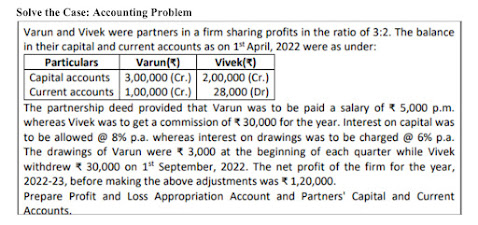
Solve the Case: Accounting Problem


Step 1: Prime Your Brain – Set the Case

Before diving into the passage, read the question at the end first.

“Prepare Profit and Loss Appropriation Account and Partners' Capital and Current Accounts.”   

That’s your case summary.

Just like Holmes asking, “What am I solving?”, you are now telling your brain:

➢ Recall the formats.
➢ Focus on data relevant to P&L Appropriation, Capital, and Current Accounts

Your brain is now primed—alert, focused, and ready to pick out what matters.

Step 2: Scan the Clues

Skim the passage like a detective scans a crime scene.
What are your clues?

• Capital & Current Balances
• Salary to Varun: ₹5,000 × 12 = ₹60,000
• Commission to Vivek: ₹30,000
• Interest on Capital @ 8%
• Interest on Drawings @ 6%
• Drawings pattern for each partner
• Net Profit: ₹1,20,000

Your primed brain now starts highlighting , categorizing, and organizing information—automatically.

Step 3: Piece Together the Timeline

• Start with the Profit and Loss Appropriation Account
 - Debit side: Varun’s Salary, Vivek’s Commission, Interest on Capital
 - Credit side: Net Profit
• Use this to calculate their final profit share
• Adjust Current A/cs for all income and drawings
• Update Capital A/cs with opening balances and final figures

Outcome: What Changes?

• Reduced mind-wandering
• Focused search
• Improved attention
• Higher accuracy
• Structured thinking

Sherlock Holmes: “Elementary, my dear Watson — the case is solved!”
“It is a capital mistake to theorize before one has data.”

That’s exactly why priming works.

It tells your brain what data matters- before it begins. 

Learning strategy draws inspiration from the book Productive Failure by Manu Kapur.

Blog Archive