Showing posts with label stories. Show all posts

Wednesday, June 10, 2026

Who is Right?


I was reading the final chapter of The Courage to Be Happy by Ichiro Kishimi and Fumitake Koga, when my son, who was watching True Detective on Netflix, paused the serial and said, "Listen to this dialogue. Rust Cohle, a character in the series, says, “I think human consciousness is a tragic misstep in evolution.”

He continued, "The problem with people is that they are too self-aware.”

We know we will die. 
We worry about the future. 
We regret the past. 
We compare ourselves with others. 

“That's why human beings suffer."

I smiled, and he looked at me curiously. I read aloud from the book I was reading: "The world is simple, and life is too. Keeping it simple is difficult." I said, "Isn't life simple? It's the meaning we attach to it that makes it complicated. 

Take this example. Someone criticizes me. The criticism is the event. 

Then my mind starts creating stories: 
'They hate me.' Everyone thinks I am incompetent.' 'I am not good enough.' The event was simple. The interpretation became complicated." 

"That's not simple," he interrupted. "People get hurt." 

"Yes," I replied, "people do get hurt. Pain is real." I continued, "A dog gets wet in the rain and moves on. A human gets wet in the rain and thinks: 'Why does this always happen to me?' 'My day is ruined.' 'Nothing ever works out.' The rain is the same. The experience becomes different because of the meaning we give to it." 

He immediately replied, "That's exactly what the dialogue means when it says consciousness is a tragic misstep in evolution. 

“Animals don't think like that. Humans do. Consciousness causes suffering." After saying that, he returned to watching his serial. 

As I returned to my book, I realised that perhaps the philosopher and the character in the serial were asking the same question but arriving at different answers. 

The character in the serial sees consciousness as the source of suffering. The philosopher in the book sees consciousness as the source of freedom. A few minutes later, I withdrew to my book, and he withdrew to his serial. 

Yet, in our own ways, both of us were thinking about the same thing—human consciousness. So, who is right? 

Perhaps both are. Consciousness gives us the ability to suffer, but it also gives us the ability to rise above suffering. It can trap us in fear, but it can also help us choose courage. It can make us anxious about life, but it can also help us find meaning in it. Perhaps happiness begins when we find the courage to use our consciousness not to dwell on fear, but to choose love, and to choose life. 

The world is simple. Life is too. Keeping it simple is difficult. 

As we wrapped up The Courage to Be Happy in our Masterclass, I realised that the most meaningful learning often happens outside the pages of a book—in conversations, in questions, and sometimes in an unexpected dialogue between a mother reading a book and a son watching a serial. The book may have ended, but the reflection continues.

- Gurdeep Kaur

Thursday, October 19, 2023

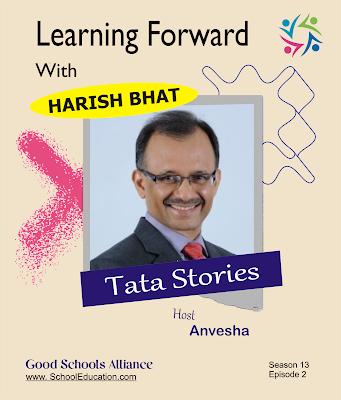
Learning Forward with Harish Bhat


Learning Forward with Harish Bhat, Season 13, Episode 2. 
Harish Bhat, currently the brand custodian at Tata Sons, has held many roles in the Tata group over the past thirty-four years, including Managing Director Of Tata Global Beverages and Chief Operating Officer of Titan's watches and jewellery businesses. Harish is an alumnus of BITS Pilani and the Indian Institute of Management Ahmedabad. An avid marketer, he has helped create many successful Tata brands. He writes extensively and is a columnist for The Hindu Business Line and Mint. 

Autor of #TATASTORIES: 40 timeless tales to inspire you. Tatastories is a collection of little-known stories of individuals, events and places from the Tata Group that have shaped the India we live in today. 
We ask Harish questions about the book and why the Tata Group is deeply respected and valued for its contribution to the growth and development of India. Harish highlighted the words of Jamsetji Tata in the book. He said the community is not just another stakeholder in business but is, in fact, the very purpose of its existence and throughout the numerous tales. In another book, Tatalog, it is particularly emphasised that the DNA of every TATA enterprise is a combination of pioneering, purposive, moral and ‘not perfect’. 
While reading #TATASTORIES, a feeling that is uniform for many is that we feel like a participant and not mere passive observers. Dancing across this long arc of time are thousands of beautiful, astonishing Tata Stories, many of which can inspire and provoke us, even move us to meaningful action in our own lives. These stories bring to vivid life the extraordinary longevity, vibrancy and success of Tata. But at their essence, they are simple, moving stories of great teams, men and women, which hold profound lessons for all of us. 

Coming soon!
Enjoy our shows on www.DilJeeto.com. You will love the stories our students, teachers, and passionate educators share. Please find out more about My Good School at www.SchoolEducation.com.

Saturday, April 1, 2023

Freedom and Peace - Welham Boys' School


When you were a student, what were the three most critical instances wherein you felt that more Freedom at your disposal would have allowed you to realise your goals/ potential in a better way? Do you think any of those circumstances exist even today?

If we think about Freedom, the simple and short answer is, Freedom is from within. Being a student has many advantages. One learns to prepare for life for the greater good of oneself and the nation. The question remains are we really free? Do we have the liberty to act and do as we want?

In my days, we had many restrictions; we never had access to the world; to be precise, we didn't benefit from the Internet. The Internet has set us free to seek knowledge from places we never imagined.

Many places in India needed more infrastructure to have Freedom of movement. Now we can move from one place to another without much hassle.

The explosion of sports in present-day India is phenomenal. Now we have many avenues in sports which have given us limitless Freedom to explore our talent in many ways other than conventional means.

All the above circumstances do not exist in today's world. There is so much Freedom and exposure that we need help understanding where to start.

And finally, let me add one of my favourite quotes by our father of the nation, Mahatma Gandhi "Freedom is not worth having if it does not include the freedom to make mistakes."


According to you, what about human behaviour causes people to give up peace and adopt violence? How do you think classrooms can be used to shape peace-loving individuals?

Peace begins with a smile." —Mother Teresa once famously said, and these words describe the goal of humanity as a whole.

Peace is the purpose of life. To attain it, we have to strive to great lengths. Humans, as per se, are animals, so the animal instinct remains within us, within our subconscious. Humans have fought great wars, and millions have succumbed to these wars when in fact, if we look through history, these were senseless acts without any cause or reason; one of the main reasons for violence is hidden within the unconscious, the insatiable desire for the conflict. So, humans are not fighting humans so much as humans are fighting the human condition to wage war for profit.

Education is our only weapon to fight our desire to wage wars. Children must be taught peace is the purpose of our existence. A peaceful classroom is invaluable to both educators and students. It makes it possible for teachers to teach and students to learn.

To create a space and dynamic environment that will have a universal impact. To introduce languages to describe abstract concepts as the greater good. To tell positive stories about students, teachers and the school. These stories are symbolic and influence what students use to define social status. Convey clear rules, expectations and responsibilities for students.

Explicitly teach positive communication strategies to build a repertoire of easily accessible skills. Positive self-talk and learning techniques.

Engage the students in activities that integrate strategies and develop peaceful habits of mind. Deep breathing is an easily accessible but often overlooked strategy for anxiety prevention, conflict resolution and self-regulation. Use role plays to practice peace-making skills. Hold regular class meetings, circles and other opportunities for students to participate and provide input.

As our father of the nation, Mahatma Gandhi, the true warrior of peace, "A man is but a product of his thoughts. What he thinks he becomes." Keeping in mind his teaching, students must be taught how to work for peace and thus work towards the purpose of life.

- Neelima Parmar, Monika Gupta and Vandana Sahay
Welham Boys’ School

Tuesday, September 27, 2022

Humility and Appreciation - Mridula Ranjit and Roopa Bhattacharya


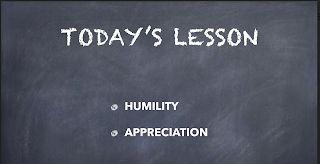
HUMILITY
The students discuss the value of humility. The students are encouraged to come up with what
their take on humility is....inputs from teacher ranges from thinking not too high of oneself to
thinking highly about others, and having patience in listening to others' viewpoints to show empathy for everyone's view.

Then students are divided into 5 groups of 8 students each. The students first name their group. Then they make a story to bring out 'humility'. They are given a fixed amount of time, after which each group gets to present the story. The teacher ensures that all students participate. She provides each group understanding of the activity. The creativity of children in story weaving was noteworthy. 

One story that came up involved a rich man who was stranded on the street due to a flat tyre. And who helps him but a cobbler. The novelty in stories ensured the engagement of children.

The impact is that children are engaged and actually talk about the subject with feelings and passion. Another observation is that when activity on one value is done, it automatically encompasses many other matters. The satisfaction of a deal being talked about, discussed, narrated and even acted out is a big takeaway for the teacher.

APPRECIATION
The activity starts with the teacher appreciating the class. Then the class discusses the impact of
appreciation and why it is essential to appreciate. The teacher steers the discussion to discuss
points like appreciation brings in happiness, and the quality appreciated is reinforced.

Next, the student's attention is brought to genuine appreciation and honest appreciation. They discuss how dishonest appreciation breaks trust. (we again observe values cannot be compartmentalized). The students are asked to find a word or sentence of appreciation for their partner, preferably starting with the first alphabet of their names. They say the words of appreciation in front of the whole class.

Our primary children usually complain a lot about their classmates. It was observed that after this activity if the students started to complain, the teacher would immediately remind them to first think of what they had said about their partner. This significantly reduced the complaints among the students.

The teacher's takeaway was the increase in happiness in the class.

Mridula Renjit
Roopa Bhattacharyya
Ahlcon Public School 
JOL Cohort 2022

Wednesday, June 22, 2022

If I were an Educator - Rishona Chopra

Impatient and fearful, how do we handle the situation?

If I met an impatient and fearful student, situations I can think of with them are like this -

An impatient student - If a question is asked, they can't wait for their turn. They can't wait for other students to finish speaking or working in a team; they don't wait for anyone else and carry on doing their work without any regard that they have to work in a group.

A fearful student -  if they are afraid of being laughed at or are worried that they might fail exams and not do well in their studies.

If I were a teacher, then for the impatient students, I would try to give them a taste of their own medicine - by not being patient with them and then soon tell them that when you are patient and give others a chance, they also feel nice. Still, when you are impatient, it simply shows that you are being disrespectful to them. 

For the fearful students, I would tell them that all their fears are just in their minds. Fear is created in the mind. All you need to do is stop imagining to remove the fear. I would remind them of a Birbal tale - where Birbal was told to imagine that he is in a deep forest surrounded by hungry tigers and lions and has no weapon either, so what would he do? Birbal said in reply, "I would stop imagining". I would tell the fearful student that we were born to live and enjoy, even if they are laughed at, no one cares because you know what you are, and if it's about failing, real success is when you fail and then get back on your feet and try again.

If this were a real-life situation, I think I would be successful in helping the students, but still, I need more experience with children, so it might not really work with the impatient student, but it could with the fearful students. My advice to educators who want to inculcate these values in children is just that the only way is to relate with stories and real-life situations; you can connect with a Birbal tale or a Nassrudin tale; stories with values help to bring about values in children. My earlier class teacher used to tell several unique stories with values in the reflection period. Through her little tales and real-life experiences, understanding values and even Science was much more accessible!

Rishona Chopra
Grade VI
Gyanshree School

Monday, November 1, 2021

My Good School Dil Se, Episode 2: Billabong Thane

Listen to the wonderful story of the Billabong High International School Thane

My Good School Season 1, Episode 2 - 'Dil Se' means from the heart! "My Good School Podcast - Dil Se" is about the stories that explain how schools can achieve significantly better teaching standards, foster a sense of community, and help students reach their fullest potential. My Good School Community shares how they connect, communicate, collaborate and create an environment where the joy of learning is brought to life. 

Dr Ashok Pandey, the show host and Director Ahlcon Group of Schools, speaks with the stakeholders at Billabong High International School Thane: Mr Sudhir Goenka, Trustee/Management; Ms Kalyani Chaudhuri, Principal; Ms Sanika Joshi, Teacher; Rehan Singh, school student; Ayonnya Bhattacharya. ex-student; and Ms. Prajakta Patil, parent. All the stakeholders share their personal experiences and what goes into the making of a good school.

Established in 2006, Billabong Thane celebrates 15 glorious years of responsibly creating 21st-century learners and empathetic future citizens by imparting knowledge that ensures young minds' holistic growth and development. A school where children feel at home; Where EQ precedes IQ; Teachers are facilitators, life-long mentors, and their students often remain their "kids";  and Where we unite to ideate, innovate and improvise. The school works to create a bond of trust and belonging.

Billabong is a vertical school, where the Principal sits on the second floor, and the school ten storeys, wherein the show host quips that 'the sky's the limit!'. Kalyani walks up and down the building all day long to ensure that she connects with the children and stands tall as a school leader who works to empower every teacher at school. She considers herself the luckiest person every morning and is always excited to touch the lives of all the people - the children, staff and stakeholders. She refers to the school as a temple of learning and shares why she feels on top of the world. 

Rehan, a school student, shares his ten plus years at school; he gives all credit to his teachers for their pure love and making every child happy without any expectations. His one-minute speech '...limelight makes me nervous, he would like to thank the people he values most in his life...no matter when he fell they did not let him down.

Sanika again shares her transformation in 11 years; she has grown professional and spiritually. The teacher-taught relationship is full of happiness, and she shares how the thank you book records the joy of learning on the campus.

Ayonnya recalls her relationship with teachers and how they prepared her as a person of high percentile to contribute to society. She shares the bond of friendship, activities, drama, and being the first batch at the school who had an entire decade of school experience, offered her the opportunity to grow up to be a kind and compassionate person. When she was unwell for an extended period, the teachers went beyond the call of duty to help her. The parents of the school are active learning partners and appreciate how the students lead; collaboration between stakeholders.

They have a well-knit parent and teacher body who collaborate to make Billabong a good school.

A passionate Billabong fan thus writes:

"Amidst the din and bustle of a busy street
We have a school where minds and hearts meet.
Uncles, aunties, teachers and friends
Make BHIS a happy place to attend.
Austere but gentle, strict but kind-
This is where rules and liberty lie intertwined.
Oh, Billabong is where we love to go!
Because it helps us explore as we grow.
Here we learn the core values of life,
To continue serving as we strive.
Here we learn to wipe away tears
For ours is a school that genuinely cares."

Website: billabongthane.com

Streaming on Vurbl.Com

Thursday, October 21, 2021

Celebrating 100 Episodes "I am passionate about Education...

A gift of the pandemic times, lockdown and tranquillity offered the best soundbox experience and was perhaps the ideal time to speak and listen. We were pursuing the Joy Of Learning Professional Learning Program with educators from schools across the country, and this was how I discovered the gift of audio!

This is the story of making 100 Episodes "I am passionate about Education..."

Joy Of Learning (11 Sessions) The teachers collaborate and work in groups to explore the 22 values and discover how the values help in an individual's personal and social development. The values come alive at their school and enhance learning at the classroom level. JOL is an extensive and profound learning experience that immerses members in inquiry and problem-based learning models. Staff members work collaboratively to gain knowledge to solve significant student learning problems in their schools. We seek to understand individual members' needs and then assist them in meeting objectives through a collaborative learning environment and with the support of experienced coaches. The learning program is delivered by Zoom and other eLearning methods, and the focus is on helping teachers find solutions to help the schools provide better.

As we zoomed in and listened to teachers' stories by choice and teachers by chance, I wondered why we were so mad about teaching and learning. Despite the thankless job, with little appreciation, our teachers are perhaps the real changemakers in the world. So this was the eureka moment; let us find out what makes them so mad about the profession,  the quest for meeting 100 educators began!

Does one have to be a teacher to be an educator? Hello, there is a teacher in each of us, and even beyond in the environment, nature, living and non-living. The whole world is my school, and everyone is my teacher.

On my last visit to Finland to attend the Hundred Summit in 2019, I was fortunate to meet entrepreneurs, policymakers, youth leaders, investors, school heads, students, and people from all walks of life. People head to Helsinki for the Education Week in early November every year to share ideas and innovations and how every problem has a solution, waiting to be simply showcased. This made me reflect on my life and how in near 40 years of living with altruism, I had the good fortune to travel from Sydney to Los Angeles, Nepal to Sri Lanka, East to West, and even head an international youth program. 

2016, 2017, 2018 and 2019, my years of taking Learning Forward! Every winter, I travelled to the USA to attend the Learning Forward Annual Conference to meet thousands of teachers and passionate educators from across the world; this further increased with the expanse of my network.

My travels in India and the conferences attended in the past decade. Meeting school alumni, industry bodies, and the five different avatars of my life made it very difficult to make a list of 100 influencers in my life, particularly those who have made a difference to others.

My teachers, fellow travellers, friends and colleagues, my list of passionate educators started evolving. The first one was a teacher of Sex Education. She shared how she was working to sensitize communities and look at life with a gender agnostic lens. Then I met teachers who have had a phenomenal impact on my life, simple real-life people who are real influencers and role models. Yes, we lack mentors and people who practise what they preach; the next part of my agenda is to list real stories.

You will love the stories shared by our happy teachers and passionate educators. They grow the capacity of your people to improve student achievement and transform your school into a culture of trust and collaboration in less time with fewer resources. Each person in your school contributes to the culture of your school. School culture is built on the actions and interactions of the people. You make your school stronger by adding value to others and making others feel valued. Thus, the show's spirit and the live content without any format made the show even better, from the heart and soul.

My life's focus is on school transformation with an emphasis on culture as a service. Over 30 years of experience has empowered thousands of teachers and touched the lives of near a million children. The Future Of Learning  - Long-lasting success in professional learning needs a 'culture of learning .' I feel teachers need to take charge of their own learning. They can support teams to design the future of education and transform schools to deliver better learning outcomes.

As an Author, Entrepreneur, Mountaineer and above all, passionate about taking learning forward. Founder Learning Forward India, Ambassador Hundred.Org, Chairman Bhadrajun Artisans Trust, Owner of The English Book Depot and former National Director of The Duke Of Edinburgh's International Award. The episodes perhaps help me reflect and recreate my life as I reconnect with people and, after decades to learn how we could touch each other's lives. Recording the shows was a kind of surreal as unknowingly we are doing similar type of work in our unique ways. As a journalist, an industry person, a member of a Royal Family, leaders and simple folks all work to make the world a better place to live in.

In the series of 100 Episodes, I travel across the world to decode my passion for education. Meeting teachers, coaches, entrepreneurs and leaders; they share how, in their way, they go about with the singular focus to help schools deliver better, build trust and relationships to spread the joy of learning.

The 100 episodes will inspire you by listening to personal examples of teachers working to help children experience the values. This will also help people take stock of life and how they wish to lead their lives. Education without sharing values is never complete. This was another significant learning when producing the shows.

Episode #100, Releasing on Saturday the 23rd of October 2021, is a tribute to John Martyn, who inspired and enriched the lives of the children from the rural areas near Dehradun. In 1935, John Martyn accompanied Arthur Foot to India to establish the teaching staff of The Doon School, a newly opened boarding school for Indian boys. Martyn was at Doon for 31 years, thus becoming one of the longest-serving schoolmasters in the school's history. After he died in 1984, his wife Mady Martyn wrote a book about him entitled Martyn Sahib, the story of John Martyn of the Doon School.

In his honour, his wife and Martyn's friends set up John Martyn Memorial Trust in a village at the foothills of the Himalayas called Salagaon. The trust runs a school for underprivileged children and provides free education to over 150 children. The past 37 years have been an incredible journey as the school witnessed the lives of many disadvantaged children transforming because of quality primary education.

Yes, in this show, I meet the teachers of The Fabindia School, the parents, board members and students to find out how one man's passion for bringing a piece of land to life helped build the changemaker school, where I have had the good fortune to spend near a decade. I would like to conclude with the good words of my real friend for life and colleague in the mission for quality in education "Sandeep is a passionate educator. He is one of those individuals who have dedicated his life to making the greatest impact on the greatest number of people." William Nanda Bissell, Chairman of the Board, Fabindia. This is perhaps what each of the 100 passionate educators has been doing all their lives, impacting the lives of one and all on their journey, building relationships and, of course, following their hearts. 

Playlist "I am passionate about education...
https://vurbl.com/playlists/I-am-passionate-about-education/

Available on Apple, Google, Spotify, Anchor, Overcast,  Radio Public, Jio Saavan and all podcasts worldwide.

- Sandeep Dutt, School Improvement Coach and a wannabe Radio Jockey! You can find about more about what he does for life on www.Sdutt.com

Thursday, September 23, 2021

My Good School Dil Se - Show Opens 2nd October 2021


Beginning the 2nd of October 2021, we share the joy of learning and how schools prepare children for the world. 

We share stories from the heart and explain how schools can achieve significantly better teaching standards, foster a sense of community, and help students reach their fullest potential.

'Dil Se' means from the heart! 

The seven-part series shares how elite schools connect, communicate, collaborate and create an environment where the joy of learning comes to life. 

In the first episode, we share the story of The Fabindia School, find out how the school has successfully built a great relationship with all the stakeholders - Students, Parents, Teachers and Management - to win hearts and create a school that prepares children to face the world. 

You will find answers to questions like:

How is the human element highlighted in the school? 

Factors that make a school from good to great? 

What goes into making a good school? 

How are values taught in school? 

How do stakeholders work to make it a good school? 

What is the vision of the promoters?

"Warm greetings, Ladies and Gentlemen, we are now going to begin what we can call our history in the making of excellent schools from the country. My Good School Dil Se is a show to bring the best practices of the best schools for whom, for those who are interested in schooling, for those who want to educate children, for those who want to create social capital for the country, for those who want to produce human capital and for those who want to excel in cognitive and character building. And that is what the show is about. I'm Ashok Pandey, Director of Ahlcon Group of Schools in Delhi, and I am privileged to be the host of the show." - Ashok Pandey

Learning Forward Station on Vurbl.Com
https://vurbl.com/station/learning-forward/
You will love the stories shared by our happy teachers and passionate educators. We grow the capacity of your people to improve student achievement and transform your school into a culture of trust and collaboration in less time with fewer resources. Each person in your school contributes to the culture of your school. School culture is built on the actions and interactions of the people. You make your school stronger by adding value to others and making others feel valued.

Vurbl app for ios at the app store and that Android will be releasing soon!

Tuesday, September 14, 2021

My Good School Dil Se

My Good School 'Dil Se' - Stories from the heart - on the show, we invite all the stakeholders for the school: Teachers, Students, Parents, Ex-students, and the Management, for a candid conversation to showcase how they have together built their My Good School.

We explore:
What is the meaning of being humane?
Elements that make a school from good to great?
What goes into making a good school?
How are values taught in school?
How do stakeholders work to make it a good school?
What is the vision of the promoters?

In this seven-part series, we begin with The Fabindia School. The school emphasizes a holistic approach to education, offering extensive extracurricular programs and academic courses.

Saturday, July 24, 2021

Neelam Sharma, her incomplete dream...


Episode #87: Sandeep Dutt, in conversation with Neelam Sharma, her incomplete dream to join the Indian Army was fulfilled after contributing immensely to RIMC as a teacher and General BC Joshi Army Public School Deputy Head. Uttarakhand has been her home ever since. She has served at day and boarding school, almost two decades; she devoted most of her life’s career to one school at Jaipur, where she began her career as a teacher and moved up to shoulder the responsibilities of a Vice-Principal. Her students were always in awe of her and, to date, seek her life advice, making Neelam a fascinating personality. Her passion for teaching is exemplary and beyond words to most. It is said that “teaching is in her DNA, a family legacy”. Neelam’s upbringing has been at the prestigious Mayo College, Ajmer. Her clarity and humbleness reflect throughout when she declined an assignment for an administrative position in a boarding school. At the Sagar World School, Tijara gathered her details and excelled in all aspects with her vast and expansive experience. Moving on to head a school at Dehradun and finally the last inning as the Principal at Bhopal. She has travelled to several countries to earn and share an immense wealth of learning and experience. In the podcast, she mentions that being from a family of teachers, it was natural for her to become a teacher! Her father and family added to her growth as a passionate educator; she talks about how we need to adapt to help children learn; they must feel loved and respected, find good mentors and are brought up in an environment of trust and well-being.

You will love the stories shared by our happy teachers and passionate educators. We grow the capacity of your people to improve student achievement and transform your school into a culture of trust and collaboration in less time with fewer resources. Each person in your school contributes to the culture of your school. School culture is built on the actions and interactions of the people. You make your school stronger by adding value to others and making others feel valued.
---

Send in a voice message: https://anchor.fm/learningforward/message
Support this podcast: https://anchor.fm/learningforward/support

Monday, June 7, 2021

Footprints of the past - Sukhpreet Kaur

Today's turning point

“Tell me a fact, and I’ll learn. Tell me the truth, and I’ll believe. But tell me a story, and it will live in my heart forever.” – Indian Proverb.

Storytelling is a unique way to enable students to understand, respect, connect, and appreciate different cultures and promote a positive attitude in them. It is the art of touching the students' soul and helping them listen to their inner voice. It is a natural mode of thinking. Before our formal education begins, we start learning from Aesop’s fables, fairy tales, or family history. 

During my student life, storytelling was a culture of my family. Every Sunday, there was a session of storytelling by my parents. Stories were of different types and on different topics. It was a magical tool and a guiding spirit for us. 

I, too, love to narrate stories to my students. One day I narrated the following story to my students:

In the past, in our country, it was a custom for shoe-makers to keep an empty chair outside their shops in the morning. As soon as the first customer would arrive, the shopkeeper, after selling the pair of shoes, would lift the chair and take it inside the shop. When the next customer would come to the same shop, the shopkeeper would look around the market and point to a shop with a chair still placed outside and ask the customer to purchase from that shop with the assurance that he will get what he needs.

If the customer would ask why the shoemaker is losing his earnings for someone else, he will say that I have already got my first earning of the day (bohni - in Hindi) and my fellow members need to earn for the day. 

An empty chair outside a shop was a sign that the shopkeeper had not received any customer yet, and all the shoemakers had an understanding amongst them that they have to ensure that each and every one of them must get at least one customer for the day. This ensured that they had a strong community bond, and all of them grew together.

I observed silence in the class. The moment I was about to speak, students started asking me thought-provoking questions like--

  • Do such people really exist? 

  • Can we inspire someone? 

  • Can we change the world the way we want for the betterment of mankind?

  • Will our elders listen to us?

I was quiet for a second, and then we shared our feelings with each other. 

 I believe that a story can guide and help students

  • to connect with their teacher 

  • to enhance their listening skills

  • to change their thought process 

  • to reflect

  • get inspiration for the future 

  • to promote a feeling of well-being 

  • to relax their body, mind and soul

  • increase willingness to communicate their thoughts and feelings

  • for active participation 

  • enhance their verbal proficiency

  • to use imagination, creativity, critical thinking

  • to learn cooperation

  • to bridge the gap of past and present

  • to share their opinions and experiences willingly


So, do share your stories and experiences of your teaching life and inspire all of us. 

Sukhpreet Kaur
Gyanshree School, Noida

Friday, January 29, 2021

Responsibility commands Cooperation- Medley DGS

“Be Responsible” is something we all have been hearing since childhood. It is one of the first few expectations laid upon us from our parents. "at-least take responsibility of your stuff" “be responsible, you are not a kid anymore” and so on, yet it takes ages to understand the simple meaning of this word. 

This year, on Teacher’s day Facebook was full of lovely messages filled with gratitude from students all across the globe for their teacher’s right from primary school to college. One of the messages was, “What I am today is because of my teacher.” It filled me with awe and respect for my profession even more. Then, suddenly a thought struck me and scared me to the core. What about the ones who are in jails, criminals who never got caught, the rapists and murderers, the corrupt bribe takers? Did none of them go to the school and if the answer is NO. Is it not true for them What I am today is because of my teacher”? 

When I asked this to myself, I understood the meaning of responsibility. To be responsible, means to take responsibility of your words, actions, behavior, thoughts and their consequences. That means, my responsibility is not limited to my work, but its result and how this result is impacting other lives. In this sense a teacher’s actual performance will be reflected not with the success of her students but with the development of the society as a whole. But what can I do all alone? This thought put me into a pause. Which got cleared when Sugandha shared her experience, that how one child of her class influenced others.


After hearing her I remembered the famous quote of Mahatma Gandhi “Be the change you wish to see in the world”. And now I know that I just need to take the responsibility and will eventually get cooperation from others as Responsibility commands Cooperation. 

Anubhuti has beautifully captured this video which speaks for itself.

We all have our own stories of this understanding and insight, Kirti had her realization during lockdown when she thought, “it’s a matter of one or two months and after that everything will be okay then I'll be back to the school and will resume the teaching the way I was doing it before.” But when the situation became grave then she took the responsibility of teaching her students through online classes. Which initially was very difficult for her but slowly and gradually with the cooperation from everyone she handled the situation, even the kids became her support system as they too cooperated and enjoyed this new system of learning, now it's been a year that she is able to take the classes efficiently and effectively.

Rudrani realized her full potential when she took the responsibility of looking after foreign delegates during her university seminar. Overcoming her nervousness and under confidence, she not only fulfilled her responsibilities but also enjoyed doing that, and she got support and appreciation from everyone.  

Chandralekha in one of her science class divided the class into four groups and asked each group to prepare a quiz for the other three groups. This exercise became such fun among kids; they not only referred their books but also searched the internet to be creative and innovative with their questions. All the group members cooperated and came up with amazing questions. What a beautiful depiction of responsibility and cooperation shown by young children.

In Mamta’s words:-

जब व्यक्ति किसी कार्य की जिम्मेदारी ले लेता है,

तो वह अपनी उन्नति का मार्ग प्रशस्त कर लेता है।

...किंतु जब हम उत्तरदायित्व लेने में आनाकानी करते हैं,

 तो हम बस दोषारोपण तक ही सीमित रह जाते हैं


सहयोग उत्तरदायित्व हाथ में हाथ डाले चलती है ,

इन दोनों से ही समाज को प्रगति मिलती है।

यदि हम, अध्यापक निष्क्रिय होकर बैठ जाएंगे!

तो आने वाली पीढ़ी को कैसे सद्मार्ग  पर ला पाएंगे!!

Proud to be Educators From Medley DGS at The Doon Girls' School - Anubhuti Sharma, Chandralekha Negi, Kirti Bisht, Mamta Kandpal, Neelam Waldia, Rudrani Ray and Sugandha Ahluwalia.

Blog Archive