Showing posts with label supportive. Show all posts

Sunday, March 29, 2026

Love Learning vs Hate Learning


Learning Forward Saturday, March 28, 2026, with Brinda Ghosh and Sandeep Dutt

Today’s session was deeply thought-provoking, focusing on the emotional journey of a student who struggles academically. The passage highlighted how stressful and painful the waiting period for results can be, especially for students who lack confidence in their abilities. The line “The two months… had been sheer torture” clearly reflects the anxiety and fear students experience.

What stood out to me was how the student actually knew some answers and had put in effort, yet the rigid evaluation system failed to acknowledge partial understanding. This made me realise how important it is for teachers to appreciate students’ efforts, rather than just focus on final results.

The session helped me understand that many so-called “weak” students are not incapable, but often discouraged by the system and a lack of support. As a future teacher, I feel it is important to create a classroom where mistakes are valued as part of learning and where students feel encouraged rather than judged.

Overall, the session was insightful and reminded me to be more empathetic, patient, and supportive toward every learner.

Ankita Mishra

The reflection on ‘Love learning and hate learning’ resonates deeply. In this context, the role of a teacher is crucial. They can nurture the love for learning by creating a supportive environment, celebrating small wins, and making learning enjoyable. They can also help students navigate the struggles by providing guidance, scaffolding challenges, and fostering a growth mindset. By doing so, teachers can help students see learning as a journey of growth rather than a source of stress.

Monika Ojha

Today’s session was thought-provoking, highlighting the emotional struggles of academically weak students. The line “The two months… had been sheer torture” clearly showed the anxiety they faced. It made me realise that students often put in effort, but rigid evaluation fails to recognise it. I learned that “weak” students are not incapable; they are just discouraged. As a future teacher, I will focus on being empathetic and supportive, and on valuing effort over results.

Neha Pandey 

Today’s session gave me a deep insight into the emotional challenges faced by students who struggle academically. The line “The two months… had been sheer torture” strongly conveyed the stress and frustration such students go through during their learning journey.

It helped me understand that many students make genuine efforts, but traditional assessment methods often overlook their progress. Being labelled as “weak” can lower their confidence and motivation. In reality, these students are not less capable; they simply require more guidance, patience, and encouragement.

As a teacher, I want to adopt a compassionate and understanding approach. I will try to create a classroom environment where every child feels safe, respected, and encouraged to learn. 

Jyoti Pandey

The distinction between “loving ”and ‘hating’ learning is a powerful one. It highlights why the teacher’s role is so vital; by fostering a supportive environment and celebrating incremental progress, educators can transform challenges into growth opportunities. When teachers provide the right scaffolding and encourage a growth mindset, they effectively shift the student’s perspective from stress to a genuine love for the journey.

Jyoti Mishra

Wednesday, January 15, 2025

Smile Vs. Frown - Sunbeam School Varuna


This educational video explores the emotional impact of a smile versus a frown, highlighting their significance in building positive relationships between teachers and students. Through engaging visuals and simple explanations, the video demonstrates how smiling fosters a welcoming, supportive environment while frowning may create distance or misunderstandings. This project, designed for both teachers and students, aims to promote emotional awareness and encourage positive interactions in the classroom. Sunbeam School Varuna Production Ankit Verma, Ranjana Singh, Alok Kumar Singh, Abhishek Pratap Singh and Aakash Aggrawal

Friday, May 24, 2024

Embracing Change - Sunbeam Annapurna Production

"Embracing Change" offers a clear and practical demonstration of how positive peer pressure can be harnessed in a professional setting to foster growth and innovation. Peer pressure, typically viewed negatively, is redefined here as a supportive and motivational force encouraging individuals to step out of their comfort zones and embrace beneficial changes.

In the faculty lounge, Diksha introduces a new project-based learning approach. Priyanka and Uma immediately express their support, embodying openness and enthusiasm for innovation. They emphasize the benefits of this teaching method, which enhances student engagement and critical thinking. Their positive reactions create an encouraging atmosphere that paves the way for constructive dialogue. Shivangi, initially sceptical and cautious about deviating from traditional methods, represents a common reaction to change. However, rather than dismissing her concerns, her colleagues address them empathetically and constructively. Uma acknowledges Shivangi's apprehensions, stressing that growth comes from trying new things. Diksha reassures her by outlining a clear plan for a smooth transition, including training and support, which helps alleviate fears of a steep learning curve. Positive aspects of peer pressure:
  • Supportive Environment: Enthusiastic peer responses create a sense of comfort and acceptance.
  • Constructive Dialogue: Concerns are addressed respectfully and practically, demonstrating peer support.
  • Shared Goals: Emphasis on student benefits unites the team, reinforcing the positive influence of peers.
  • Gradual Integration: Starting small reduces perceived risks, making peer encouragement more effective.
Shivangi's eventual agreement to try the new method demonstrates how positive peer pressure, applied thoughtfully, can lead to meaningful change and collective growth. This scenario shows that mutual support and open communication among peers can help teams embrace new ideas and improve practices for the benefit of all, highlighting the powerful and beneficial role of peer pressure in a collaborative environment. Masterclass 2024 team Sunbeam Annapurna.

Sunday, June 18, 2023

Courage and Patience Part 1 - KNPS Phagwara


Composed by: Pooja Bawa <poojabawa96@gmail.com>

Assignment: Courage and Patience

Write/develop 2 Reflection pieces:

Think of two (2) situations where you as an educator were faced with (preferably real)/might face the challenge of dealing with:

1. A Fearful Student
2. An Impatient Student

How did/will you deal with the student?
A) If it was a real-life situation, were you successful in helping him/her overcome their problem?
B) What is your advice to educators who want to inculcate these values in their students?


Reflection Piece 1: Dealing with a Fearful Student

Situation:
During my time as an educator, I encountered a fearful student who was struggling to participate in class discussions and activities. The student appeared visibly anxious and hesitant to engage with peers and express his thoughts.

Recognising the importance of creating a safe and supportive learning environment, I prioritised addressing the student's fears and helping him overcome his challenges.

Approach:
First and foremost, I approached him with empathy and understanding. I had one-on-one conversations with him to understand his fears and concerns.

Outcome:
His confidence and active participation in class significantly improved. He began to offer insightful contributions during discussions and even volunteered to lead small group activities.

Advice to Educators:
To help fearful students overcome their challenges, educators should consider the following:
1. Foster a safe and supportive environment
2. Establish a personal connection
3. Gradual exposure and positive reinforcement
4. Encourage risk-taking and learning from mistakes

Reflection Piece 2: Dealing with an Impatient Student

Situation:
As an educator, I encountered an impatient student who consistently exhibited signs of impatience during class, often interrupting others and becoming frustrated when tasks required more time or effort than she anticipated.

Approach:
I began by having a private conversation with her to address her impatience. I wanted to understand
the underlying reasons behind her impatience and identify any specific triggers. To address these challenges, I implemented several strategies.

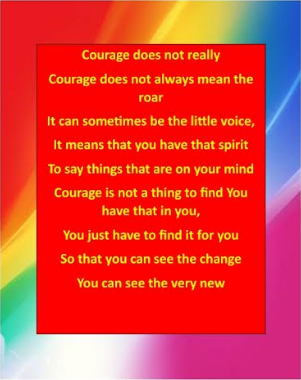
Courage propels us, like a wild hurricane. It fuels our dreams, empowers us to soar, To conquer mountains, and unlock every door.

With courage as our ally, we face the unknown, Embracing challenges, seeds of greatness sown. For in every heart, there lies a flame untamed, Waiting for courage to ignite, unashamed.

Post by Chahat Sharma <chaahatsharma2@gmail.com>

---
Courage and patience are two sides of a coin,
Together they make a person who can join,
The fight for what is right and true,
And wait for the right time to pursue it.

So, be brave and patient, my friend,
And never let your spirit bend.
For courage and patience will see you through,
And lead you to a life that's bright and new.

Poem by Vandana Sharma <vandnasharma144@gmail.com>

Tuesday, January 31, 2023

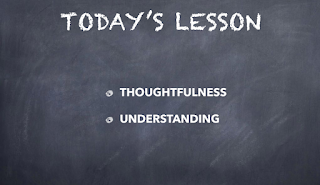
Thoughtfulness and Understanding - Laxmi Kant Bhatt

THOUGHTFULNESS: A sound mind is capable of making distinctions and clarifying, capable of the various modes of discourse that we talk about so often in writing: description, illustration, persuasion, and explanation. A sound mind can make decisions, inquire, and learn how to learn. We want people to be able to practice these various aspects of thoughtfulness alone and with others, verbally and orally, in written form with multiple subjects and with a core kind of knowledge and wrong kinds of activities, given their ages.

UNDERSTANDING: Student-teacher understanding has displayed many advantages in the classroom. First, students who share a positive understanding with their teacher develop more vital social-emotional skills. In addition, these students are more likely to absorb more academic knowledge. The result of a strong student-teacher relationship is that it allows students to feel confident through exploration and taking risks in their academic tasks. In short, students with a positive student-teacher relationship demonstrate more robust performance in the classroom. However, creating an environment that incorporates mutual respect is one of the most significant impacts of a positive student-teacher relationship. One way an educator can build a strong relationship with a student is to explicitly define learning goals and expectations positively. This could look different for groups of students or individual students. The strong connection will allow educators to be aware of their student’s learning and adjust their learning goals and expectations as needed.

Similarly, the educator should enable opportunities for students of all learning styles to participate in class discussions through oral and written communication. In addition to academic advantages, positive student-teacher relationships improve mental health and assist students in developing self-worth. Often, students look up to their educators as mentors. With this in mind, students will likely feel pride when the educator encourages them in their learning and social interactions. Social competence, problem-solving abilities, autonomy, and a feeling of a bright future or purpose are protective elements that boost resilience. These all can be developed in a supportive teaching atmosphere. As noted, students benefit from positive student-teacher relationships. Likewise, educators benefit as well. While creating solid relationships with their students, educators are strengthening their own interpersonal and professional skills. Educators are more likely to respond effectively to stressful situations by improving their interpersonal communication skills. In addition, educators can form relationships with parents and coworkers. In summary, students and educators benefit from creating positive student-teacher understanding.

L.K Bhatt 
The Doon Girls' School

Thursday, June 18, 2020

Responsibility and Cooperation - Swabhi Parmar

“When you do what you have promised, people see you as a responsible and reliable person.” This statement
is the true definition of responsibility. A responsible person can be trusted more than any other person. A person who shows the attribute of real responsibility is the most reliable person and we can believe them easily. Any individual who is responsible has the quality of cooperation. The term cooperation itself comes with a lot of responsibility. Being trusted is a good feeling. Any individual whether it is adult or child, all love to get trusted and this can be attained only if you are a responsible person. Responsibility means nothing if you constantly over and under-do it. This means building schedules and routines for yourself. So you should be consistent in your work and never stop no matter what.

Responsibility is taking full accountability for the actions you have made and never claims that it is anyone else’s fault except your own. By doing this, you are actually giving the world a message, that you’re in control of every part of your life. A responsible person admits the real reasons why they haven’t done anything so you should never give any excuses. If you have the responsibility of everything in your life then you can get cooperation from others. This cooperation can lead to good results in life. When everyone is working together, things can be done more quickly and efficiently. By increasing cooperation among employees, you can make their workplaces more welcoming and inviting, which increases the enjoyment of the time spent on the workplace. 

Cooperation is important because it allows people and groups to work together to achieve a common goal or derive mutual benefits. Cooperation also means taking turns and helping each other out. The two most important ingredients to get along in this world are sharing and taking turns. As a leader, you must set the tone of how complaints are registered, and you must develop the wisdom to respond appropriately instead of reacting to anyone’s negativity. So we should be cooperative and responsible for our own actions always in life and in any circumstances. We should be supportive of every individual of our community and environment. 

 Swabhi Parmar 
 The Fabindia School 
 spr@fabindiaschools.in

Blog Archive