Showing posts with label observation. Show all posts

Thursday, January 26, 2023

Art and it's importance - Subrata Sarkar

Nowadays, Art is taught in every school to develop students’ strength to explore their emotions, opinions, and ideas through a required medium. Paintings and sculptures are popular forms of Art. Art is an expression of the reality of your core. If you can see the unique side of a situation which can’t be seen by the majority, you are an Artist. Art should be taught to every student to know another side of life.

Art is not only doing sketches and paintings but also managing our lives and making our surroundings beautiful by documenting that particular moment. Knowing Art is about creating a separate room in your mind. For example, ancient people used to live outside without homes; even now, only four walls and a ceiling are enough to protect themselves. Still, your mind will not be satisfied only by that, and you will need more unnecessary things to make the room beautiful because it’s a matter of your feeling.

Instead of four walls, you desire a beautiful architectural form and arranged environments around you. Documenting the moments through Art reminds us about our human revolutions so far. When studying Art or observing an object, you are trying to connect that particular object, feeling and knowing better about something or someone else. At that right moment, you may find a different meaning or perspective. That perspective is your contribution. So, Art helps build a relationship with everything around them, even with a single insect, and an artist can respect all their existence. That’s why an Art guru always seems to suggest observing things. Here Drawing is the best form of keeping something in detail.

Art is a practice of seeing life uniquely, and students may explore the bright side of negative things in life in terms of their career, visuals, feelings, opinion and many more. That’s why the mother of Art is combined with expression like singing, painting, dancing, writing, performance etc. At this moment, if the page of Art is wiped out from your life, your life will go blank because whatever you are wearing, how you are behaving, whatever you are talking about or making your life very simple & intelligent are the fundamental fragments of Art. Think once why only a particular thing is extraordinary for you, although plenty of similar items are available. If you can understand Art, that means you’re a devotee, or if you create Art, you are unique. As like we can feel a song profoundly but can’t sing. So, for the students, Art makes them realise how important their feelings are in the present time.

I have a task for you if you accept. Have you ever wondered why only something that you like in the universe without reason? Everyone loves flowers, even you also. If I ask you why do you love that? Why is it beautiful? Tell me the exact reason for the beauty of that flower? “I just like it” is not the answer. Go near a beautiful flower, observe it carefully along with your copy, and start writing about its beauty–it’s not a simple task. I’m sure your mind will go blank. You may feel but hard to express. It will be a unique achievement if you try and can write a few lines. That’s the supreme achievement in Art, as you deeply feel something and can make someone feel the same in the same density is a big challenge for an artist. This is how your mind is getting to be mastered.

Sometimes I am amazed by how ancient people struggled to document Art forms in caves in 40,000 BC. Today’s yield of success is derived from them. They were unique. If you start a journey of Art History towards prehistoric, you will be mesmerised at every turn. “Without our past, there is no future”.


ART: Art is an expression of values or emotions and the connection between qualities of a relationship (it could be anything), creating a form of whatever you think of. 

Subrata Sarkar
The Fabindia School

Monday, September 26, 2022

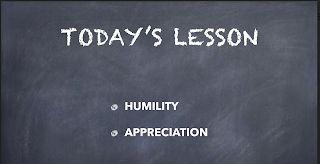
Humility and Appreciation - Jaspreet Kaur

Humility

Humility is the quality of being humble and means putting another person's needs before your own and thinking of others before yourself. It also means not drawing attention to yourself and acknowledging that you are not always right.

Activity

In Grade V 'A', as a Class In charge, I motivated my students to wish Class four employees daily when they come to school. I observed that initially, a few students started wishing them good morning and good afternoon. After One week, I watched that all students had started doing it regularly. Every day, they want to wish the Class four employees, whether he/she is gardeners, gatekeepers or Ayyas. One day one student went to the accounting office for a pain killer. When he came back, I asked him about his health. He said, "I am wonderful, Ma'am, but one Ayya (school maids) was not feeling well, so he brought a pain killer for her at her request". This, for me, was a great observation. I hugged that child and appreciated his action in Infront of the whole Grade V 'A'.

Impact on students

Students learnt humility from one of their friend's actions.

Stay humble and be kind.

Appreciation

I requested the student to appreciate the small actions of parents, garbage collectors, peers and class four employees. I counsel them to thank their parents when they give them food and water or help them with homework. I told them to say thanks when Ayyas cleaned their desks after lunch. It was observed that most of them have done the same. 

Impact on students

Appreciation is a beautiful thing. It makes what is excellent in others belong to us as well.

Jaspreet Kaur 

Kamla Nehru Public School, Phagwara.

JOL Cohort 2022

Sunday, June 6, 2021

Do You See ? - Nibbrati Rathore

Observation - The Master skill

Some people see, some observe. 

Some see and yet don’t see!

Some see and observe but don’t comprehend. 

Some see, observe and comprehend, but don’t act!


Look at this picture, now observe it carefully.

Try to think of a one-line story for the picture. 

Now, think of 2 more aspects that can be drawn from this picture.

.

.

.

By now, you must have come up with various versions of your views. This is the power of observation. When we observe anything closely, we come up with many new findings.


Well, some of the one-liners which came to my mind are: 


Observation is an integral act every living being does. It is the fundamental requirement and a gift embedded by nature with the primary motive for the “survival “of all living beings. But in the case of humans, we go one step ahead beyond survival – “SUCCEED.”

To make observation worthwhile, you can keep in mind the following points:

  1. Sachetan (सचेतन ): Be mindful, means become “conscious”. A state where you are conscious of your acts, thoughts and observations. To initiate the mind consciously, one needs to live in the present. Which requires decluttering your brain every day through conscious efforts. Most of the time, we remain engaged in what others think of us, how have I spoken in the meeting, have I been able to impress others etc. this way, we spend a major quantum of our energy on ourselves. As an observer, you need to consciously notice the world around you and not just the world within you. 

  1. Purpose (उद्देश्य): A piece of note-sheet lying on the floor of a class could very well be overlooked by the teacher, but if it is an examination hall, the note sheet will get immediate attention. We observe better when we have a purpose behind it. If you wish to retain any observation for a longer period of time, try to attach a purpose with it. This works.

  2. Brainstorming: (मंथन ): Observations would be meaningful only if we ask questions like, why, what, how, when, etc. Sherlock Holms mesmerized people with these questions and could catch the culprit. His main skill was observation. The mind churns the inputs given to it with the churning rod of logic and past experience. Repeated churning helps to infer the true nature of things. Due to this nature of ‘churning’ minds, we are called manushya in Hindi, which means someone who continuously evolves to create something new (solutions, discoveries, etc.).

  3. The missing piece: (अनुपस्थिति): Power of seeing what is absent is another aspect of observation. For example, if a fire extinguisher is not present where crackers are made, it tells a story. Observe a situation for a period of time and set a baseline of what is normal. And then, you can compare the future events back to the normal event. This helps you in finding the changes. A conscious observer can quickly pick the missing things. 


As a class teacher, I happen to spend my zero periods with the same class every day. It’s a wonderful opportunity to closely observe the behaviour of the children and know them better. Only because of the observations I make through the year could I identify behavioural changes in my students, find reasons behind them, and devise solutions to manage them better.

Try and observe every child of your class, derive inferences and dig out ways to help them. And the only investment is your “TIME”. 

To give a kick-start to fine-tune your observation skill, leaving you with another picture. 


Try to observe it and drop a one-line story in the comment box.

Nibbrati Rathore is an educator at the Gyanshree School, Noida

She is a Life Members and volunteer on the National Training Team of Learning Forward India.


Join Learning Forward, find out more at www.SchoolEducation.com.

Monday, February 17, 2020

Fun Learning : Urmila Rathore


Play-The name itself has a lot of curiosity, enthusiasm and fun. When a child plays games and participates in any activity, he does a lot of effort to win and face the challenges. Playing games improves various skills, values, and more so brings curiosity in the minds of these children

Sports teach us to face challenges, to become decisive and of course the possibility of winning a competition.

We should play with children to know their personal lives, challenges, abilities of thinking. When we play with children, they become more comfortable in sharing their thoughts and this way develop a strong bond with their mentor.Children like to play with their friends and family with a lot of enthusiasm. Sports also remove hesitation and fear of public speaking in a group or a team.

Last summer I went to Delhi to attend a workshop 'Drama in Education' which was an amazing experience for me. Before going there, I had lots of questions in my mind like -
What will happen? How will we do? Who will be our mentor? How he/she will behave with us? How will I speak in front of unfamiliar people? and so on. I was a little nervous but excited at the same time to learn from the workshop. This curiosity and enthusiasm makes me optimistic to face whatever will be next. We reached there and met many people belonging to different parts of our nation, made friends, did many groups activities. Through all the games, skits, dances, orchestra related to the academic subject, we learnt skills of collaboration, observation, punctuality, responsibility, imagination, confidence and many more!

Playing games also cover our subject related problems and that’s why all educationists are emphasizing on play-way methods in schools because it makes our learning easy to understand.
A curious child learns more effectively. As it is said, “Curiosity is the mother of discovery”, so an educator must inculcate this skill into a child through his teachings and let him/her find the information. In this way, children become more self-reliant by doing it themselves. It thus creates a learning environment.

Enthusiasm is basically dependent on the environment and physical health. Parents, educators, guardians should learn to be an enthusiast and fill it in their children through storytelling and adventures. We should also tell them the success stories of our players and great leaders.

An enthusiastic child can be a great leader, actor, educator or inventor. It plays a big role in our life and helps in achieving a goal. It never keeps us down. It motivates children and makes them ready to face the world.

A happy child always creates curiosity and enthusiasm and these aspects rejuvenate and recreate our thoughts, imagination and learning.
 Urmila Rathore,  Educator
ure4fab@gmail.com
TheFabindia School, Bali

Friday, August 23, 2019

Reading: First Step Toward Learning - Ajay Vijayvargi


Reading is one of the most vital disciplines in life. Reading, put simply, is the ability to decode words, symbols into something meaningful and is a part of language processing. Reading is a virtue, which can be attributed to every successful person around us and for this reason, it is important that this virtue is developed in students from their early stages, since their childhood.

During the childhood years, when the children are unable to read themselves, parents should be the guiding light and focus on reading out loud, even during the toddler years. Reading out loud should not necessarily be in English but in the most comfortable language of the parent and child and should have different subjects like fiction, non-fiction, of studies and others. This will help students eventually have hands-on over two languages and further, as an incentive, the bond between the parent and child strengthens, as the personal touch while reading out loud will always be there for the child. Further, the child’s listening and observation skills will also be boosted, which enhances the overall learning process and growth of the child. This will also become a first step in the process of ‘Learning by Doing’.

Reading out loud exercise can be continued for an extended period as it benefits the parent alike. Not only this, but early exposure to the reading newspaper at home will also inculcate and mould the reading habits amongst students and their awareness about the country, world and its happenings. In the teen years, students should be exposed to reading quietly and spending time in libraries, where books of various genres are available. This helps in faster comprehension and develop skills like speaking and writing.

Combined efforts at home as well as the school for promoting reading and developing reader skills certainly boosts the child’s overall development. While parents at home should ensure that both parents and child exchange relevant articles that they read in books, newspapers etc., teachers at school should regularly organize activities like debate, extempore which leads to the sharing of knowledge.

To sum up, reading should be continued at every stage of life in different forms. Reading makes a person complete. Global-mindedness, awareness, a better understanding of complexities, solution-oriented approach are few of the many qualities a vivid reader has and such people command a respectable position in society.

I am reading Matthew Raggett's book How Your Child Can Win In Life.
Ajay Vijayvargi, The Fabindia School

Tuesday, September 19, 2017

Mental Hygiene

When the child enters this world and goes in the arms of their dear ones, the thought to feel secure and guarded enters in their infant mind and they start connecting and feeling comfortable in the arms that give them immense love, care and affection, and when the child enters the phase of 3-5 years their thoughts, heart and eyes starts to explore the world to feel ,touch and understand what the world make them experience in terms of their experiences with things around them, when someone is hurt or in pain the child understands to sympathies a person and help them to be happy and this quality in the child is inculcated by the actions of the elderly people at that particular situation that the child experienced and learned by watching you.
     
If a child watches their elders abusing anyone or disrespecting anyone, he may not react at the very moment but its placed in the subconscious mind and it comes in action when the same situation the child experiences he copy paste the same actions as he feels that was the right way to deal as my elders had dealt it at the same situation before.
             
Action are very minutely observed by kids mind and heart .To inculcate empathy in kids it’s important to act to sensitivity to mankind and all lives existing by the elders to help a child build in the personality to be sensitive to every humankind and to feel the pain and an understanding to act by helping them to reduce it.
 
I want to share an experience of a counselling session where a child wanted to commit suicide at the tender age of 10 years because the religious priests had inculcated in the Childs mind that since he is a child his sins will be forgiven but ones he grow up his sins will be punished upon by the god so the child decided out of this great fear not to grow to the age to be tortured with the punishment and conveyed his will to end his life to his mother. On hearing the whole case I talked to the child and started counselling him in connecting him to the god in a positive way that god loves everyone and shall shower blessings on you if you be a great person and I conveyed him its very easy, just be kind to everyone and love them , once he connected with god in the positivity of loving his fear immediately reduced and the child instead of being fearful to god started loving god so its very important how we convey things to the child the half glass empty or the half glass full shapes the thought process of a child so “LIVE TO LOVE AND LOVE TO LIVE”

ROLE OF SCHOOL IN SHAPING PERSONALITY OF THE CHILD
School plays a significant role in shaping personality of the child ,the most important aspect of personality of the child are communication skills, logical thought process, empathy ,interpersonal skills , counseling skills , decision making skills and behavioral reaction skills

~ Ms. Tazeen Siddiqui is Managing Director, Mansha Educational society. Her email address is  fortazeen@gmail.com  

Blog Archive