Showing posts with label develop. Show all posts

Thursday, April 17, 2025

๐ŸŽจ Impressions That Inspire: A Thursday of Thought and Fire ๐ŸŽถ

๐ŸŽฏ Purpose with a Pulse: Why We Gathered, What We Gained

As part of our ongoing Thoughtful Thursday series, this session explored Impressionism across literature, visual art, and music. The aim was to inspire educators to weave these forms together, deepening students' emotional and sensory engagement and allowing creativity to flow freely.

Golden Glows and Gentle Flows: What Impressionism Bestows

  • Impressionism is all about evoking feelings, not dictating meaning—letting images, sounds, and words speak softly and suggestively.
  • Art captures fleeting light and motion; literature paints with moods and metaphors; music stirs emotion through tone and silence.
  • Integration of art forms makes learning holistic and heartfelt.
  • Avoid giving detailed instructions—give students space to feel, interpret, and express themselves.
  • The arts become a doorway to personal understanding and more profound empathy.
๐Ÿ“– Stories in Shadows: When Words Paint and Meanings Drift

  • Impressionist literature avoids clear-cut narratives, instead using imagery and mood to allow readers their own interpretations.
  • Authors like Virginia WoolfJoseph Conrad, and R.S. Thomas paint with words, letting moments linger like mist.
  • Example: In Conrad's Heart of Darkness, nature is used not only as a backdrop but also as a metaphor for internal turmoil.
  • Why it matters: This approach cultivates empathy and imagination, encouraging students to explore inner landscapes.

๐Ÿ–Œ️ Brushes and Breezes: Art that Catches the Light

  • Born from a desire to break away from rigidity, Impressionist painting captures the essence of a moment rather than its details.
  • Hallmarks include:
    • Loose brushwork
    • Outdoor painting (en plein air)
    • Bright, expressive colour palettes
  • Artists like Monet and Van Gogh invite us to feel the moment, not just see it.
  • Why it matters: It teaches students to observe the world more intimately, appreciating subtle shifts in mood and light.

๐ŸŽผ Echoes in the Air: Music that Moves the Mood

  • Impressionist music, like the works of Eric Satiespeaks through mood rather than melody.
  • Satie's Gymnopรฉdie was shared as an example: simple yet emotionally profound.
  • Introduced the idea of "colour" in music, relating to tone and timbre.
  • Why it matters: Encourages students to listen beyond notes—to the feel of sound, building more profound auditory sensitivity.

๐ŸŽญ When Arts Align: Weaving Wonder Through Every Line

  • Blending literature, visual art, and music creates a multidimensional learning experience.
  • Effective integration tips:
    • Avoid rigid instructions
    • Sensitise students to the "why"
    • Let expression lead the way
  • Why it matters: Students develop creativity, interpretation skills, and emotional intelligence through cross-modal exploration.

 ๐ŸŒฑ Steps to Bloom: What Comes Next, and How We'll Grow

  • Delve deeper into the "colour" of music in upcoming sessions
  • Teachers to experiment with Impressionist-inspired integrated activities in classrooms
  • Continue the momentum with weekly Thoughtful Thursdays to build a strong foundation in arts integration

We hope you enjoyed our creative journey through Impressionism in art, literature, and music. Let the colours, sounds, and stories inspire you—and don't forget to share your reflections and thoughts in the comments below. We'd love to hear from you!

Sunday, February 2, 2025

Love Learning vs Hate Learning - Ayushi Chowdhry

An interesting topic! The terms "love learning" and "hate learning" generally refer to an individual's attitude and mindset towards acquiring new knowledge, skills, and experiences.

Love Learning:

- People who "love learning" tend to have a growth mindset, believing that their abilities can be developed through dedication and hard work.

- They often find joy and excitement in discovering new things, exploring different subjects, and overcoming challenges.

- This mindset can lead to a lifelong pursuit of knowledge, personal growth, and self-improvement.

Hate Learning:

- On the other hand, individuals who "hate learning" might have a fixed mindset, feeling that their abilities are innate and unchangeable.

- They may view learning as a chore, a source of stress, or a necessary evil, rather than an opportunity for growth and exploration.

- This mindset can lead to a lack of motivation, disengagement, and a narrow range of interests.

It's essential to note that these attitudes can be influenced by various factors, such as:

1. Past experiences (e.g., positive or negative interactions with teachers, peers, or learning materials).

2. Learning styles and preferences (e.g., visual, auditory, hands-on).

3. Cultural and societal expectations (e.g., emphasis on academic achievement, vocational training).

4. Personal interests and passions (e.g., pursuing hobbies, creative activities).

If you're struggling with a "hate learning" mindset, consider the following strategies to help you shift towards a "love learning" attitude:

1. Identify your interests and passions.

2. Find learning materials and resources that cater to your learning style.

3. Set achievable goals and celebrate small victories.

4. Seek support from peers, mentors, or educators.

5. Emphasize the process, not just the outcome (e.g., focus on learning for its own sake, rather than just grades or external validation).

Remember, developing a love for learning is a journey, and it's okay to take it one step at a time.

Ayushi Chowdhry
Sunbeam Bhagwanpur

Tuesday, December 31, 2024

Tom and Jerry- Sunbeam School Indiranagar

In a school, teachers and students are like Tom and Jerry. Where the teacher, like Tom, keeps chasing the students to complete their tasks so that the students complete the given tasks on time. But some students are like Jerry, who are restless, they cannot stay on any task for long and get bored very quickly,  they also start misbehaving and do not even complete their work. In such a situation, a teacher tries that the students should be attentive by making them do different types of activities so that they can develop an interest in their subject and complete their task.

When a teacher behaves normally with the students and keeps aside his seniority, considers himself a facilitator of the students. There is trust in the teacher develops in the students, due to which they share their problems with the teacher which hinders their personality or learning. A teacher is not there only to impart bookish knowledge, he has to play different roles, sometimes he has to be a guardian, sometimes a friend, because to make a student a good citizen, a teacher has to take many forms.

Sunbeam School Indiranagar Varanasi
Chandrani Singh
Shalini Tiwari
Shilpi Chakraborty
Vijeta Wilson
Mizan Ali

Friday, September 27, 2024

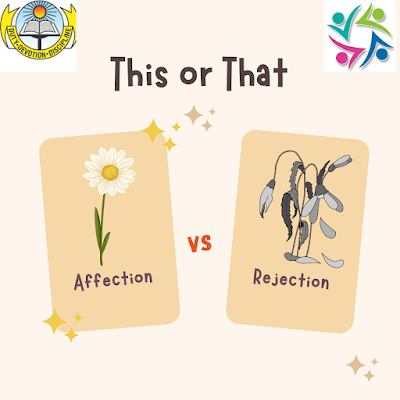
Affection VS Rejection - Mohini Rai

When we, as a teacher, every year meet to a new class full of 40 student then we not only meet with each 40 students rather we meet 40 families, 40 environments, 40 surroundings! I as a teacher strongly believes that it is very important for a teacher to understand that particular child among those 40 students, who has come from unhealthy disturbed families.

When a child grows up in normal family surrounded by friendly environment ,it actually helps the child to develop into mentally and physically healthy and strong. The child gradually develops into a balanced personality. Sometimes due to any casualties or incidences, when the family goes through any trauma, it also affects the little child’s psychology and it's development. And somehow these little children and their thoughts get ignored by the family. Under such circumstances the child develops an unbalanced personality and starts showing rejecting and repulsive attitude towards people in the society.

It is not necessary that all the children shows the same symptoms. Each individual behaves differently. This phase of their life becomes very crucial because they need affection and acceptance. In absence of affection and positive acceptance such children start showing various behaviour such as hyperactive- unstable behaviour and also sometimes destructive mindset. If we as a teacher try to talk to such children, initially they don't make eye contact because they try to hide their hidden emotions because they know that if they will do so the whole truth through their eyes will just flow in one go.

I still remember an incident when it was an assessment exam and in the creative writing question one child has shared the incidents of losing his mother during the COVID. When I got to know this then I tried to talk to that child and I found that child was like was about to burst into tears and tears and tears. His poor father was unable to take care of him and hence have left him in a boarding school. Although the child had adjusted in the school very well but his blank's face and teary eyes were clearly expressing the deep sorrow of child's heart. I as a Pastoral teacher told him that I am always there to listen him whenever he needs to talk to me.

Mohini Rai
Sunbeam Suncity School

Wednesday, September 2, 2020

Hope and Friendship - Jitendra Suthar

Someone once said, “Having good friends who love and support you for whom you are are important
for your happiness. Figuring out what makes a good friend can teach you how to be there for your friends when they need you the most.”

Today, I will be talking about people’s opinions on friendships, what makes a good friend, and how to be a good friend so then you’ll learn how to choose a good friend. Normally, we all have the same opinion on a good friendship. A friend is someone special that helps you through good and bad times. It has been shown in statistics that the better quality of your friendships, the happier you are and the better you feel about yourself!

Friendships can be short or last a lifetime and as you get older, you may find that your friends change. For example, we all started school being nervous and wondering, “Will I have someone to play with at recess?” or “Will I make friends?” Now, After finishing post-graduation, I have made so many friends that I would hope to continue staying connected with, but I’m also looking forward to meeting new people and build lifelong pals. Now, we have opinions about good friendships, but what about bad friendships? What can they cause? Usually, some results from bad friends can lower you.

Where there is friendship, there is hope. We all have a person standing by us in any situation no matter it is wrong or right is our friend. We have a tendency of searching for a shoulder where we can pour our self out and that our friend. 
    
As we get older, we will find that our closest friends may change from day to day. This is normal because as we become mature, we may develop new interests, which will expose us to a new set of friends. Regardless of who we are spending time with or view as our closest friend, it is important to remember that we should always treat each other with a very high level of respect so we get the most out of our friendships we develop. Like a quote that someone said, “There comes a time in your life when you realize who really matters, who never did, and who you always will” 

Jitendra Suthar
The Fabindia School
jsr@fabindiaschools.in

Monday, May 25, 2020

Courage and Patience - Kavita Devda

A famous quote by Mr Winston Churchill about courage is “Courage is what it takes to stand up and speak; courage is also what it takes to sit down and listen.”
Courage is when you are brave about something you fear. It is important because we all have to do things we don’t like sometimes. Everyone is afraid of something or someone. The difference is how you deal with your fear. Courageous people believe in themselves. They know who they are and what they stand for. They are passionate about their beliefs and values. They step outside from their comfort zone to meet the challenges that are ahead. Patience is very important in life because there are so many things that take time to develop for us to experience in a positive way. If we try to make something happen, we put a lot of stress on ourselves. 

Life is not about living in the future or in the past. Life is about accepting the present movement. Patience is the biggest lesson for man to learn. The beginning of any work is easy but after some time we face difficulties. When difficulties surround us we must have patience. 

Kavitha Devda 
The Fabindia School

Wednesday, April 29, 2020

Happiness and Tolerance - Byju Joseph

Tolerance is the quality of possessing a positive attitude towards everyone. As social beings, we all need to be tolerant with other people who are of different races, cultures, languages, religions and nations. They have different opinions, beliefs and ideas which may not be familiar with us. The depth of tolerance lies in the ability to make our mind broader enough to accept others ideas and thoughts. This approach really helps to expand our knowledge and understanding level. It is the positive energy of humanity.  The responsibility of tolerance lies with those who have the wider vision of reality.

As educators, we must have tolerance, respect, and equality in our learning community. We must be ready to listen and accept the ideas and opinions of our children. It creates a deeper understanding of their views and beliefs. Former American President John F. Kennedy once said, ‘Tolerance implies no lack of commitment to one’s own beliefs, rather than it condoms the oppression or persecution of others’. Tolerance is a virtue that depends upon peace and strength. It is the ability to endure pain and hardships. In another way, having tolerance is a good ability to overcome certain circumstances but it depends on how we handle the situations. It helps us to overcome challenges and accept things in our lives.

Happiness is something that we can't buy from anyone or from anyone. It is a feeling that comes from within. We live our lives trying to find happiness without realizing it is within ourselves. We need to realize it and embrace it. We can make others happy only when we are happy. There are many occasions in our life that provide a lot of happiness to us. It is a mental satisfaction that we achieve when we accomplish something or when our mind fulfils or satisfies with something. We all do several things which we like and from all those, we get mental satisfaction which makes us happy. There are moments of happiness that we cannot control sometimes because of the fruitfulness of hard work and proper planning behind such events to make them successful. Such feelings arise within us and thus they provide more and more occasions to enjoy our lives.

School being the second home of children, it must be a happy place. Educator's duty is to teach the values and practice them among students and thus to make the school a place of happy learning It is important to develop the values like tolerance and happiness in children which are very essential for the successful completion of tasks in their learning process. These values help them with their mental and social development. They help the children to understand each other in all aspects which will lead to better social bonding and relationship. Possessing these values to help the children to become good citizens of our country. So, let us work together to achieve the goal.

Byju P. Joseph
The Fabindia School

Tuesday, February 11, 2020

Writing Skill:Usman Gani

Students who learn to write a complete sentence at a young age are more likely to apply that knowledge and develop that skill into writing complete paragraphs as they age. Mastering writing at an early age is associated with higher outcomes on standardized testing and overall performance in school. Good writers are good readers. Writing gives voice to our inner thoughts and allows us to share them. As a form of communication, writing can transcend time and is a way to pass stories from generation to generation. 

It has been said that the best way to improve anyone’s reading is to have them write. Writing focuses students on phonics, comprehension, mechanics, developing their voice or perspective, and communicating this perspective to others. Gone are the days of diagramming sentences.  

Balanced Literacy focuses on developing the many skills that good readers and writers possess, in an authentic method of communication. Writing makes for better readers and improves comprehension and critical thinking.  

Usman Gani #HappyTeachers
The Fabindia School, Bali
ugi4fab@gmail.com

Monday, July 9, 2018

Maree Scully: Changing from the Inside Out

“Should I invest money in coaching or put it towards new clothes?”  The person who asked me this question had just finished describing her need to overcome a longstanding and destructive personal habit.

While it’s always tempting to add to our wardrobe, a new look on the outside will never bring inner growth and desired change.  We often misunderstand how growth and heart transformation take place.  We think that perhaps with more discipline and stronger willpower, we can do this on our own.  Sometimes that does work!  But there is a healthier way to grow and change.

Recently I was watching a documentary on ‘Breaking the Food Seduction’ and the doctor mentioned as a throw-away comment that it is not possible to change our eating habits on our own.  He mentioned that a little bit of group support makes the difference between success and failure.  A group that meets regularly and shares successes, stories, and challenges, will change their eating habits and their lives!

Some years ago I read the book ‘How People Grow’ by Dr’s Townsend and Cloud.  The overwhelming thought that I came away with is that God designed us to grow in the community – with loving supportive and accountable relationships.  It was never intended that we run this journey of life on our own, yet we have somehow perfected it through our tendency towards keeping up appearances, busyness and building walls to keep others out.

One of the things I love about coaching is that it enables people to grow and change in a supportive, safe, loving, accountable relationship.  The coach works with you on a journey of self-discovery. To this end, he or she will challenge you and ask you difficult and maybe uncomfortable questions.  The coach creates a safe place for you to reflect, think deeply, and arrive at a point of greater awareness that results in a commitment to change. 

Even good friends or colleagues don’t always hold each other accountable or intentionally encourage growth.   Maybe you have colleagues with whom you can be transparent and who may be willing to ask you ‘What progress are you making in that area of leadership?’  Why not give them permission to ask?  Let’s stop trying to change and grow on our own.  Find people, whether it be a coach, a friend, a colleague or a mentor, to journey with you, to support and challenge you in your leadership growth. 
This morning I read an article by Laura McCamy on ‘6 things people who are good with money always splurge on’.  She quotes a personal finance expert as saying that coaching can be a good career investment for entrepreneurs and employees alike. "Whatever is hard for you and challenging for you, investing in a coach to help you with that," she said, is a worthwhile investment.  Coaching is an investment in your growth.

Let’s not stay stuck on the inside while sporting our new wardrobe on the outside!
Maree Scully
coaching4growthltd@gmail.com
www.coaching4growth.co.nz

Blog Archive