Showing posts with label humans. Show all posts

Friday, July 1, 2022

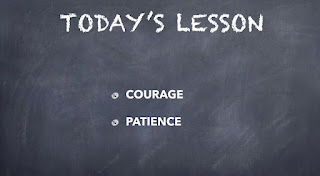
Courage and Patience - Maitreyi and Sukhpreet


COURAGE

"Courage is not the absence of fear, but the judgement that something else is more important than fear "– this is the thought that we mentors should encourage and engrave in the minds of our students. 

The emotion 'fear' is something that a child is born with; that is why an infant startles at a loud sound, the fear of the unknown makes that baby cry. It is the value of 'Courage' that parents and we teachers need to teach the child the way to overcome 'Fear'. 

As a teacher, I have noticed children having fears of different kinds. Some are scared of their exams, some are scared to express themselves to their teachers in class, and some are even scared to talk to their peers. All these children are aware of their fears, and they avoid them as much as possible. I believe all fears have a history of some occurrence in a child's life.

Various actions in a child's life leave a conscious, sub-conscious effect on the child's mind and affect the child's behaviour in the future. There are fears which set in the child due to lack of self-confidence. Children are conditioned through their environment to judge their own life and categorize the same into failures and success. Hence, the fear of failure discourages the child from even attempting. 

The students should be discouraged from judging every action of theirs and be taught to concentrate on analyzing their abilities and be conscious of their limitations. We teachers should make a child understand to hone their skills and encourage them to do the little bit 'extra' in a particular field, only if the child is capable of the same. It can never be forgotten that children always learn by observation. Hence, teachers and parents must circumvent all their activities into failures and successes.

Teachers should counsel the parents of the children to understand their children as separate human beings and not as their reflection and expect the child to fulfil specific aspirations they were unable to achieve. A parent must realize that their child has his own likes, dislikes, and aspirations as a separate individual. Parents are responsible for encouraging their children to follow their dreams and become happy, confident humans.

As a teacher, it is practically impossible to control the environment children face at home. Hence it becomes essential that they have to create a competitive yet hypercritical free environment at school. 

 A few pointers that can help us cultivate courage are - 

  1. Understanding the background of the child and the reason for his/her such behaviour. 
  2. We must observe them minutely so that we can bring positive change in the behaviour of the child. 
  3. Share real-life stories with them that will bring courage to their life.
  4. Nudge them to get involved in a cause for which they are passionate.
  5. Encourage them to volunteer in class activities.
  6. Create a nurturing environment for your students.
  7. Encourage students to achieve their goals.

Teaching students to have courage in the classroom not only increases engagement and academic achievements but also helps them to face adversities in life. To develop courage in a child, as a teacher, we need to gain that child's confidence and make them realize that having fear is normal. We teachers can share our personal anecdotes with the child, our own stories wherein we have overcome our fears and those situations of how we have learnt to handle our concerns. A teacher expressing their personal experience gives the child a sense of confidence to relate with their teacher and accept themselves as they are. 

It is important to make the child realise that being brave is not to be scared ever but to overcome the fear and to not allow it to control our actions. 

Teachers should be evaluative, not judgmental; we should not judge a child by their fear and give up on their activities. On the contrary, when we evaluate the child, we should remember their drawbacks and judge them on their own standards. If a child learns to compete with himself and strive to outdo his previous performance, he surely will be calmer and ready to face the competitive world in the right frame of mind.

PATIENCE

Patience is truly a virtue that is very important that it is imbibed in every person. Due to curiosity and anxiousness, children get confused about how to handle the situations and are generally in a hurry to complete the work at hand and hence do not develop the virtue of patience. Technology and modern gadgets have made life move at a faster pace, the younger generation is used to seeing life at this pace, and they are unaware of life at a calmer and slower pace. 

To teach the children the virtue of patience is a huge task. We can cultivate patience in children by creating in them the realization of the advantages of being patient. We can teach patience with very regular day-to-day examples like showing them to wait for a flower to bloom and making them realize that the result is always excellent by waiting patiently. 

How a teacher can encourage a pupil to be patient are: 

  • By giving them tasks that show results after a long period 
  • Evaluating the mistakes they make, being in a hurry and giving them feedback on their performance would have been better if they did it with patience.
  • Encourage activities like participating in book reading clubs.
  • A few activities for children to teach them patience
  • Pass the Parcel. Wrap a present in many layers and hand it over to the kids
  • Baking
  • Gardening
  • Work on a Puzzle. 

Maitreyi and Sukhpreet
Gyanshree School Noida

Saturday, June 12, 2021

Freedom and Peace - Reena Gusain

C:\Users\DELL\AppData\Local\Temp\Rar$DIa0.844\WhatsApp Image 2021-05-17 at 15.58.43.jpeg

"Peace is the result of retraining your mind to process life as it is, rather than as you think it should be," by Wayne W. Dyer, which means accepting the situation as it is rather than conflicting, disagreeing or revolting against it. So we can embrace it and find peace in it.  As we all know, humans are destined for hard work, accept challenges, remain competitive and enthusiastic for the future. But in this process of moving ahead, some people find peace in achieving the goals, but some may not. It may differ from person to person. Peace gives the utmost pleasure, which we humans have to find out in all situations. No matter how successful, how rich you may become but peace cannot be compromised, and if one does so, then both body and mind have to pay the consequences. Nobody can bring peace, but we ourselves should take the initiative to build peace. 


C:\Users\DELL\AppData\Local\Temp\Rar$DIa0.012\WhatsApp Image 2021-05-17 at 15.58.43 (1).jpeg'May we think of freedom, not as the right to do as we please, but as the opportunity to do what is right' well said, Peter Marshall.  The concept of freedom may also differ according to their mindset and situation faced by people. But the perfect freedom can be said that making best to the opportunity given in a situation. With power, there comes responsibility; therefore, with freedom, there comes the ability to explore new boundaries, but to an extent, it does not hamper other’s freedom. For example, cutting down forests may be freedom for mankind, but it is just hampering their natural habitat for other creatures. 

So with this, we may conclude by saying what peace is to the mind. Freedom is to the soul.

Reena Gusain
The Doon Girls School

Monday, May 25, 2020

Covid 19 - Prakash Dangi

Coronaviruses (CoV) are a large family of viruses that cause illness ranging from the
common cold to more severe diseases such as Middle East Respiratory Syndrome (MERS-CoV) and Severe Acute Respiratory Syndrome (SARS-CoV). A novel coronavirus (nCoV) is a new strain that has not been previously identified in humans. Coronaviruses are zoonotic, meaning they are transmitted between animals and people. Detailed investigations found that SARS-CoV was transmitted from civet cats to humans and MERS-CoV from dromedary camels to humans. Coronavirus disease (COVID-19) is an infectious disease caused by a newly discovered coronavirus.

Most people infected with the COVID-19 virus will experience mild to moderate respiratory illness and recover without requiring special treatment.  Older people and those with underlying medical problems like cardiovascular disease, diabetes, chronic respiratory disease, and cancer are more likely to develop serious illness. The best way to prevent and slow down transmission is to be well informed about the COVID-19 virus, the disease it causes and how it spreads. Protect yourself and others from infection by washing your hands or using an alcohol-based rub frequently and not touching your face. Maintain at least 1-metre distance between yourself and others.

 The COVID-19 virus spreads primarily through droplets of saliva or discharge from the nose when an infected person coughs or sneezes, so it’s important that you also practice respiratory etiquette (for example, by coughing into a flexed elbow). At this time, there are no specific vaccines or treatments for COVID-19. However, there are many ongoing clinical trials evaluating potential treatments. WHO will continue to provide updated information as soon as clinical findings become available. So " STAY SAFE and STAY HOME".

Prakash Dangi
The Fabindia School

Monday, May 4, 2020

Self Love – Be You- Swabhi Parmar

As humans, we are keen on wanting more. We think that if we buy that house or if we earn
more money, we will be the happiest. We shall ask for nothing more. Believe me when I say that I have said it to myself every time I wasn’t content with what I had. We think all our worries would go away if only we could achieve that target. But we fail to realize that the moment we achieve that goal we will come up with a new goal. We will convince ourselves that this will make us happier. 

This is a vicious and never-ending circle. Let me tell you what self-love is. First, it’s about being content. It’s about telling ourselves that we have more than enough to go on. Life is all about ups and downs and we should embrace it equally. We have to know how to keep it together anyway. Self-love is when we are keener on making better decisions and nurture our well-being despite what is going on around us. Loving one’s self does not mean developing a shell and blocking out the world. It doesn’t mean having an ego so big that no one else can fit into a room with you. It doesn’t mean forgoing relationships because you only enjoy being with yourself. 

And, while it may be tempting for many, it doesn’t mean you should only have pets for the rest of your life. It does mean becoming comfortable with who you are. It means recognizing that someone else who didn’t learn unconditional love has a hard time giving it. It means recognizing that most human beings hurt, and they pass this hurt along to other people. Understanding this can help you turn yours from waiting and wanting someone to make you whole, to realize you have that ability inside of you. Self-love is a very important aspect of one’s life. It is very much important to love yourself but Yes don’t be obsessed with yourself. Self-love leads you to self-motivation. You can realize it in the cycle of life that whatever we go through in the end it is us who have to deal with that pain or sorrow. We should always be content and love our self in the best possible manner.

Swabhi Parmar.
The Fabindia School

Blog Archive