Showing posts with label independence. Show all posts

Saturday, December 6, 2025

Task Separation in Parent-Child Relationships


Reading from the book "The Courage To Be Disliked" and discussing Adlerian psychology's "separation of tasks" concept for improving relationships.

Key Takeaways
  • Separate Tasks to Reduce Suffering: Identify whose task an outcome belongs to (the person who receives the result) and do not intervene in others' tasks. This is the first step to lightening life's load.
  • Intervention is Egocentric Control: Forcing others to act for their "own good" is often a "life lie" used to fulfil the intervener's own goals (e.g., social appearance, control), not to help the other person.
  • Freedom Requires Rejecting Recognition: Living to satisfy others' expectations is unfree. True freedom comes from choosing one's own path, even if it means being disliked.
  • "Productive Failure" is Essential: Allowing others to fail is necessary for them to learn and build courage. Constant intervention prevents this growth and fosters a fear of challenges.

The Separation of Tasks
The core principle is to identify whose task an outcome belongs to.
Rule: The person who receives the end result of a choice owns the task.
Example: A child's studying is the child's task, as they receive the results (e.g., grades, school admission).
Intruding on another's task is the root of interpersonal conflict.
This is not non-interference (indifference); it is offering support only when requested, respecting the other's autonomy.

Applying the Principle
Parent-Child: A parent's worry over a child's choices is the parent's task. The child is not living to satisfy parental expectations.
Workplace: A boss's unreasonable anger is the boss's task. The employee's task is to do their work without lying, not to seek the boss's approval.
Belief: Believing in someone is one's own task. How that person acts is their task. Pushing one's wishes without this separation becomes "stalker-like intervention."

The Gordian Knot: A Metaphor for Change
The "Gordian Knot" anecdote illustrates the need for a radical approach to complex relationship problems.
Conventional Method: Trying to "unravel" the knot (e.g., using conventional social thinking) is slow and ineffective.
Adlerian Method: "Cutting" the knot (e.g., separating tasks) is a direct, revolutionary act that creates freedom.
Result: This creates a necessary "moderate distance" in relationships, which is essential for healthy interaction and mutual respect.

The Desire for Recognition vs. Freedom
The Youth argues that living to satisfy others' expectations is easier and provides a guide for life.
The Philosopher counters that this is an unfree way to live, driven by a fear of being disliked.
Trying to please everyone is a "life lie" that leads to continuous stress and self-deception.
Conclusion: Separating tasks is not egocentric; intervening in others' tasks is. True freedom comes from choosing one's own path.

Next Steps
  • Gurdeep: Share the Kindle bookmark and Otter.ai takeaways in the WhatsApp group.
  • All: Reflect on the concept of "separation of tasks" in personal relationships.
  • All: Consider the balance between maintaining boundaries and nurturing relationships.
  • All: Explore ways to communicate and collaborate without getting caught in cycles of expectation and judgment.
  • All: Research "Productive Failure" to deepen understanding of experiential learning.
AI-generated content thanks to Fathom AI.

Wednesday, February 26, 2025

Heart vs. Mind- Sunbeam School Annapurna

In the journey of education, teachers often find themselves caught between the heart and the mind—the heart that urges them to go the extra mile for every student and the mind that reminds them of maintaining expectations and discipline.

This video captures the everyday dilemmas educators face: Should we offer extra help beyond what’s expected, or should we hold students accountable to foster independence? How do we ensure we are nurturing yet firm, guiding yet allowing room for growth?

Through real-life scenarios, we showcase how teachers navigate this delicate balance—offering support where needed while ensuring students rise to challenges, building resilience, responsibility, and confidence. Because at the heart of great teaching lies the perfect blend of compassion and structure.

Diksha Jindal
Shivangi Gupta
Janhvi Meghnani
Sunbeam Annapurna

Monday, January 1, 2024

Freedom & Peace: Samriddhi RPKM

When you were a student, what were the three most critical instances where in you felt that more freedom at your disposal would have allowed you to realise your goals/potential in a better way? Do you think any of those circumstances exist even today?


Choice of subjects: As a student, I often felt limited by the subjects available. I wished for more freedom to choose the subjects that truly interested me and aligned with my career goals. This would have allowed me to realize my potential in a better way by pursuing my passions and strengths.

Extracurricular activities: I felt restricted by the limited options for extracurricular activities at my school. More freedom to explore a wider range of activities would have allowed me to develop various skills and interests, ultimately helping me to realize my potential more holistically.

Independent projects: I often wished for more freedom to pursue independent projects and research that went beyond the standard curriculum. Having the autonomy to explore topics of personal interest would have allowed me to push my boundaries and achieve greater academic growth.

These circumstances still exist today, as many educational institutions have rigid structures and limited options for students to explore their interests and strengths. However, there is a growing movement towards personalized learning and flexible curriculum, which aims to provide students with more freedom to pursue their goals and potential in a better way.

What is it about human behaviour, according to you, that causes people to give up peace and adopt violence? How do you think classrooms can be used to shape peace-loving individuals?

Human behaviour is complex, and various factors contribute to individuals resorting to violence. Social, economic, and political factors, along with personal experiences, can influence this behaviour. Classrooms play a crucial role in shaping individuals' values and attitudes. Fostering a peaceful environment involves:

Promoting Understanding: Encouraging empathy and understanding diverse perspectives can reduce misunderstandings that may lead to conflict.

Conflict Resolution Education: Teaching conflict resolution skills equips individuals to address disagreements peacefully, fostering a culture of dialogue rather than confrontation.

Cultivating Open Communication: Creating an atmosphere where students feel comfortable expressing themselves can prevent suppressed emotions that might escalate into violence.

Emphasizing Emotional Intelligence: Developing emotional intelligence helps individuals manage emotions effectively, reducing the likelihood of impulsive, aggressive behaviour.

Incorporating Peace Education: Integrating peace education into the curriculum can raise awareness about global issues, tolerance, and the importance of cooperation.

Positive Role Modeling: Teachers can model peaceful behaviour, demonstrating how to handle challenges constructively.

By addressing the root causes of aggression and promoting positive values in educational settings, classrooms can contribute to developing peace-loving individuals.


Samriddhi @RPK Moradabad

Seema Kulshreshtha, Rakhi Gupta, Saraswati Singh, Saloni Bharadwaj, Anju Gupta, Gurpreet Kaur, Meeta Gulati.


Thursday, May 6, 2021

Freedom and Peace - Flyers DGS

Listen to our story
 “Freedom is the oxygen of the soul.” Moshe Dayan    

Freedom is a basic right of all living beings. Freedom is an abstract idea that can't be touched, seen, felt, reached or explained. All this gives a vague idea about freedom. But what exactly does freedom mean?

Different people have different opinions, definitions and thoughts about the idea of freedom. Some talk about freedom in the political sense, some talk about social freedom, some about personal independence and some define it as religious freedom. But the fact that everyone wants to be freeholds true in all cases. Education or preaching does not make us free. Freedom is the absence of any pressure from the social, political and religious environment that we live in.

But freedom is not an absolute right, and it too has some constraints or terms and conditions in simple language. At times, freedom is specific to the age group we fall into or according to our social environment.  A popular saying goes: “Your freedom ends where mine begins”.

Freedom is the state of mind of being free, independent, or free from prison. Freedom means to ask nothing from others, to expect nothing from others, and there is nothing to depend on others. Freedom is a choice of a person to live life the way he/she wants. Freedom is to present yourself the way you are, but it doesn’t mean to live only your life, instead help others to live happily and freely. Freedom comes with restrictions. It is a responsibility. Freedom doesn’t mean to live your life freely and make others’ life miserable. Freedom allows us to work together while maintaining autonomy.

Freedom allows us to enhance the expression of creativity and original thoughts and increase productivity. It allows us to invent something new and helps us to live a high quality of life. Freedom of thinking, speaking and actions helps us to take our decisions independently. It is a condition in which we are fortunate to speak, act and be happy without unnecessary restrictions. Deprivation of freedom is like a punishment to a human being in which neither the captivator nor the captive is at peace.

One of our members writes – “Being a woman, freedom means to me to be able to walk alone without any fear, to earn equal wages, to dress-up the way I want, to choose any occupation, to be treated equally and not to feel guilty for living my life on my own terms and conditions.”

On the other hand, peace is a state of mind and heart when we are calm and quiet, with no disturbance, like a still pond with no ripples. Peace is a stress-free state of serenity and calmness that comes when there is no fight and everything coexists in harmony and freedom. Peace helps us to rebuild ourselves; it strengthens us and helps us to restore. Peace is the ability to manage conflicts constructively as an opportunity for change and increased understanding.

Peace means learning from others. It means to nurture all individuals. Peace is a sense of appreciation and respect for all the little and big things in life. A peaceful mind has peaceful thoughts, speaks words of peace and will at peace.

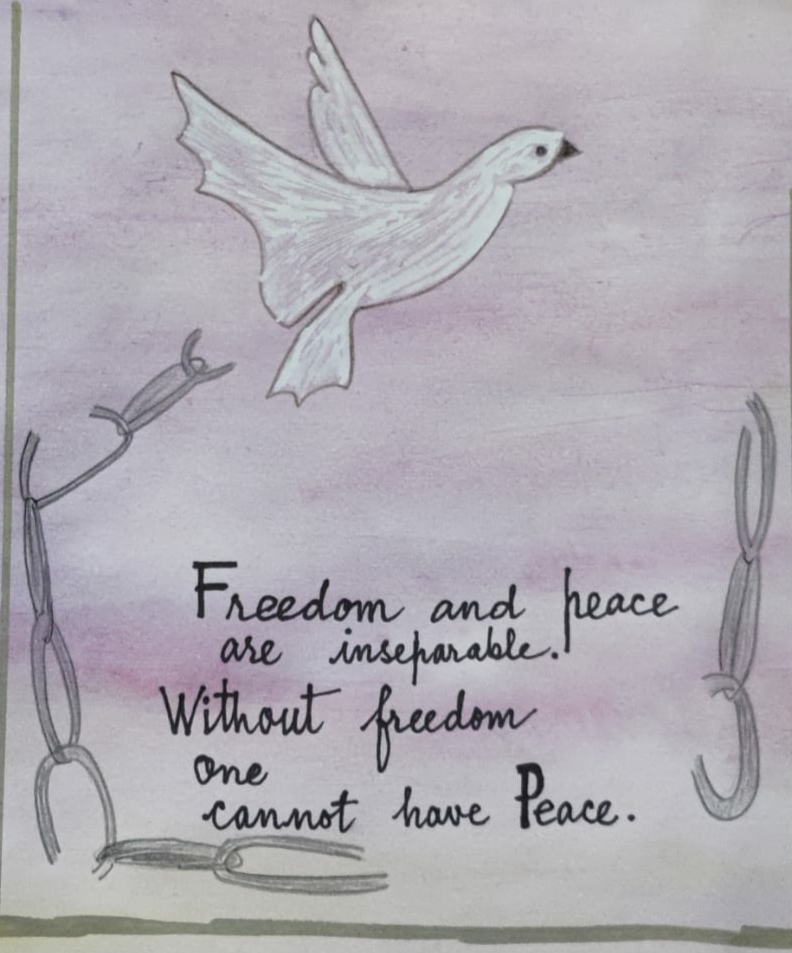
Freedom and peace cannot be separated from each other because we cannot be in peace unless we have the freedom of speech and actions. We get freedom when we allow freedom to others, same as we have peace of mind when we allow it to others. We make the right decisions when we are free to think, and there is peace in our heart. And, of course, when we get freedom from our desires, we get actual peace inside.

Written with enthusiasm by FLYERS DGS - Vijaya Jugran, Urvashi Uniyal, Vandana Goel, Bhumika Vyas & Ritika Tyagi, at The Doon Girls' School in Dehradun.

Monday, May 3, 2021

Freedom and Peace - Dynamic DGS

Freedom is a mighty word...it is the power to think and act in a way that we feel correct. The word freedom could mean different things for different people. For some going for a dance class or singing in a class could be freedom, while for others wearing a certain type of clothes could mean freedom. Children do need to be supervised, but they also need the freedom and space to grow. Adults sometimes inhibit the children with their prejudices and opinions. We need to give them the freedom and independence to think and make choices. We want children to be their own individuals when they grow up. Of course, they might err at times, but that is the only way they will learn. When we allow children some freedom, we convey that we trust them, and they respect that trust. If there are too many restrictions, they tend to become rebellious at times. Thus it’s important to allow certain liberties, but one should also know where to draw the line.

जीवन बंधनों  में बंधकर जीना है अगर,

करना है अपना हर स्वप्न दरकिनार अगर,

तो लगने लगेगी हर सांस एक बोझिल 

सफर।

टूटे हुए सपनों की एक इमारत भर ।

इसलिए.........

जिंदगी की जिंदगी से मुलाकात होनी चाहिए, 

खुशियो की भी आपस में बात होनी चाहिए, 

अस्तित्व है जीवन में कुछ ये एहसास  होना चाहिए, 

पंखों को उड़ने के लिए आकाश  नहीं नया कोई चाहिए, 

बस  थोड़ा पर फैलाने के लिए आजादी पर अधिकार होना चाहिए ।।

Peace means a calm and composed state of mind. Peace is harmony, freedom from quarrels, wars, arguments; it is inner contentment . . . which is very essential for mental health. We tend to focus on physical health, but very few of us realise the importance of mental health. A calm and peaceful mind helps us think clearly and make better decisions and keep a healthy environment. Kids need to be corrected when they go wrong, but they don’t need constant nagging.


There should be no bullying amongst children for them to be peaceful. Thus all schools should have zero tolerance for bullying.  Children should be assured that they are safe.  Teachers need to introduce this word right from the beginning of school to be familiar with ‘peace’. We also need to teach the kids to resolve issues and fights without hurting each other.


A peaceful state of mind allows new thoughts and ideas to be developed easily. When people learn compassion and tolerance, only inner peace can be achieved and then there will be no place for hatred, anger, selfishness. How can one forget the role of meditation! Yes, meditation helps in bringing peace and attaining divinity. Practising meditation regularly alleviates stress-related problems, deeply relaxes the mind and rejuvenates the system. This peace will then radiate, create a ripple effect and indeed lead to global peace.


Let's remember this equation:-

peace of mind = calmness, tranquillity, serenity =happiness, So what is the relationship between peace and freedom?


To achieve anyone, the requisite of the other is a must. As Pope John Paul II has rightly said that we should not accept violence as the way of peace. If we respect true freedom, the peace that results will be based on justice," a peace founded on the incomparable dignity of the free human being." Whatsoever may be your field, whether you are at home or in a public space, if you feel free to express your thoughts or ideas and not succumb to outside forces, then you will attain peace of mind and body.


Dynamic DGS @ The Doon Girls School, Dehradun - Reena Gusain, Reah Sikand, Meenakshi Panwar, Rachna Bharrdwaj and Sumali Devgan

Wednesday, August 19, 2020

Independence Day - Swabhi Parmar

Every year on 15th August, India celebrates Independence Day. India became an independent country in the year 1947 from British rule. Each one of us is born free, dies free and wants to live free. India achieved its Independence with great struggle and effort. Several freedom fighters and many great men sacrificed their lives to achieve the nation’s freedom from the grip of British rule. The movement of independence in India was started by the Indian freedom fighters under the leadership of Mahatma Gandhi. 

These freedom fighters endured a severe struggle in order to achieve the nation’s freedom. 15th August is celebrated with high enthusiasm in order to pay honour to our legendary freedom fighters, who sacrificed their lives for our motherland. Independence Day motivates us to love our country and be forever willing to sacrifice our lives for its honour and integrity. Being a part of such a beautiful nation one must not forget these sacrifices. We must honour and preserve the integrity and dignity of the country. We should maintain the slogan of unity in diversity.

There is a saying that if you want to see change then first change yourself. Because it always starts with us. Freedom is not only a privilege but it is the duty of each and every being of the nation to respect our motherland. We can truly enjoy freedom when we will be free from social differences and many ill practices which happens in the nation. This should not be motivated at any cost. If you expect equality then you should be capable to give equal treatment to everybody. So you must give respect to take respect. On this note, I wish you a very Happy Independence day. Let's spread positivity and peace all around.

Swabhi Parmar
The Fabindia School
spr@fabindiaschools.in

Tuesday, August 11, 2020

Quit India Movement - Kusum Sharma

Quit India Movement Day (77th anniversary) is observed on 8 August which is also known as August
Kranti. It is considered as an important movement in the freedom struggle where masses also participate and take charge itself.

 In April 1942, the Cripes mission failed. Within less than four months, the third great mass struggle of the Indian people for freedom started. This struggle is known as the Quit India movement. On 8 August 1942 at the Bombay session of All India Congress Committee by Mahatma Gandhi during World War II passed a resolution of Quit India Movement. This resolution declared that the immediate ending of the British rule in India was an urgent necessity for the sake of India and for the success of the cause of freedom and democracy, for which the countries of the United Nations were fighting against fascist Germany, Italy and Japan. The resolution called for the withdrawal of the British power from India. Once free, it said, India with all her resources would join the war on the side of those countries who were struggling against fascist and imperialist aggression.

The mantra of movement do or die. We shall either be free or die in the attempt”. “Quit India” and “Do or Die” became the battle cries of the Indian people during the Quit India movement. By the end of 1942, about 60,000 people had been jailed and hundreds were killed. Among the killed were many young children and old women

The war years were a period of terrible suffering for the people of India. Besides the misery caused by the repression by the British army and police, there was a terrible famine in Bengal in which about 30 lakh people died. The government showed little interest in providing relief to the starving people. There is no doubt that the "Quit India Movement", united the Indian people against British rule. Although most of the demonstrations were suppressed by 1944. But after Gandhi's release in 1944 from the prison, he continued his protest and went on a 21-day fast. By the end of World War II, Britain's position in the world had changed dramatically and the demand for independence could no longer be ignored.

Kusum Sharma
The Fabindia School
ksa@fabindiaschools.in

Thursday, June 25, 2020

Freedom and Peace - Prakash Dangi

Everybody wants to be free. It means the opportunity to think and decide without any interference. Everyone wants freedom in social, economically, and cultural life. It is a condition in which people have to speak and act freely. The value of freedom can only be understood and appreciated by those who have a sense of part and a highly developed understanding of human nature.

Freedom of thought, opinion, creativity and faith are fundamentally human beings. Freedom of expression is one of the most important issues in recent years. Freedom of expression does not require following the opinion of the people, but we must give everybody the right to expose their ideas. 

Freedom refers to a state of independence where you can do what you like without any restriction by anyone. Every teacher's responsibility is to build a freedom environment in the classroom because it is essential for friendly learning. It is necessary for school life because when all teachers feel the freedom they all work together for the student's future.

“Peace” is a word that is almost as frequently as “truth,” “beauty,” and “love.” It means being one with life itself having no fear or bitterness. who is free from passion, fear and anger’ is said to have achieved inner peace. It is an important role play in education because education is more effective and meaningful in a peaceful environment.

A teacher’s prime responsibility is to help students become good human beings, motivated to fulfil their true potential not only for their own benefit but also for the betterment of society as a whole. A teacher must adapt the value of peace because “The destiny of a nation is shaped inside the four walls of the classroom”. The teacher has the greatest responsibility of building a nation.

Prakash Dangi
The Fabindia School
pda@fabindiaschools.in

Tuesday, June 2, 2020

Simplicity And Trust - Prerna Rathod

Simplicity and trust, these two things are not ornaments that we can wear; these are the qualities of a person and are connected to each other. It means that if you are simple it is quite easy for people to trust you because you will have nothing to hide. In other words, if
we keep things simple, there is no place for trust issues. Also, there is a beauty in simplicity. "True sophistication lies in simplicity."

Simplicity is a quality or condition of being easy to understand or do, whereas trust means firm belief in the reliability, truth, or ability of someone or something. If a person has the ability to keep things simple and is able to keep the trust of people, then that person definitely lives with inner peace. A person should not only have these qualities to show to the world, but he/ she must have it when he is alone too. Simplicity makes life simple and having someone's trust is truly a blessing.

I would like to recall some quotes:
"Live simply, so that others can simply live." This indeed means that keeping our life simple will help others to live simple.

The best example I can recall is of Mahatma Gandhi. He leads a simple life. Thus, people trusted him from their heart. They believed that Gandhiji would help them to achieve freedom for India. They followed all rules made by him and at last, we got our freedom. Thus, India got its independence in 1947.

Prerna Rathod The Fabindia School

Tuesday, March 17, 2020

Priyakee Gupta: Division divides/-

Division divides/-
(turncoat approach)

What else is division supposed to do anyway? The foreigners who managed to invade us and decamp away with our wealth could do so because they did not endure or encounter a joint unified force again them.  We were disharmonious and disjoint, propelled by individual interests and entities. The British the last of them all, made hay while the sun shone. Their policy was to ‘divide and rule’ and they succeeded.

After independence, we thought there would be one India but separate lists were created to segregate us into scheduled casts,  tribes and the so-called general ones.  Unwittingly, we built barriers instead of bridges. The plea of ‘one nation one voice’ still stands unaddressed because India speaks in many languages, many of which we do not understand.

TURNCOAT
Division divides! Does it?
Incidentally, the quotient of division is obtained by the process of multiplication! Eg. to divide 27 by 3, one would have to multiply 3 by 9. Why should we thus deduce that division divides?

Remember when we were not free?  Irrespective of our varied casts and communities; religion and language,  did we not rise together against the British? On the call of our great Mahatma Gandhi, did we not sweep our country with a fervour of non-violence and ultimately drive the aliens out?

Even to this day, we experience inclusiveness in our diversity. We respect those who are different and acknowledge their contribution to our lives. They have multiplied our joy and enriched our existence. The different festivals that we get to celebrate in India, is just an example. I am sure you agree!

Whether division divides or multiplies, on the metaphysical plain, thus remains a subjective perspective...just as beauty lies in the eye of the beholder. Happiness divided/shared is happiness multiplied they say.

- Priyakee Gupta <priyakee@gmail.com>

Thursday, June 6, 2019

Palmer J Parker: Courage To Teach


Palmer J Parker offers immodest proposals regarding the education of a new professional:
  1. We must help our students debunk the myth that institutions possess autonomous, even ultimate, power over our lives.
  2. We must validate the importance of our students’ emotions as well as their intellect.
  3. We must teach our students how to “mine” their emotions for knowledge.
  4. We must teach them how to cultivate a community for the sake of both knowing and doing.
  5. We must teach—and model for—our students what it means to be on the journey toward “an undivided life.” I want to examine this one by one.
14 We Teach Who We Are - The Courage to Teach Guide from Center for Courage & Renewal on Vimeo.

Friday, August 14, 2009

Update and directions for Award Volunteers

THE WORKSHOPS AND PROGRAMMES BEING RUN IN THE NEXT FEW MONTHS ARE A PART OF THE 'CAPACITY BUILDING AND TRAINING' (CBT) INITIATIVE, SPECIALLY FUNDED BY THE INTERNATIONAL SECRETARIAT, THESE WILL NOT BE REFERRED TO AS National Training Workshop (NTW), AS IN INDIA THE NTW (NATIONAL TRAINING WORKSHOP) IS AN ANNUAL FEATURE AND IS BEING HOSTED BY THE ZONES in ROTATION.

The next NTW is being managed by the South Zone, and Mrs. Margarette Davidraj is planning this in January 2010 at Ooty.

With kind support for the new Development Plan from the Trustees and funds from IS, the renewed focus will be to build the 18-25 year Award Programme, the emphasis will be on Capacity build and Training (CBT) at a national level.

CBT and NOT 'NTW', will carry forward the theme of youth engagement and work on ways to deliver the Programme for the 18-25 age groups

Building on the core competency and capacity building in India, the focus will be on:

  • Train the Teachers and Award Volunteers
  • Offer a snapshot of the Award experience
  • Responding to an enhanced national agenda
The effort is promote the Award Programme in partnership with the Corporate and Social sectors. This will be in addition to the good work being done by the Zones at the School level, for 14-18 age groups. The National Award Office, will focus on building the Award Programme in partnership with corporate / social / institutions and groups that further the education and development agenda.

The forthcoming events are :-

September : Role of Volunteers 

October 9-11 : CBT "Capacity Building and Training Workshop"
last date of filing nominations is 21st August 2009-08-14
Please email to sandeep.dutt@iayp.in if you need the form.

December - Award Holders Forum

All the three events are being funded by a special one-time grant by the International Secretariat and will be delivered in New Delhi alone.

When the Zones choose delegates / participants, there is the need to choose individuals in light of the new enhanced national agenda please.

Finally, to save all from information overload, we have set up a warehouse for information and updates at http://www.brewingknowledge.com/
This will have the latest news and updates about our Programmes and Developments. All updates and information will now be available on our websites
 
Many thanks for the feedback by the Zonal Chairpersons and the Field Officers, for the most valued inputs.

With best wishes for the Independence Day.

Blog Archive