Showing posts with label monitor. Show all posts

Friday, March 14, 2025

Reading My Good School - 14th March 2025

My Good School: Where Passion Meets Education, by Sandeep Dutt and published by Rupa Publications Pvt Ltd. Read with us every Friday afternoon.

Quick recap

Sandeep led a discussion on the importance of continuous learning and leadership in education, emphasizing the role of principals and teachers as chief learning leaders. He highlighted essential qualities for educators, including integrity, empathy, and the ability to inspire, while stressing the need for a balanced approach to teaching and administrative responsibilities. The session also covered the significance of mentorship, effective communication, and relationship-building in creating a positive learning environment, with Sandeep encouraging participants to engage in regular reading, reflection, and professional development activities.

Next steps

• Minakshi will note down and remind Sandeep about discussing the book "Schools That Learn" in a future session.

• All participants are encouraged to subscribe to the GSI (Good Schools of India) Journal at gsi. in for weekly updates and session recaps.

• Vidyotma will share the registration information for the Friday session with teachers in her school.

• All participants are to plan to attend the Friday sessions at 5:30 PM for reading and reflection.

• All participants are to look out for the addition of art sessions on Fridays in the future.

Summary

Teacher Proficiencies and Life Purpose

Sandeep discusses the importance of teachers developing proficiencies in reading, art, poetry, and music to become better educators. He emphasizes the need for teachers to continually learn and reflect, comparing it to a daily necessity like eating. Sandeep also shared a passage about the importance of understanding one's purpose in life and the value of the human soul, encouraging the participants to consider why they were present at the session.

Principal's Role in School Leadership

Sandeep discussed the role of a principal as the chief learning leader in schools. He emphasized that the principal should lead by example, motivate, coach, inspire, teach, mentor, be a visionary, ensure teamwork, and lead by example. Sandeep also highlighted the importance of continuous learning and the need for a systems approach. He mentioned the book "Schools that Learn" by Peter Senge, which they plan to read after finishing "My Good School". Sandeep also discussed the limitations of the current schooling system, which Sandeep believes has commoditized education. He suggested that education should be viewed as an intangible wealth rather than a commodity.

Leading by Example in Education

Sandeep emphasized the importance of a chief learning leader being a learner, having good governance, and having active participation from all stakeholders. He highlighted the need for a leader to lead by example for teachers, students, and the community. Minakshi shared her teacher experience and the importance of leading by example, emphasizing the need for virtues and humility. Sandeep also mentioned the need for a leader to fulfill their purpose, otherwise they have done nothing.

Teacher's Role in School Leadership

Sandeep discussed the role of a teacher and principal in a school setting, emphasizing the importance of leadership, mentorship, and creating a positive learning environment. He highlighted the need for a balanced approach encompassing teaching and administrative responsibilities. Sandeep also stressed the significance of effective communication and relationship-building with parents and the community. He concluded by encouraging continuous learning and setting higher standards for oneself, which he believes is essential for a successful learning leader.

Choosing the Right Mentor for Success

Sandeep discussed the importance of choosing a mentor rather than a monitor for a class. He emphasized that a mentor should be someone who can inspire, value their position, and commit to being disciplined. Sandeep also highlighted the challenges of finding the right mentor, such as peer pressure, physical strength, and academic performance. He suggested that a compassionate and loving individual would make the best mentor. Minakshi agreed, emphasizing the importance of empathy in a mentor. Sandeep concluded by mentioning a trophy for love and compassion at his school, suggesting that this quality is crucial for a good mentor.

School Leader Qualities and Student Mentors

Sandeep discussed the essential qualities of a school leader, emphasizing integrity, autonomy, group dynamics, human relations, positioning, and task effectiveness. He highlighted the importance of self-direction, trust, and valuing all individuals in creating a positive organizational environment. Sandeep also mentioned the role of student mentors in promoting a safer school environment and advancing the school's mission.

Introducing Right Side Story and Taurian World School

Sandeep introduced a new partner, Right Side Story, and welcomed Taurian World School. He encouraged participants to subscribe to the weekly newsletter featuring news, reflections, and relationship-building opportunities. He also mentioned that the newsletter will include links to the chapters they've read and the blog where these chapters come from. Sandeep emphasized the importance of reading, reflection, and relationship-building for teachers. He also mentioned that they will start doing art on Fridays and focus on becoming a teacher. Vidyotma agreed to share the session with her teachers and expressed her appreciation for the session.

Follow The Reading Tracker
Click above

AI-generated content may be inaccurate or misleading, so please use your discretion to authenticate it and connect with Sandeep Dutt by email at LF@ebd.in for further assistance.

Wednesday, June 22, 2022

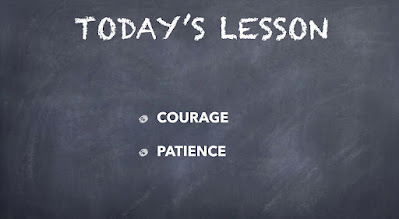
Courage and Patience - Nitin Sharma


1. A fearful student:

“Fear is a fundamental human emotion that can help us protect from danger and prepare us to take action. 

Here I would like to share the story of Sujal, who joined the school three years back. He used to sit at the last desk in the class. He was not very comfortable sharing his response with the teachers. After noticing, I met Sujal’s mother in this context a month later. After meeting them, I learned that in his previous school, in his class, 55 students were there, and no personal attention was paid. Sujal used to sit on the last seat and also had a short vision. His math teacher was very harsh and used to run the syllabus fast. Sujal had never matched his speed, so he kept lagging behind. His work remained incomplete, and he even got corporal punishment from the teacher. He kept telling his parents that he would no longer go to school. So, his parents decided to change his school. His mother burst into tears after narrating this incident, and also, the whole scene of corporal punishment was running before my eyes. I promised to help this child the best I could and requested my colleagues support him in overcoming his fear. 


2. An impatient student: 

Patience is not the ability to wait but to keep the right attitude while waiting. In today’s scenario, students quickly lose their patience in the classroom. Here I would like to share the story of one such student Manya of class VII, a very restless and outspoken girl. Her response in the class was good. Manya was in the habit of passing the comments on to others whenever reading was done in the classroom. She used to intervene by saying that she would do the reading alone and not give a chance to other students. Even though she was in the habit of disturbing the teacher in the class by passing small comments like this boy is saying this and that to me. Thus, the whole teaching environment in the class was disturbed by her. Many students in the class had written a letter regarding her behaviour and requested to take action against her. One day I called Manya and gave chances to others. She was responsible for class monitoring and helping the weak students to come ahead. 


How did/will you deal with the student? If it was a real-life situation, were they successfully helping him/her overcome their problem?

Yes, it was a real-life situation in both cases. To help the fearful children, the following steps were taken:

  1. All subject teachers were requested to hand holding, that is, to give sufficient time to complete their work. 

  2. Buddy was assigned 

  3. More exposure was given (involvement in the activities) 

  4. Good appreciation was given even for small response 

To help the impatient child:

  1. More responsibilities were assigned, such as helping other students. 

  2. Some actions of teamwork were assigned. 

Advice:

Courage and patience are very essential values not only in teachers but in our life also. These two values will help us to attain our teaching goals. As we know, patience usually wins in the end. A student needs to be courageous enough, and a teacher must be patient for effective teaching. 


Ms Nitin Sharma 

Kamla Nehru Public School, 

Phagwara 

JOL Cohort 2022

Thursday, June 18, 2020

Responsibility and Cooperation - Sharmila Vijayvargi

Responsibility means having a duty to deal with something or exercise power, control over something or even being accountable for something. Cooperation, on the other hand, means working together towards achieving the same result or end. In life, one in order to fulfil its responsibility needs to have cooperation from everyone. To this, one of the simplest examples is of junior kids. 


They are always motivated to take up responsible positions such as being a class monitor, blackboard in-charge etc., and in order to get themselves selected for the posts, they seek cooperation from their peers in the classroom when the teacher asks the class in general, as to who the class wants to be the monitor etc. This example shows the interest of students to take up a post of responsibility with the help of cooperation. 

Once they are being made the monitor, the opportunity of being rewarded makes them perform their duty in a better, responsible manner. Likewise, in various sports, the captain, being the responsible person for the entire team's performance and win, can do so by seeking cooperation from teammates. Sour relations between teammates affects their performance. 

Similarly, as teachers, we owe a great responsibility towards our students, school and environment and in order to fulfil the same, we need to work in coordination and with the cooperation of all the stakeholders to achieve the larger objective of holistic growth and development. This will not only benefit the students but the optimum fulfilment of our duties with collaborative team efforts will also boost our self-confidence and motivate us to work to achieve our goals. 

Sharmila Vijayvargi
The Fabindia School
svi4fab@gmail.com

Saturday, February 18, 2017

Policy and Governance Update - CSF EdMonitor via

Policy and Governance
Educators
Edtech
DISCLAIMER: This document is being furnished to you for your information. You may choose to reproduce or redistribute this report for non-commercial purposes in part or in full to any other person with due acknowledgement of Central Square Foundation (CSF). The opinions expressed in articles contained in the CSF EdMonitor are solely those of their respective authors and, as such, are not necessarily endorsed by CSF.  CSF makes every effort to use reliable and comprehensive information, but does not represent that the contents of the report are accurate or complete. CSF is an independent, not-for-profit organization. This document has been prepared without regard to the objectives or opinions of those who may receive it.
Copyright © 2017 Central Square Foundation, All rights reserved.

Blog Archive